Showing posts with label Word of Mouth Advertising. Show all posts

Wednesday, June 29, 2011

“I Have Seen the Future and It’s Square.” Also Comes with Its Own Missionaries.

Square is the simplest way to accept credit cards. It’s easy to use and comes with a free credit card reader for your phone or iPad. Sign up is quick. When you swipe cards with Square there is just one fee: 2.75%. No complicated contracts, monthly fees, or merchant account.

Fifty words – and a straight-to-the-point picture – make the USP behind Square brand mobile payments as clear as day. Yet because I don’t work with credit card payments I wasn’t immediately aware of the power of this idea that comes from the company headed by Jack Dorsey, who was also the founder of Twitter.

It sure has power, along with key appeal points that have created a dedicated band of missionaries for the new system: convenience and cost containment.

I looked Square in the face at a lavender festival in Blanco, TX. I wanted to purchase some panoramic photography greeting cards from Revealing Light Photography’s Bill Brockmeier, working from one of the many small artists’ booths there. Nice cards. I asked if he took the American Express card; that’s when Brockmeier pulled the Square card reader out of its pouch and attached it to his iPhone.

Transacting – my AMEX, his reader and iPhone, photographing me holding the cards for the receipt, my signing the iPhone screen – took about four minutes. Another 25 minutes passed in the presentation of the whole micro-retailer concept between Brockmeier and me.

Brockmeier is a convert to Square benefits – one of its righteous missionaries for maximum convenience and lower transaction processing fees; much lower than could be obtained with any merchant bank-card program. There’s complete transparency, too: the cost-per-transaction rate is a major selling point featured on the Square website: 2.75% per swipe. You better believe that the app itself is free.

Square has been featured in so many “Best of” lists and write-ups that the only excuse I can make for not having been aware of it sooner is that I’m not a retailer.

It is precisely this small-retail enabling power that is such a game-changer, in my opinion. Its concise, benefit-driven narrative makes it easy for people like Brockmeier to proselytize for new believers. Founder Dorsey has already been credited for fine-shaping Square’s go-to-market story: “Everything we do here is design,” he’s noted as saying in a TechCrunch piece. “It is about the importance of telling good stories through your products and editing them down to their core narrative.”

A good story makes for a good brand; plus makes for easier fund-raising: Square has just finished raising $100 million in new financing. VCs believe in it, too.

PS: The difference between WOM and mission work is probably passion. Thanks and a tip of the marketing mob-cap to Bill Brockmeier for the passionate marketing missionary experience.

Thursday, June 04, 2009

Dumpling Dynasty

Welcome glorious, beautiful and esteemed web visitor, may your stay at the home of Wu and Wu be full of double happiness and splendid astonishment.

This is the greeting you see first on the Dumpling Dynasty website – a remarkable voyage into one woman's self-proclaimed dream to be the Queen of Asian Kitsch. And boy, does she succeed!

I have to mention that (once again) Rachel Elizabeth Baron and Alison Bond brought this line of products to my attention, having purchased the astounding travel bag you see above. Made of cheesy but durable industrial plastic, the New Jersey roadtrippers purchased this marvel at Pearl River in NYC's Chinatown.

Note the darling, wide-eyed Asian sailor girl on the bag. The equally wide-eyed fawn. The mysterious lantern with its smiling face (which appears as a striding radish on the reverse side of the tote). These are continuing characters in the stock company created by “super-talented Brit illustrator Fiona Hewitt” and her husband, Andy Tainton. Certainly, the products are made in China but created, illustrated and joyously promoted from East Sussex, UK.

Dumpling Dynasty's “petite delights” are a world all their own – a retro range that's as quirky and charming (and oddly functional) as anything I've seen in a year. It's very sophisticated, possibly the kind of visual humor that takes a sense of humor born and bred in the land of the Monty Pythons.


The illustrations are flawless, one of those excellent adventures in cultural referencing that can be so wryly evocative...like the Chairman Meow work of Kevin McCormick.

Go the the Dumpling Dynasty product page, check out the Bunny Kit as a worthy example: This is a brilliant, brilliant kit with everything you need in it (including the stuffing) to make your own bunny. Plus, to prove we are totally in tune with the needs of the world's greatest creative minds, we have included a beautiful 'the adventures of my bunny' notepad and pencil set.

I suppose marketing a product line like this is classic word-of-mouth, a leading-edge-cool thing that attentive kitsch shoppers like Baron and Bond pick up on without conscious thought. Review the products and purchase them for yourself. Become the first one on your block to visit the “Wu and Wu Wonderland!”

Tuesday, March 03, 2009

Bacon Chockies!

We’ve been talking about healthcare and – possibly – living a long time. Let’s kick that idea in the head and move on, thanks to Susan Kirkland, Master Designer. She called my attention to a chocolate-covered bacon confection created by Roni-Sue Chocolates in that pleasure dome of culinary creation: New York City. Called Pig Candy, it’s crispy fried bacon strips, dipped in either milk or dark chocolate. (There is also a devilish item yclept Bacon Buttercrunch.)

This is in addition to the collections of truffles and other goodies which you can browse right on Roni-Sue’s website. ‘Course, this being NYC, there’s already an argument in print about just who makes the city’s “best” chockies. Along with the seven highlighted by the New York magazine article, a dozen or more people have pitched in with their choices…all scrumptious.

You can do this kind of word-of-mouth stuff in the City where there are ever so many glitterati and literati and cuisineers and just-plain opinionaters.

Kirkland points specifically to meat candy, though – and in this particular category, Roni-Sue doesn’t have an exclusive. For example, let’s look to the forums on Egullet.org and discover that Snowangel “Recently made Bacon Candy with bacon from Lenny’s meat market in New Ulm, MN. Also made some with ‘thin’ bacon ends from Hackenmueller's meat market in Robbinsdale.” Goodness, that’s tasty!

And then, from Vosges Haut Chocolat, there’s Mo’s Bacon Bar: “Applewood smoked bacon + Alderwood-smoked salt + deep milk chocolate, 41% cacao.”

Enough. Enough. My cardiologist(s) will see far more of me if I keep this up. I can’t read Kirkland’s mind; maybe she’s reminding me that all work (healthcare, e.g.) and no play (say, chocolate bacon bark – what a lark!) makes Ree-shard a dull boy. Thanks, Susan! The next box of bacon chockies is on me.

Photo: Hannah Whitaker, New York, with appreciation. It appears in the copyrighted article, “Cocoa Locals,” February 8, 2009.

Wednesday, February 18, 2009

Montgomery Brewpub

On the trip back from Atlanta, it was simple enough to program an address into the Tom-Tom: 12 West Jefferson Street, Montgomery, AL. That GPS thingy took us directly to the door of the Montgomery Brewpub just in time for lunch – with beer.

I don’t want you to think that every time Barbara and I go on the road, we navigate by microbreweries and pubs. Nothing could be further from the truth*. (We actually load the Tom-Tom with the addresses of Starbucks stores – Atlanta and Newnan, GA; Montgomery and Mobile; Slidell, Covington and Baton Rouge, LA…and so on. It’s easy: There’s a mapping function on the Starbucks site.)

Actually, we end up depending on AAA TourBooks more often than not. How come? Well, most microbreweries and brewpubs would rather leverage their “fan base” to build repeat business, rather than use relatively expensive classic advertising. True, this’s a generalization. But word-of-mouth can pay off big over time. Outlasting passing fads is a huge deal; being in the AAA TourBook for Alabama for years does pay off.

The Montgomery Brewing Company opened in October, 1995, in a building right in the heart of the city’s old Central Business District. The structure itself was built in 1913 by the Gulf, Mobile & Ohio Railroad to store heavy equipment. We’re coming up on this pub’s 14th birthday…and it’s hung in there.

We’re glad we showed up because we got to try a rarity: “Velvet Elvis” is a dark lager created by brewer Jamie Ray to bridge the gap ‘til it’s time to produce the next batch of stout. Classically, schwarzbier is a medium-bodied, malt-accented dark brew, colored a deep brown, with a chewy texture and a firm, creamy, long-lasting head. That’s what the German Beer Institute says and I’m sticking with it. The Montgomery Brewpub version was real good and so was the food. The staff seemed a bit distracted but served us well.


Sometimes you’ve got to search out the product – it won’t come searching for you. I know, that’s not supposed to be advertising’s role. But so many marcom roles have already shifted over the past decade. With WOM, you can put your advertisements where your (fans’) mouths are. Earlier this week, ours were in central Alabama. Filled with “Velvet Elvis.”


*Why yes, we did stop in Abita Springs for dinner. Why do you ask? Thanks to AAA (again) for roadtripping aids.

Wednesday, December 24, 2008

Street Marketing

Cruising the blogs, I found this superbly telling photo posted on the Shiela Edelman blog, without comment. It’s enjoyable in so many ways, I’ll do the commenting while saying “thank you” to Edelman in Pittsburgh.

The grate adaptation goes beyond an imaginative sales message or creative medium (though the street ad for Vijay Sales encompasses both of these). To me, it drives home an understanding that Indian consumer marketing is moving up…it’s already come a long way but its roots are in the street – with the people.

There’s some portion of Indian society that will recognize and appreciate the wry humor behind “Need a New Barbecue?” Thanks to Google, though, we can find out even more. Vijay Sales is (apparently) a very large chain in India, principally known for electronics and appliance sales. It has a large-scale presence on the Internet in terms of mobile phones and other CE goodies.

The telephone number shown in the photo is for Vijay Sales #384, in Prabhadevi, Mumbai; “near Citibank,” says the Yellow Pages. And one additional virtue of the Worldwide Web is the customer reviews: This particular Vijay store gets hammered on customer service. For example:

Cash counter guy not able to give me a receipt, saying that the computers are down, they can’t generate bill. Further, he tells me that credit card slip is sufficient. I DEMAND some valid proof of my payment and purchase. 30K is not chana-singdana. I am given a paltry receipt without any order number to keep.

This shopper advised that buying something off-the-shelf from Vijay (like a barbecue grill) was alright but don’t count on any kind of after-sales installation.

Fortunately, we can just look at the “street art” idea behind this particular sales promotion and be amused – probably the way most non-Vijay customers were. I’ll also drop a line to Sunil Shibad in Mumbai – maybe he knows this campaign or the retailer. Meantime, Merry Christmas Eve!

Friday, November 14, 2008

Idaho Spud®

Older, “classic” brands don’t always represent great products.

That seems to be true of the Idaho Spud, from the Idaho Candy Company in Boise: “Delivering the Finest Candy and Service Since 1901.” Laura Kamrath delivered these treats to Houston; she picked up several at a trade show in Louisiana. Patrick Fisher, writing on FinkBuilt.com, calls it an “old-skool candy bar.”

The Idaho Candy Company started in 1901, built a new factory in ’09 and produced more than 50 different candy bars and many boxed chocolates (including Owyhee Butter Toffee) over the years. The website boasts a fan club with Idaho Spud recipes and not much else.

Like other older candy brands, its fame these days spreads more by word of mouth than formal advertising…enthusiasts who spot it lurking on the lower shelves of smaller grocery stores – or run across it a an oil industry trade show, for God’s sake. We (Kamrath and I) suspect that someone connected the brand name to the oilfield term “spud in” – to begin drilling, to start an oil well – and decided to use the bars as memorable handouts.

Sad to relate, the Idaho Spud is an unusual confection, an acquired taste like a number of regional candy bars. Its flavors…a wonderful combination of a light cocoa flavored marshmallow center drenched with a dark chocolate coating and then sprinkled with coconut (Sorry, no potato!)…are muddled and a bit stale.

There must be some nostalgia, and quite a lot of private-label manufacturing, to enable the Idaho Candy Company to remain in business. I wish ‘em success…but no one’s going to waste a formal marketing campaign on the Idaho Spud.

On the other side of the Spud is the almost equally classic Zero candy bar, created in 1931 by the Hollywood Candy Company in Minnesota and made ever since of “Caramel, Peanut, and Almond nougat covered with white fudge.”

Zero has a loyal consumer base (including me) and I ran across a fresh box as recently as this afternoon in a Huntsville, TX, Valero C-store. To repeat one candy retailer, I’m comforted that candy bars like the Zero, and yes, even the Idaho Spud, are merely “hard to find,” not “no longer in production.” Since the Zero is produced today by Hershey, I’m pretty certain it gets more channel attention that the stolid Spud.

But hey, you’ll want to taste-test these two traditional confections. Let me know how that turns out. Ta for the weekend.


Photo: Richard Derk/Los Angeles Times

Thursday, May 29, 2008

Dalhart Superstar

I arrived in Dalhart, TX, one day last week to find most of it blowing east toward Oklahoma. Not perhaps the most brilliant introduction to a Northwest Texas town best known as the center of the 1930s’ Dust Bowl. That’s sure easy to understand, though; the west wind is driving the topsoil across the road as far as the eye could see.

Since I was driving north of US 87 from Amarillo, there wasn’t much choice about where Barbara and I were headed and there wasn’t any mistake when we arrived: Another middle-of-the-hinterlands town that was not looking like a jewel this past week.

(You may recall news of a wide band of “killer” tornadoes stretching from that part of Texas all the way up to Minnesota.)

It’s something of a boom town again, with the price of oil so high and plenty of activity in the ‘patch. You can poke around here to find out more about the various area attractions, such as the XIT Ranch Museum, Palo Duro Canyon or the Veterans Park on 7th Street – not as pretty last week as this post’s photo.

Really, I did not see Dalhart at its best.

What I did see, as I guided the Prius north along the windy street, was a tiny little building on the corner of the highway and Peach Avenue called Superstar Coffee Company: As far as I could tell, the only place between Amarillo and maybe Trinidad, CO, where I could get a decent cup of fresh coffee.

No Starbucks but a good attempt in the back of beyond, Lisa Silacci and her family moved to the Dalhart area last year on other business and she decided to open this coffee shop to catch the traffic passing up and down US 87 (called “Railroad Street”) in front of the grain elevators.

She and her family are from the great Northwest where there’s a coffee shop on every corner and she says Dalhart needed one of these – it looks like she’s going to educate every rancher and oilfield hand on decent coffee one cup at a time.

I don’t know the whole story (and I didn’t have the camera as usual so there’s no photograph of the tiny drive-through outbuilding that Lisa and her husband Gary are using for Superstar). So I’m going to ask Lisa to send me a photo for another blog post a bit later on. I’m here to tell you, though, that the entrepreneurial spirit is alive and well in that corner of US 87 and Peach – and by golly, she’s a member of the Dalhart Chamber of Commerce to prove it.

WOM: Next time you’re passing through Dalhart, “The XIT City,” stop off at the Superstar Coffee Company for a fresh cup of joe. Lisa’s got all the modern conveniences, flavors, even a buy-10-get-1-free card which she will initial for you instead of stamping or punching (Superstar isn’t that advanced yet).

There’ll be no inside seating for a while but you can drive yourself right up to the window and talk with Lisa her own self. And say hello for me. Just tell her I’m the guy passing through in the Prius. Okay?

Sunday, May 18, 2008

Barbara’s Orbi

“Orbi combines the benefits of SafeCut technology with a unique, ergonomic design that makes it the most comfortable and easy-to-use can opener ever created.” This note is from LaPrima Shops, describing the GC11836 Can Opener created by Jump Design Inc. for Good Cook®.

“No more dangerous edges. This revolutionary opener cuts into the side of a can, leaving a smooth ridge and a top you can lift straight off with bare hands. The ergonomic handle is easy to turn.” So sayeth theKitchenStore.com under the can, jar and bottle opener category.

Bed, Bath & Beyond: “If you are tired of the awkwardness and strain of twisting and turning traditional can openers, try the Orbi Safe Cut Can Opener, the easiest, safest and most comfortable opener around. Not only does it leave lid and can edges completely smooth, but it prevents cross-contamination by never letting the blade or lid come in contact with food or fall inside the can. Plus, the Soft Touch comfort grip and user-friendly design make it great for those with arthritis, reduced grip strength, limited dexterity, carpal tunnel syndrome and tendonitis.”

And our simple favorite from Amazon.com: “Open a can without bleeding.”

There’s no advertising that I’m aware of. Jump Design, in Loft 10b on Van Brunt Street in Brooklyn, is self-described as a small industrial design firm that specializes in designing innovative consumer products: In our spectacular office location we design inspired products which are sold at Target and other major stores.

The only contact name I’ve found is Jürgen M Parlowski. If what I suspect is true, he and his team have found a terrific model: Create “needful things,” match them up to marketing organizations, and let those companies do the selling. Jump Design (I’m seeing parts of Parlowski’s name here) just keeps on doing neat work.

Good Cook promises “a metamorphosis in kitchenware” and it does advertise. (The name is a registered trademark of Bradshaw International, Inc., and not to be confused with The Good Cook, from The Book of the Month Club.) Good Cook was launched in ’87 – good job there – and, according to its website, has now captured 43% of the market in drug and grocery stores. That’s superb testimony to the company’s products as well as its distribution methods.

But Barbara discovered the Orbi in a mail-order catalog, purchased it immediately and now swears that it is the best can opener she’s ever used. Since Barbara has arthritis and has had difficulty with can openers for years, this is more than a gadget – it’s a blessing.

There’s a WOM component to this story, too. Shortly after Barbara started using it, Philippe Holtzweiler came over from the UK for the Offshore Technology Conference (see here). In addition to being a combat shopper, he’s a gadgeteer of the first magnitude. Barbara showed him the Orbi and opened a couple of cans with it. Holtzweiler jumped on the Internet, ordered it up and had it delivered overnight. He took his Orbi back to Bishop Stortford with him after OTC was over.

I’m not so much of a gadget fan myself…but Barbara’s the perfectly suited consumer for this perfectly designed utensil: A match made, originally, in Brooklyn.

Thursday, December 06, 2007

Wobble Tales

After blogging about Wobble Wedges®, I had the chance to talk with their creator, Robert Bellows. Here’s such a marvelous story about small-business triumph, I asked him if he’d write about it. He agreed to do it in the form of lengthy answers to six questions.

It’s a long read; I haven’t edited it much. Bellows said, “I had a great time looking back at the magical evolution of the Wobble Wedge.” See if you agree.


1. What made you decide that you wanted to become an entrepreneur?

I never decided to become an entrepreneur in the start-a-business-and-sell-it-for-millions mold. Perhaps I’m an entrepreneur in the sense that my work choices have been consistently driven by a deep desire to explore the realms of my own creativity while maintaining independence, the most precious resource of all.

The trick, of course, was getting paid in the process. If the business earned millions or if it earned just enough cash or somewhere in between that would be fine. Following that path by both intent and accident I have been a school teacher, carpenter, ranch hand, welder, tutor, artist, copywriter, publicist and a marketing/sales director in several businesses.

So how did Wobble Wedge come about? In my early 40s, I lost a business that I had expected to pursue for many more years. The demise of the business came from multiple forces much larger than our small company could counteract. To be frank, I was disillusioned by what came down. Taking a total break from business was the perfect solution. In the following months I began introducing myself to the world as an artist.

Over the next few years I made well over 100 sculptures and sold them through galleries and shows – a good living and a total blast. But the cash flow came in an uncomfortable boom and bust cycle. My business head popped and said, “Hey, why not start a really small business that will provide a steady cash flow but won’t require much daily office work?” That was the seed that sprouted into the Wobble Wedge.

2. How did you decide on the wedge? And what steps led to its engineered qualities?

For as long as I can remember I have always had a scrappy-looking 3-ring binder titled “Ideas.” Every time I had a business or product idea I had a habit of writing it down in the notebook: ideas of who needed the thing, who might buy it, and what it might take to make it and what it would take to distribute it.

Then reality would set in. Do I want to sit at a desk, manage a pile of employees, raise money, be responsible to bankers or shareholders, manage field reps and on and on? The answer was no….already done that. The ideas that required complex marketing and production were fun to dream about. The mere act of writing it down allowed to me let go of the idea so a new one could come in.

The question gradually changed from, “What business could I create that would be successful?” to something more like, “What business will support what I want to do with my time?”

What did I want? Simplicity. The product had to be simple. It had to be easy to understand. It had to be universally needed. It had to be cheap to make and cheap to buy. It had to be well made and very cool. It had to be fun to sell. And most of all, it had to have a “Wow, I wish I had thought of that!” factor.

How could I find that? Simple again. State the question as clearly as possible then forget about it.

One day, sitting at an annoying wobbly restaurant table, my wife (Terry Cohen) asked the magical question: “Think you could figure out how to fix this?” Whoa, that ain’t rocket science, it’s not even high school algebra.

All it takes is a small wedge. It could be used for all sorts of things...wait, that’s it: this is what we need to invent.

The first wedges were hand carved from a plastic block and from scraps of wood. I used my funky models for everything I could think of from stabilizing wobbly tables to leveling fountain sculptures.

Experimenting with them made it obvious that each wedge had to relate to the other...they had to nest to prevent slippage. They had to be stackable to fill large gaps. They had to be easy to trim. They had to be easy to retrieve even if they were inserted too far.

I showed my hand-carved wedges to an 80-year-old tool maker that had been making injection molds for years. With my samples in hand and a few pencil sketches he began machining some very precise samples. A few models later we had a perfectly simple but very functional design.

3. Would you expand on the (years’ long) marketing efforts you put into the product?

In the original vision, the product had to be “universally understood.” To be honest I didn’t know the full meaning of those words at the time. But their meaning is clear now. If anyone sees a Wobble Wedge, it takes only a fraction of a second for them to say, “I know where I could use one of these.”

We create literature, but really Wobble Wedges don’t need explanation. As such we didn’t have to go to the hefty expense of trying to educate or convince people to buy these.

Instead, we had the less expensive task of just letting them know that at long last here was a solution that they had been looking for all their life: handing a consumer, a contractor or a restaurant owner a couple of Wobble Wedges is in itself a complete marketing message.

Our primary marketing message is that Wobble Wedges are universally needed. That statement generated this line: Everyone needs Wobble Wedges. Now we needed to simply remind consumers of why they need Wobble Wedges. Everyone knows that most things are far from plumb, smooth or level. Everyone knows that almost nothing in the world is truly flat. So, why not just say what they already know. Hence the line: Because the World Still Isn’t Flat.

4. How critical is the “Wobble Wedge” brand name to your marketing efforts?

Wobble Wedge is a fantastic named coined by my brother Warren. The beauty of the name is again its simplicity. It describes the problem and the solution in one very memorable name. But even more than that, the name allows for universal application. It is not limiting in any way.

A contractor can relate to a Wobble Wedge as quickly as a waiter can. If we had called the product a Stable Table, for example, we would only appeal to restaurants. Contractors would have nothing to do with it.

So yes, Wobble Wedge is and excellent name, but not absolutely critical to the success of the product. We sell Wobble Wedges under many names targeted to many very specific markets. Our brand name is well known, but the quality, superior functionality, and readily available inventory of our Wobble Wedges is what keeps us in the game.

While we stimulated many PR stories for Wobble Wedges in the early years, the product itself stimulates its own story now. You see one, hit yourself on the forehead and say, “Why didn’t I think of that?” Then someone like you writes a blog about it. That is the magic of Wobble Wedge.

5. The Wobble Wedge solves for a specific kind of problem. But Focus 12 itself doesn’t seem to have a problem now. If, after 20 years, you were asked what problem the company itself faces, what would that problem be?

Our Mom & Pop business is doing great. It is small and simple as we created it to be. It has provided very well for us. At this moment, we it looks like we’re going into a very exciting period of growth. That growth is already bringing in a level of complexity in our business that is taxing our small staff….that’s just Terry and I.

We have new products and new molds and new customers that will drive a whole new part of our business. But the coming complexity challenges our core mandate of simplicity. Both of us are getting older. As much as we love our business, we’re beginning to think of other things we’d like to do. Maybe a bigger business isn’t what we want. Maybe it is.

We’re still working on that question. Perhaps writing this response to your questions will stimulate that process. It is always amazing to me how we touch each other’s lives.

6. Last question: do you read Mother Earth News?

Yes, I was sort of an idealist. Perhaps that has eroded with time. It’s funny that you mention it. I haven’t seen that mag in years. Last month my wife brought one home to show me an article on gardening. Gardening sounds good to me these days. There is nothing like dirt under your fingernails and a freshly picked tomato to remind you of what is real.


Good storytellers are few and far between. Thanks to Robert Bellows for sharing this one. And for the fun of it, get your hands on a Wobble Wedge.

Friday, November 30, 2007

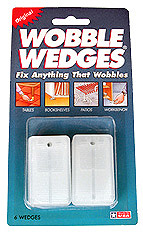
Wobble Wedges®

If one of us in the “Thursday Night Martini Gang” has jammed a book of matches or a wad of napkins under our cast-iron table at Mo Mong once these past 10 years, we’ve done it a hundred times. With the passing of matchbooks, leveling an awkward table became more of an annoyance.

Shift scene: a pub in the Brookhaven section of Atlanta, where four of us had just sat down for a couple of pints and burgers…a pleasant patio lunch on a beautiful day. And the table wobbled. Teeter. Totter. Teeter. Totter. While I was looking around for a napkin to wad up, the ever-resourceful Edith Fusillo reached into her purse and pulled out a small white plastic shim. She lifted the table slightly and shoved this thing under the leg. No more teeter-totter.

“It’s a Wobble Wedge,” she proclaimed and she and Bob beamed at us. “Every table in Venice wobbles. I found these at The Container Store and we always carry them with us.”

Sheesh! Of the hundred or thousands of useless knickknacks and gadgets in the various catalogs of the world, here are these Wobble Wedges – complete with registered trademark. So the first thing we do is go off to the nearby Container Store and pick up a couple of packages. Barbara stashed hers in various compartments of her purse. I stowed mine in…well…my man-bag. Map case. Alright, dammit, my purse.

This is word-of-mouth marketing in action. Only after I got back here to the home computer have I gone to the website; you can read all about Wobble Wedges, “the tapered plastic shims that do it all.” You should look at this site: simple, homegrown, but with all the information you’d need to realize why this is one of the world’s great inventions.

And it’s only a million or so years old. Stone Age (though I’m told that the Association of Social Anthropologists is not happy with this term). After all, the reason we’ve used matchbooks to level the damn table is because they’re wedge-shaped.

Our modern, purse-carried Wobble Wedges are made of polypropylene, tapered at a 5.75° angle with some extra features like nesting ridge teeth that make it adjustable – and so awfully handy. The Wobble Wedge is patented and manufactured by Focus 12, Inc.; conveniently packaged; it even comes with a small hole so you can tie a string to it. “Everyone needs Wobble Wedges ‘cause the world isn’t flat.” Nice line.

The only problem: you tend to forget about the Wobble Wedge when you leave the restaurant. Edith says she and Bob left dozens of them in restaurants all over Venice (the paving and flooring are so out of true, you see). Still, they’re cheap enough, three bucks per six-pack. You can get ‘em in jars of 300 in case you’re truly into leveling.

So this today’s WOM contribution: Wobble Wedges. Pass it on.

Thursday, October 25, 2007

Baltika WOM

You’re gonna start thinking that Signalwriter is a beer blog – back-to-back posts about the world’s oldest beverage and all. Sue me.

This is really about word-of-mouth, WOM for the uninitiated.

I ran across and sampled Baltika (“The famous beer of Russia”) when Barbara and I had dinner at a new Houston restaurant, Bohemia. Don’t rush, despite the B4-U-EAT reviews; but it had several varieties of this Russian beer. I had the Baltika No. 9. It turns out that [a] the number on the label indicates the alcoholic strength of the beer and [b] the Baltika line includes 2-9. No. 9 was a fine pale beer…and strong like bull. Reminded me of a Bulgarian beer I had in Athens last year, but crisper.

Last week, we attended the birthday party of artist Howard Sherman, at his Commerce Street Art Warehouse studio. We brought some beer along for the party and gifted him with a smuggled-in bottle of He’Brew Monumental Jewbilation beer.

He pulled out a couple of bottles of Baltika No. 4 which is a dark beer with 5.6% alcohol: very tasty. I like a dark beer. He said a friend of his turned him on to it and he’s been drinking it for the past few weeks. There’s a No. 6, a porter that I’d like to try, and No. 8 is Baltika’s wheat beer. (Jewish beer, Russian beer...maybe we can have a progrom.)

Off I went to the website (by Web Design New York), which has a pleasant Flash opening with balalaika music. Along with Baltika Beer history and descriptions, there’s a long segment from CNBC’s “Lunch Break.” Somebody really did a great PR job on this: the talking heads taste-tested Baltika against Heineken and Beck’s on camera and had some fun doing it.

So here’s this broad line of beers from Russia. I get the impression that its US marketing is mostly WOM, backed up with a good website and some decent public relations activity. There’s an opportunity for premium imports here in America, though beer sales are “sluggish” domestically, according last week’s Wall Street Journal. The same article (October 18, 2007) notes that Baltika could end up being owned by the giant Danish brewer Carlsburg, because of consolidation efforts.

How come? Economics. Jean-Francois van Boxmeer, Heineken’s chief executive, said in an interview last month that the beer industry today takes so much capital, it isn’t worth the expense being in many of the world’s markets unless your company is either the No. 1 or No. 2 player.

Baltika is the No. 1 selling beer in Russia. Its website proclaims, “…the OAO Baltika Brewery is in no way inferior to the world’s leaders in beer production.” I suppose the question is, will WOM be enough to make Baltika Nos. 2-9 a bigger player in our market? Likely not. But if the brand gets big-brewer horsepower (and advertising) behind it, there’s no reason why it can’t be right up there with the other premium Euro-imports. Besides, it’s good beer.

Saturday, September 29, 2007

Purina® Diet*

I have two dogs and I was buying a large bag of Purina at Wal-Mart and was in line to check out.

A woman behind me asked if I had a dog.

On impulse, I told her no: I was starting The Purina Diet again, though I probably shouldn’t because I’d ended up in the hospital last time, but that I’d lost 50 pounds before I awakened in an intensive care ward with tubes coming out of most of my orifices and IVs in both arms.

I told her that it was essentially a perfect diet. The way that it works is to load your pants pockets with Purina nuggets and simply eat one or two every time you feel hungry. The food is nutritionally complete so I was going to try it again. (I have to mention here that practically everyone in the line was by now enthralled with my story, particularly a guy who was behind her.)

Horrified, she asked if I’d ended up in the hospital in that condition because I had been poisoned.

I said, “No. I was sitting in the street licking my balls and a car hit me.”

I thought one guy was going to have a heart attack – he was laughing so hard as he staggered out the door.

Stupid lady...why else would I buy dog food?!?


*This is a true story, according to its contributor. He has asked to remain anonymous. See how urban legends get started?

Sunday, August 26, 2007

Mambo Floridiana


Chip Weber of Rubber Chicken for the Soul commented on my blog post about my new Moon Dog shirt. He loaded up on classic Mambo Loud Shirts from Australia and sells the remainder of the stock on eBay as well as on his own site. Now he cruises the Web for people who write about wild and crazy tropicals and offers them even better deals on these out-of-production spectaculars: a form of word-of-mouth advertising that’s perhaps a little slow, but he sure does hit his targets: the best kind of shout-out there is.

He’s 52 and 6”5” tall – he thinks that size has a lot to do with Mambo. He met some Aussies in Hong Kong in the mid-90s who were wearing Mambo shirts and fell in love with ‘em. (These days, Chip and his wife Jenny hang out down on Merritt Island in Florida.) He picked up a few shirts a decade ago.

When Mambo sold out, Weber found a “secret” source for these shirts and bought them all – the whole story will come out when he’s sold them. Instead of having a couple in his collection, he’s got, like, 85.

Dare Jennings, who started Mambo Graphics in Oz, originally asked Reg Mombassa to design t-shirts and Loud Shirts for him. Mombassa has said, “A pair of oscillating buttocks or a heaving chest provide an excellent perpetual motion armature over which to stretch the illustrated fabric, giving the images on the cloth the illusion of life and self-motivation.”

I’m glad to think of these loud shirts as having a life of their own – even if the buttocks and chests Mombassa was thinking about little resemble my own. Hey, I’m just a collector here.

So I did ask Weber to send along “Day of the Dead” (pictures above) as well as “Mambo Tropicana Lounge,” which will shock those who know me: this one’s a little quieter than usual. Still, it’s got a great chest on it. Thanks to the big guy from Florida.

PS: What I heard from Weber is that Mambo is actually Jennings’ acronym for Means for Acquiring Models, Bucks and Opiates.

Saturday, July 14, 2007

Screwing Stakeholders

When it comes to stakeholders, a company’s relationships can be either overt or covert. The Associated Press, for example, reported this on 20 June:

Tidewater Inc., the world's largest operator of vessels serving the offshore oil and gas industry, may move its corporate headquarters to Houston, company president Dean Taylor said Wednesday.

“We have a lot of sympathy for the city, but our shareholders don't pay us to have sympathy,” he said. “They pay us to have results for them. We ultimately need to do what's for them.”

This sterling example made the Houston Chronicle the following day via its “Around the Region” section…just a three-‘graph article that caught my attention because Taylor, who’s not only CEO but Chairman of the Board, seemed to go out of his way to tell the members of its long-time New Orleans home to drop dead. The Times-Picayune has been all over this story; Tidewater has been mending its Louisiana fences ever since.

On the covert side, Chronicle columnist Loren Steffy reported yesterday that Sprint Nextel is cutting off customers – canceling their service – if they use the company’s customer service help line too frequently. You ought to read Steffy’s column because he’s a far better journalist than I am and reports the story better. But one telling point is worth repeating here:

…The bigger problem is the message Sprint is sending to all customers — and to all customer service employees. As it moves down this slippery slope, Sprint could, for example, decide to drop customers who spend too many minutes roaming on plans where roaming charges are included in the price.

Tidewater’s done it publicly; Sprint Nextel hasn’t really spread the word about its peculiar anti-customer policy around – unless you’re one of the “riffraff” who got a service termination letter.

These love-me-or-leave-me approaches keep pointing out that we’ve got a lot of work ahead of us if we want to turn corporations into models of positive stakeholder interaction. The Stakeholder Rule© is still at the whim of CEOs and Chairmen of the Board everywhere.

The President of the New York Central Railroad, William H. Vanderbilt, was perfectly happy to say, “The public be damned.” That was 1888. He got away with it. Today, we don’t have to be so acquiescent...let’s fight back for our relationships.

“Stakeholder Rule” © Richard Laurence Baron. All rights reserved.

Friday, July 06, 2007

He’brew Beer

There’s nothing remarkable in the hot, surly morning sunlight. A beautiful middle-aged woman climbs down from a dusty family van, slides open the cargo door, reaches in and lifts out an ordinary cardboard box. About yay wide. About yay high. Heavy.

A tall older man rises out of a late-model taupe Deville, scrapes across the unpaved restaurant parking lot and takes the box from her, leaning over awkwardly to give her a kiss on the cheek. He returns to his car and presses the key fob – the trunk lid pops open. He places the box carefully in the Caddy’s trunk, just as a Suburban with a pair of Texas Highway Patrolmen and a couple of guards from the Huntsville prison unit pull up beside the car.

Puffs of dust rise from the Suburban’s tires as the driver brakes and the cops climb out – four heavy men who cross the lot, headed for an early lunch at The Junction restaurant. They don’t look at the Deville or its owner. “Mature” white guys in Cadillacs never raise a lawman’s eyebrows. The Caddy has Texas plates. The woman’s van comes from Georgia – you can see the peach on the license plate across the lot.

The troopers missed the perfect daytime switcheroo, the smuggler’s art performed without a net outside that Huntsville restaurant. Edith Fusillo had just passed me more than a dozen bowling-pin-sized bottles of He’Brew Beer. Yeah, that’s right, the real stuff, “Brewed by Jews” at the Schmaltz Brewing Company. Legal in Georgia. Not available in the sovereign state of Texas.

Even how I came to discover this great brand is like something out of Exodus (the Leon Uris novel, not the Old Testament chapter). I heard about it first from Adam Halpern at SoftSell Training; went immediately to the website which is a hoot.

In the end, like smuggling arms into postwar Palestine to equip the Palmach, I received the beer along with a marvelous example of word-of-mouth advertising.

Founder Jeremy Cowan has done a superior job of branding “the Chosen Beer.” Unlike a lot of mass-market consumer goods, the entire mishpocha gets credit on the great website, from the brewers to the art directors to the director of a very funny TV commercial. It would be excellent to see more CPG companies share out the credit for great work.

Second, the beers are not only Kosher, they’re fine examples of craft-brewing art. Edith and Bob Fusillo brought us He’Brew’s Messiah Bold (“The Beer You’ve Been Waiting For!), Bittersweet Lenny’s RIPA (a rye-based, double India Pale Ale) and Genesis 10:10 (a superb dark ale with a touch of pomegranate juice that lends the most marvelous color to the brew).

These are strong beers – 10% alcohol – but the spirits never get in the way of three distinctively different tastes. Still, each variety is true to its type and it tastes just fine.

The company admits to all the schtick surrounding the brand…it’s built a superb back story for the whole brand as well as for each and every variety it’s brewed. If you genuinely believe that each brand should have a story to tell, Schmaltz has done its marketing job extremely well.

So think about this post as a combination taste-test and brand exploration…one that began by word-of-mouth and keeps on going through every beer we (jealously) open. Schmaltz is building stakeholder involvement one bottle at a time.

I have saved out a couple of bottles of Messiah Bold for Halpern – he tipped me off about this. But until Schmaltz finds a distributor in Texas (or better yet, in Houston), I’m going to hoard this stuff as best I can. It’s “the Chosen Beer” after all and I’m choosing to keep as much as I can for our Spring Branch household. There’s no telling when the Fusillos will be making another run to Texas.

These are the kind of ales that Cecil B DeMille would have made if he’d skipped the movie business – but it’s definitely his kind of branding. L’Chaim, y’all!

Saturday, June 16, 2007

Moon Dog

If there really is “a tide in the affairs of men,” as Shakespeare writes, “which, taken at the flood, leads on to fortune,” then it changes with maturity. For white guys of a certain age (like me), the tide seems to lead on to tropical shirts.

For cutting-edge Hawaiian shirt fashion, it’s been hard to replace Reg Mombasa and the Loud Shirt Gang who used to work under the Mambo label out of Australia. It’s been look-around, peek-into-corners action; keep searching the Worldwide Web. I’m not talking about your chain-store stuff here – that’s for the hoi polloi.

I mean your really OUTRAGEOUS aloha shirts, the kind that, when you’re 6-feet-6-inches tall and weigh 270 pounds, make a definite statement (such as “I’m color-blind and I don’t care” or “Aren’t you amazed that my wife let me out of the house wearing this!”)

Thanks to the power of word-of-mouth advertising, though, I’ve scored this super-fine “Rose Tattoo” shirt from Judy and Richard Kuenstler at Moon Dog in Austin, TX. This is a handmade cotton beauty, a spectacular piece of work that shouts, “Hey, look, I dressed myself.”

I ran into this guy at one of Roni McMurtrey’s gallery openings a couple Saturdays back; we could see each other across the room because no one (man, woman or child) had shirts that remotely mustered the sheer candlepower of the ones we were wearing. Only his was…different. It had like these Mexican Day of the Dead figures on it. Really rocking.

Naturally I complimented him on his shirt. He responded in kind. Then I asked where he had purchased it. He said, “You can buy one just like this from Moon Dog in Austin.” That was simple enough to remember. But I said right back at him, “This shirt is your statement. I’d never buy your shirt. Thank you – I’ll check out the company online and see what else it’s got.”

And I did. See above.

Sure, I could have gone stronger but I like to think I’m more subtle than that (sounds of many people in background unsuccessfully smothering their ridicule). Moon Dog has plenty of options which the Kuenstlers make to order. Excellent!

Here’s a firm that’s been around since ’84 and I’m just hearing about it. But then I purposely don’t spend time in Austin either. Fortunately, word-of-mouth works once again and I’m proud to pass on the favor: Moon Dog Shirt Company.

I don’t know the name of that guy was at the McMurtrey Gallery, but he’s got a great shirt! Happy Father’s Day.

Friday, April 20, 2007

Lead Generation

So many clients ask about lead generation – have for years. This story confirms that Word-of-Mouth can help you find qualified prospects.

“Bless me Father, for I have sinned. I have been with a loose girl.”

The priest asks, “Is that you, little Johnny Parisi?”

“Yes, Father, it is.”

“And who was the girl you were with?” Johnny says, “I can't tell you, Father, I don't want to ruin her reputation.”

“Well, Johnny, I'm sure to find out her name sooner or later, so you may as well tell me now. Was it Tina Minetti?”

“I cannot say Father,” says Johnny.

“Was it Teresa Volpe?”

“I'll never tell.”

“Was it Nina Capelli?”

“I'm sorry Father, but I cannot name her.”

“Was it Cathy Piriano?” Johnny answers firmly, “My lips are sealed.”

“Was it Rosa Di Angelo, then?”

“Please, Father, I cannot tell you.”

The priest sighs in frustration. “You're very tight lipped, Johnny Parisi, and I admire that. But you’ve sinned and have to atone. You cannot be an altar boy now for four months. Now you go and behave yourself.”

Johnny walks back to his pew and his friend Nino slides over and whispers, “What'd you get?”

“Four months vacation and five good leads.”


Thanks for this “Italian Boy’s Confession” to Leigh Lerner from Montreal. And a great weekend to you all.