Tuesday, January 22, 2008

Sheetrock® Recognition

Home ownership resonates as deeply today as it did a century ago. Even in a digital age, brick and mortar (or plywood and Sheetrock) are what stabilize us and make us feel at home.

How is it that an 80-year-old economist like Alan Greenspan consciously realizes that a word he’s using on page 230 of his new book is a trademark? And thousands of other Americans don’t have clue that he’s writing about a 96-year-old staple of the US marketing scene? With just an initial capital letter “S” the long-time Fed Chairman simply recognized the trademarked status of USG’s gypsum wallboard in the paragraph above…and passed on to other things.

Too many trademarks are lost through inattention – but USG (formerly, the United States Gypsum Company) has very carefully protected its flagship brands, like Sheetrock panels and joint compounds, for years and years of careful attention. How many years?

Blogger Greg notes here that Sheetrock was invented in 1912: At least that’s the earliest patent date I have on the sheetrock that was used in my house in the late teens or 20s. When they added the bathroom to the kitchen they used sheetrock. On the back of each piece was a sticker with instructions for storing and hanging the sheetrock. At the bottom are a series of patent dates and the earliest one is June 11, 1912. The photo on the left is from Greg’s blog. (Wikipedia says 1916 – so be careful of your sources.)

Sheetrock brand gypsum board didn’t catch on broadly until after World War II, when the demand for housing boomed and labor wasn’t available to do complex lath-and-plaster walls quickly enough. It has been almost literally a foundation product of the American housing industry for the past 50+ years.

As I said, though, my attention was caught by Greenspan’s proper use of the brand name right in the middle of his new opus, The Age of Turbulence. When you read the book, you’ll understand why. He spent his early years as an economist closely studying and reporting on a huge range of industrial statistics – as a consultant for giant US corporations. He’s not simply one of the world’s great economic experts, he’s a living compendium of American industrial history. So he knows his Sheetrock – and it ends up as a proper noun in his book. Good on you, Greenspan.

Wednesday, January 16, 2008

Noguchi Christmas

Isamu Noguchi produced this “iconic” coffee table in 1944, the year before I was born. I first saw one in 1966 or so, in the home of Bob and Edith Fusillo, in Atlanta – about the same time I was learning other really important stuff like “the Goon Show” and who Barbara Hepworth was.

This table has been written about so much (here, for example), it’s like Googling Shakespeare. It has been on my mind, in my mind, for more than 40 years.

Because the table is still being manufactured by Herman Miller, Inc., in Zeeland, MI – and because I saw one on the showroom floor at Design Within Reach here in Houston – I received it for Christmas.

Thank you, Bob and Edith, for the teaching. Thank you, Barbara, for the gifting.

Friday, January 11, 2008

“Tide” Demo

Stuck for a product demonstration? Tune into YouTube and watch the “Tide” stop-motion TV spot. Already the winner of a bronze medal at Cannes and much caressed by aficionados (here, for example) of fine advertising, it’s a wonderful concept, beautifully executed.

Here’s a spoiler on the off-chance you haven’t seen it: The spot is for a storage company: The Big Yellow Self Storage Company is a UK chain with about 50 locations so far. Being able to reserve a storage space on line is a very nice touch, because one of the firm’s shining characteristics is a strong focus on customer relationship management. (This had been a slow-growth area for far too many companies outside the US – it seems to be paying off for Big Yellow.)

“Tide” was created by London agency CHI & Partners in Rathbone Street, London; and directed by Dougal Wilson, already well recognized for his music videos. He said in an interview that he grew up as part of “a quite practical and technical family;” it shows up in this TV commercial. Drew Lightfoot was the animation director. The stop-motion videography appears so simple in concept, but it’s built up with incredible detail.

Best of all, you can see a three-and-a-half-minute “making of” video here. It shows the waves of dinner services; household appliances and tools; and – eventually – large-scale furniture. As one of the property masters comments, it’s the largest shopping trip he’s ever done!

The point of this post (unlike many another comment about “Tide” going around the Web) is that this commercial is a product demo, with a wise look at our culture built into it. If you’ve ever believed that the last one with all the toys when he dies, wins, then this spot will resonate: What do you do with all the toys once you’ve got ‘em?

Many companies do product demos: Cars, appliances, consumer electronics, offshore oil rigs, you name it. The trick is to create a difference in the minds of your viewers. “Tide” succeeds in this very well. I’d like the chance to make it work for business-to-business clients – especially heavy industry.

Great spot, guys!

Thursday, January 10, 2008

Watch This

Already nominated by some as the “cool compass watch,” you could have checked out the Tissot T-Touch (Reference: T33.7.8.92) in print ads featuring MotoGP World Champ Nicky Hayden.

It’s more than a titanium watch with a black carbon face, according to Tissot – not news – but it does have this analog compass feature, which Hayden points to in print and on the Tissot website, in an LED screen.

It took me back, I tell you. When I was stationed at Cecil Field Naval Air Station in Jacksonville, FL, back in the day, I used to hang with a group of guys, among whom was “Dave.”

Dave was cool when I didn’t know what cool was, or a geek of the first water prior to the arrival of “geek.” The rest of us wore wrist watches but Dave wore an olive-drab plastic wrist compass. It became not unusual (indeed, common) for us, upon exiting one of many bars in Jax, to ask him, “What direction is it, Dave?” He’d peer down at his Compass, Wrist, Liquid-Filled, made of Bakelite, and tell us. Most of these were made by the Superior Magneto Corporation of Long Island City, NY.

You could pick up your own OD wrist compass in any Army surplus store, but Dave had his from his World War paratroop daddy. I can tell you, though, that there were no full-page ads in Wired featuring rockers and motor sports stars.

Today, Swiss watch manufacturers advertise in both old- and new-fashioned ways: in print or out-of-home media with beautiful photos of their time pieces plus various movie stars; and carry them over to their up-to-the-minute websites.

If you haven’t looked into the Breitling website, take a quick, visual peek: It’s cutting-edge and fun, especially if you like go-fast airplanes. Omega, Tag Heuer, the Armitron Automatic – it’s hard to keep ‘em straight, even if you remember which movie star is flacking which timepiece. Which one is cooler than the others? Hard to say, though some brands do go on: Rolex for one; and Patek Philippe for another, currently running a very nice ad campaign called “Generations,” which you can see here under its Communications button.

So back to Hayden and the Tissot T-Touch in titanium – with compass. If you’re tempted, you can shop on line; on awatches.com it’s $795 plus shipping. Or $596 on Amazon. The Breitling Navitimer Heritage, on the other hand, tips the scale at $20k. Coolness costs.

But remembering when we asked Dave what direction it was? That’s priceless.

Friday, January 04, 2008

Nepal Publicity?

It’s been all over the Internet already – but I couldn’t resist (since I just ran across this).

As reported by Reuters here, officials at Nepal Airlines sacrificed a pair of goats to help solve a technical problem with one of its Boeing 757-200 aircraft. (The national flag carrier has two of these.) “The snag in the plane has now been fixed and the aircraft has resumed its flights,” according to an airline official quoted by Reuters. No one has revealed the nature of the technical problem.

It’s important to note that Nepal Airlines was propitiating Akash Bhairab, the Hindu sky god, by sacrificing the goats. Because it has been so widely reported as a news oddity, why am I bringing this up now, four months after it was originally reported?

I haven’t seen that the goat sacrifice has had much of an impact on the brand itself. (Well, aside from the reaction from PETA.) On the other hand, it isn’t what you’d call a major brand – not with just two B-757s and seven DeHavilland Twin Otters.

Still, it’s a 50-year-old brand. It deserves some respect. If I had any connection with Nepal whatsoever, I’d pitch in. Why? Because there’s an opportunity to create a cross-cultural experience that has been ignored by the bloggers and the news bureaus.

Think of this, then, as a PR test case. Perhaps the Nepal Airlines people felt that this kind of religious practice is so common that it didn’t deserve notice. But the story’s obviously made its way around the world – and has had a modest but still negative impact on the airline’s reputation.

What would a good PR practitioner do? What would you do (instead of making fun of the Nepalese) to help build the brand with this goat story? Any answers from public relations professionals would be welcome – because, as the airline’s slogan says, “there is no place on this Earth like Nepal” and it deserves a fair shake.

Thursday, January 03, 2008

Green(er) Cup

If, with three sentences on a slip of paper, I could help you turn your company just a little “greener,” would you be interested?

You can do it if you make insulated travel tumblers available to your employees and customers as one of your corporate ad specialties. The one in the photo above is a stainless steel model…but after all these years, there are literally hundreds of styles, all built on the same general principles: a hand-sized container with [a] double-wall vacuum insulation and [b] a firm-fitting, non-spill top or lid with [c] a slide opening.

Here are my three sentences (and see four spiffier options below):

Use this insulated mug next time you visit your favorite coffee shop or convenience store, instead of taking your beverage out in a disposal cup. And keep using it again and again: You could save your local landfill – and the environment – a lot of waste. Thanks from the green-thinkers at XYZ Company.

Think of this as the ad-specialty version of repurposing content if you like. Truth is, our environment could use a little help on the to-go cup front. Writing in the November 2007 issue of Fresh Cup, Lois Maffeo makes a couple of telling points.

First, the standard paper-and-plastic go cup is a key part of the retail coffee biz. You know it – everybody knows it. You only have to look around at how many people are carrying Starbucks go cups into meetings…and just about everywhere else.

Second, the “average American office worker’s annual consumption of 500 beverages in disposal cups” means that trash baskets, garbage trucks and landfills are overwhelmed with the things. These are objects made of paper or plastic (or both) that are put to use for an estimated 20-30 minutes. Maffeo says that the conventional go cup is one of America’s quickest paths to the waste stream: buy it, use it, throw it away. In half an hour tops.

One answer that’s being stirred (not shaken) by the cup industry…uh, the paper product manufacturers…is creating go cups with renewable resources, or post-consumer recycled content. And this is a good one, even if it means that retailers who offer compostable cups will pay two or three cents more per cup than for a paper cup. We’ll end up paying for that, but it’s worth it for the benefit.

The better, greener answer is the insulated travel cup or tumbler – the one that you’re likely already making available to customers and prospects. (And no, I am not being paid by the Advertising Specialty Institute for this post…no promotional fees for me, thank you. Although I am open to discuss…)

No one but you and I will know if you start putting a bit of paper inside each of your company’s promotional tumblers; and add a little extra environmental messaging to your corporate brand platform.

I asked some of my colleagues if they could make my own sentences sharper or wittier. They did. With thanks to each, here are their suggestions.

1. “I cut the word count by 37% but don’t think it’s any more provocative,” Graham Rust of Rust2 in Prague said. His option:

Use this insulated mug every time you visit your favorite coffee shop or convenience store (instead of taking yet another disposable cup) and you’ll cut local landfill, and help our environment. Thanks, from the green-thinkers at XYZ Company.

2. A different take from long-time Houston copywriter Bill Holicek goes like this:

Call me Max the Mug! Use me again and again at your coffee shop and carryout. You save our trees and landfills. And show eco-friendly clout.

3. From “New Jersey Jack” Goldenberg on the East Coast:

Adding waste to the environment? Stop! Littering Earth with disposable coffee cups? Stop! Start using this insulated mug ever time you drink a cup of Joe! From the Green Thinkers at XYZ Company.

4. The principal of Simply Communicate, Jamie Roark, sent this one:

Enjoy this insulated mug instead of a disposable cup each time you visit your favorite coffee spot. Know that every time you sip, the environment sighs. Thanks from the green-thinkers at XYZ Company.

However you say it, you can help save the planet – one cup of coffee at a time.


I owe the idea of this post to Bobbie Ireland and Fran LaGrone at Wood Group (who sent me the photo); and Maggie Seeliger at KBR. All of them, at various times, have given me one or more insulated travel tumblers with their corporate logos on them. I use these tumblers a lot…just the way I describe in this post. And thanks to everyone for participating.

Sunday, December 30, 2007

Triscuit® Romance

A new print ad for Triscuit ‘Rosemary & Olive Oil’ crackers caught my attention and amusement – it’s hard to make out the headline in this scan, so I’ll quote it for you to read:

Jessica opened her box of Rosemary & Olive Oil Triscuit crackers. The aroma instantly transported her to the countryside. One bite, and she’d finally found the complexity and flavor she craved, a combination sadly missing from the pretty boy in the ascot.

This is classy and sassy – just the thing for a brand that’s under reconstruction – and beautifully targeted to its audience. You’d hardly think this cracker is more than 100 years old. You can read even more about the cracker itself here.

But the story is never so simple as that. When you Google “Triscuit,” you’ll discover that in the past year, the brand has been at the center of some remarkable upsets in the ad biz, as well as the subject of dozens of blog posts (like here and here).

Writing in The New York Times last April, Stuart Elliott broke the story that Kraft Foods was unhappy with its biggest ad agency, JWT, and showed its displeasure by shifting six brands (worth $160+ millions) to other agencies. That’s put the hurt on JWT big-time.

It looks like the Triscuit business, worth about $12.8 millions, ended up at Euro RSCG in New York, along with the Ritz cracker assignment ($32.1 millions).

Some dissatisfaction has been expressed about Kraft North America’s customer service. Freshbooks’ blogger also noted, “Nabisco has not domain-proofed their brand by buying Triscuits.com.” This was back in April; now you can, in fact, type in Triscuit.com and go right to a micro-site for the brand.

Meanwhile, new Triscuit flavors have been very popular with consumers, with lots of positive comments (e.g., mezediet.com).

Back to the ad itself, which bears a 2008 copyright. I’d led by this to conclude that the ad is from Euro RSCG and my hat’s off to the creative team. Yes, I know it’s quite popular to slam guys – but for the women in the audience, this execution is laugh-worthy.

I also compliment the team on the human touches which put this ad “in contact” with the audience: a lovely woman but no stick figure, a certain dreamy quality to the execution, reinforced by the tagline, “A tasty romance awaits.”

I expect I’ll be old(er) and gray(er) before I see this kind of advertising for, say, oilfield technology. Try as I might, I can’t ever see any E&P company going with a headline like:

Ray-Bob opened the carton with his new CX-370A drill bit inside. The fresh oil covering the layers of its diamond cutters instantly recalled his glory days on the rig floor – he knew he’d finally found the penetration and the sheer power missing from his life since Norma’d left him for that landman in Lafayette.

Ah, well. There’s always the Triscuits.

Sunday, December 23, 2007

Gifts: Armaments

The newspapers are filled with ads for very expensive watches (if you’re a guy) and the latest celebrity brand perfumes (if you’re a gal). The airwaves offer big-screen TVs and iPods.

‘Tis the Season to be buying. If you’re buying big, Neiman Marcus offers its 100th Anniversary Fantasy Gift: An Imperial Lilies of the Valley Fabergé Egg for $3,525 (including shipping).

But what to do if you are confronted on Christmas Day by a Rabbit with Big Pointy Teeth? (This is what comes of watching “Monty Python & The Holy Grail,” a seasonal favorite.)

The Holy Hand Grenade of Antioch is available for only $17.95 – an important reminder that comes to us from geek blogs. This plush version comes with critical instructions:

First shalt thou take out the Holy Pin. Then, shalt thou count to three, no more, no less. Three shalt be the number thou shalt count, and the number of the counting shalt be three. Four thou shalt not count, nor either count though two, excepting that thou then proceed to three. Five is right out. Once the number three, being the third number, be reached, then lobbest though thy Holy Hand Grenade of Antioch toward thou foe, who being naughty in my sight, shall snuff it.

This is the stuff of legends, friend, even though this model “does not really light up or explode.” Well.

Go up-market if you like to the 50-caliber Barrett M82A1 sniper rifle for something over $8,000 – it puts the Fabergé egg in the shade and offers “unmatched respect.” I kinda like that. This is NOT something you’re likely to see advertised in a pre-Christmas Valassis insert. Think of it as a 30-pound stalking stuffer.

Quite a bit more stress-y on the Visa card, The Joint Air-to-Surface Standoff Missile (JASSM) may or may not be available in time for Christmas; it depends on the success of its testing program. Lockheed Martin promises superior performance and affordable price – plus videos if you visit the company’s on-line shopping site.

Me? I’ll settle for the Holy Hand Grenade. Just the thing for a Big-Pointy-Teeth-Rabbit-free holiday season.

Tuesday, December 18, 2007

Joyful Year

Thanks to you, I had a ball this year. What Charles Dickens wrote in “A Christmas Carol” is as true for me as he’d have it for the story’s main character:

…He was wise enough to know that nothing ever happened on this globe, for good, at which some people did not have their fill of laughter at the outset; and knowing that such as these would be blind anyway, he thought it quite as well that they should wrinkle up their eyes in grins…and that was quite enough for him.

A year’s worth of joy should not be saved up ‘til Christmas. Fortunately, some of you have kept up with news and adventures in my business, my family, my life. So it’s likely that you’ve seen your names a time or two (or more) throughout the past 12 months and received my gratitude along with it.

It’s time to say “Thank you,” plus sincere greetings for a Merry Christmas and a Happy New Year – and everything else you celebrate during this month.

Because you’ve been part of it, you have contributed so much to me and my family. You are my colleagues, my partners, my friends. I am grateful for the work, the relationships, the collegial enjoyment of many hours spent with you.

You are the ornaments of my life. Best wishes for a world full of joy this season and for the year ahead.


Thanks and special wishes to Prism Design for this year’s illustration.

Monday, December 17, 2007

Risotto Report


Our on-the-scene reporter, Rachel Baron, sends: Here are a couple of photos from the contest. Alison looks super cute…I am excited to see the blog. Thanks for being so supportive. By the way, Alison did receive two tickets to “Les Misérables” and a $50 gift certificate to Quick Chek. And has big plans about how to win next year.

No word on the recipe. Same with after-action PR from Quick Chek. “Maybe tomorrow…”

Saturday, December 15, 2007

Souper Chef

The promotions that occur out of sight – in different regions of the country or other parts of the world – sometimes come into view thanks to relatives. This morning, Alison Bond (friend of Rachel Baron) is participating in the Quick Chek “Souper Chef” finals at the company’s South Plainfield, NJ store.

Quick Chek is a family-owned and -operated chain of 110 retail food store locations that operates mainly in the northern part of the state. Founder Carlton C Durling started it in the 1960s as an outlet for the milk from his dairy business.

That’s one way to begin a convenience-store operation – especially since Quick Chek didn’t start putting in “fueling islands” (that’s gasoline pumps to you) ‘til 2000. In 2006, the overall growth of the C-store industry was 15%. But that same year showed a 23.5% drop in profits, because of shrinking margins on gasoline and higher credit card costs (also associated with gas sales). So [a] Quick Chek’s slow movement toward adding pumps is probably a good thing for its profitability; and [b] its concentration on fresh food is critical to maintaining strong customer relationships.

Unlike the Stripes chain I blogged about in September, Quick Chek promotions seem to be more tightly tied to its products. The winter promotion is based on its fresh soups. It’s been well-advertised in the North Jersey, but there’s nothing about it on the company website. I’d say Quick Chek missed a bet, but not by much given the participation reported by our own team: Alison (chef) and Rachel (supporter).

In her “Food for Thought” blog, Angela Wyatt already noted: If you think you have a soup recipe that’s worth prizes valued up to $750, share it with Quick Chek. Starting today through Dec. 5, Quick Chek customers will have the chance to put their culinary skills to the test by submitting an original recipe that incorporates one of Quick Chek’s 14 fall menu soups as an ingredient to the company's first ever Quick Chek Souper Chef Cooking Contest.

Unfortunately, I have to report that Alison’s recipe, using the chain’s Roasted Tomato & Garlic soup as a basis for a risotto, did not bear away the bell. As a runner-up, Alison received a $50 Quick Chek gift certificate.

But she got chosen as a semi-finalist (out of 65 entrants in the month-long promo period) and had the chance to prepare her “Roasted Tomato and Spinach Risotto” to compete against four other contestants and their recipes on site. The event was previewed in today’s Bridgewater, NJ, Courier-News.

A soup-powered promo for a C-store makes a nice change from the ordinary gas and credit card activities. Quick Chek’s PR people ought to be able to get some winter-time mileage out of this

I also hope Alison will share her recipe with Signalwriter’s readers. More of this anon.

Friday, December 07, 2007

Pearl Morning

“Inside one hangar twenty-one Hawaiians were fighting fire. Planes roared hoarsely, machine guns stuttered overhead. In the middle of the smoke-filled hangar, Solomon Naauao, 245-pound athlete, trained the water from his fire-hose on the fuselage of a four-motor flying fortress, pushing back the gasoline fire that leaped out from the fuselage onto the wings.

“Solomon is a giant Hawaiian, a true son of a warrior. Short, thick, black hair fits his massive head like a fur cap. He was hoping the Chief would come soon with the foamite. Water was not much good against gasoline.

“One end of the burning hangar fell through to the floor, revealing a sky dotted with three approaching Japanese bombers. They were flying just a few feet above the hangar. The first one passed directly above Solomon and his fellow-fighters. Solomon heard an explosion and felt hot pain.

“‘Lord help me!’ he prayed, falling to the concrete floor. The whole inner side of his right leg was blown away.

“With his arm and sound leg he crawled through the smoke, away from the flames. When two soldiers picked him up, he learned that five others with him had been wounded, three more blown to pieces. They left him in the doorway to wait for the ambulance just coming in. As he lay there, Japanese planes flew slowly above, just clearing the hangar, and strafed the men running to carry him to the ambulance. Others quickly picked him up and sped him to the hospital.”


From Remember Pearl Harbor, copyright 1942 by Blake Clark. Of the Honolulu Fire Department personnel fighting the fires at Hickam Field that Sunday morning, Capt Thomas S Macy, Capt John Carreira and Hoseman Harry Tuck Lee Pang were dead. Lieutenant Frederick Kealoa and Hoseman Moses Kalilikani were critically wounded; and three others – Hoseman John A Gilman, Solomon H Naauao, Jr, and George Corren – were also injured. The wounded firefighters received Purple Hearts. From 7 December 1941: The Air Force Story, pages 160-161. See also today’s California Fire News blog.

Poster designed by Allen Sandburg, issued by the Office of War Information, Washington, D.C., in 1942, in remembrance of the Japanese Attack on Pearl Harbor.

Thursday, December 06, 2007

Wobble Tales

After blogging about Wobble Wedges®, I had the chance to talk with their creator, Robert Bellows. Here’s such a marvelous story about small-business triumph, I asked him if he’d write about it. He agreed to do it in the form of lengthy answers to six questions.

It’s a long read; I haven’t edited it much. Bellows said, “I had a great time looking back at the magical evolution of the Wobble Wedge.” See if you agree.


1. What made you decide that you wanted to become an entrepreneur?

I never decided to become an entrepreneur in the start-a-business-and-sell-it-for-millions mold. Perhaps I’m an entrepreneur in the sense that my work choices have been consistently driven by a deep desire to explore the realms of my own creativity while maintaining independence, the most precious resource of all.

The trick, of course, was getting paid in the process. If the business earned millions or if it earned just enough cash or somewhere in between that would be fine. Following that path by both intent and accident I have been a school teacher, carpenter, ranch hand, welder, tutor, artist, copywriter, publicist and a marketing/sales director in several businesses.

So how did Wobble Wedge come about? In my early 40s, I lost a business that I had expected to pursue for many more years. The demise of the business came from multiple forces much larger than our small company could counteract. To be frank, I was disillusioned by what came down. Taking a total break from business was the perfect solution. In the following months I began introducing myself to the world as an artist.

Over the next few years I made well over 100 sculptures and sold them through galleries and shows – a good living and a total blast. But the cash flow came in an uncomfortable boom and bust cycle. My business head popped and said, “Hey, why not start a really small business that will provide a steady cash flow but won’t require much daily office work?” That was the seed that sprouted into the Wobble Wedge.

2. How did you decide on the wedge? And what steps led to its engineered qualities?

For as long as I can remember I have always had a scrappy-looking 3-ring binder titled “Ideas.” Every time I had a business or product idea I had a habit of writing it down in the notebook: ideas of who needed the thing, who might buy it, and what it might take to make it and what it would take to distribute it.

Then reality would set in. Do I want to sit at a desk, manage a pile of employees, raise money, be responsible to bankers or shareholders, manage field reps and on and on? The answer was no….already done that. The ideas that required complex marketing and production were fun to dream about. The mere act of writing it down allowed to me let go of the idea so a new one could come in.

The question gradually changed from, “What business could I create that would be successful?” to something more like, “What business will support what I want to do with my time?”

What did I want? Simplicity. The product had to be simple. It had to be easy to understand. It had to be universally needed. It had to be cheap to make and cheap to buy. It had to be well made and very cool. It had to be fun to sell. And most of all, it had to have a “Wow, I wish I had thought of that!” factor.

How could I find that? Simple again. State the question as clearly as possible then forget about it.

One day, sitting at an annoying wobbly restaurant table, my wife (Terry Cohen) asked the magical question: “Think you could figure out how to fix this?” Whoa, that ain’t rocket science, it’s not even high school algebra.

All it takes is a small wedge. It could be used for all sorts of things...wait, that’s it: this is what we need to invent.

The first wedges were hand carved from a plastic block and from scraps of wood. I used my funky models for everything I could think of from stabilizing wobbly tables to leveling fountain sculptures.

Experimenting with them made it obvious that each wedge had to relate to the other...they had to nest to prevent slippage. They had to be stackable to fill large gaps. They had to be easy to trim. They had to be easy to retrieve even if they were inserted too far.

I showed my hand-carved wedges to an 80-year-old tool maker that had been making injection molds for years. With my samples in hand and a few pencil sketches he began machining some very precise samples. A few models later we had a perfectly simple but very functional design.

3. Would you expand on the (years’ long) marketing efforts you put into the product?

In the original vision, the product had to be “universally understood.” To be honest I didn’t know the full meaning of those words at the time. But their meaning is clear now. If anyone sees a Wobble Wedge, it takes only a fraction of a second for them to say, “I know where I could use one of these.”

We create literature, but really Wobble Wedges don’t need explanation. As such we didn’t have to go to the hefty expense of trying to educate or convince people to buy these.

Instead, we had the less expensive task of just letting them know that at long last here was a solution that they had been looking for all their life: handing a consumer, a contractor or a restaurant owner a couple of Wobble Wedges is in itself a complete marketing message.

Our primary marketing message is that Wobble Wedges are universally needed. That statement generated this line: Everyone needs Wobble Wedges. Now we needed to simply remind consumers of why they need Wobble Wedges. Everyone knows that most things are far from plumb, smooth or level. Everyone knows that almost nothing in the world is truly flat. So, why not just say what they already know. Hence the line: Because the World Still Isn’t Flat.

4. How critical is the “Wobble Wedge” brand name to your marketing efforts?

Wobble Wedge is a fantastic named coined by my brother Warren. The beauty of the name is again its simplicity. It describes the problem and the solution in one very memorable name. But even more than that, the name allows for universal application. It is not limiting in any way.

A contractor can relate to a Wobble Wedge as quickly as a waiter can. If we had called the product a Stable Table, for example, we would only appeal to restaurants. Contractors would have nothing to do with it.

So yes, Wobble Wedge is and excellent name, but not absolutely critical to the success of the product. We sell Wobble Wedges under many names targeted to many very specific markets. Our brand name is well known, but the quality, superior functionality, and readily available inventory of our Wobble Wedges is what keeps us in the game.

While we stimulated many PR stories for Wobble Wedges in the early years, the product itself stimulates its own story now. You see one, hit yourself on the forehead and say, “Why didn’t I think of that?” Then someone like you writes a blog about it. That is the magic of Wobble Wedge.

5. The Wobble Wedge solves for a specific kind of problem. But Focus 12 itself doesn’t seem to have a problem now. If, after 20 years, you were asked what problem the company itself faces, what would that problem be?

Our Mom & Pop business is doing great. It is small and simple as we created it to be. It has provided very well for us. At this moment, we it looks like we’re going into a very exciting period of growth. That growth is already bringing in a level of complexity in our business that is taxing our small staff….that’s just Terry and I.

We have new products and new molds and new customers that will drive a whole new part of our business. But the coming complexity challenges our core mandate of simplicity. Both of us are getting older. As much as we love our business, we’re beginning to think of other things we’d like to do. Maybe a bigger business isn’t what we want. Maybe it is.

We’re still working on that question. Perhaps writing this response to your questions will stimulate that process. It is always amazing to me how we touch each other’s lives.

6. Last question: do you read Mother Earth News?

Yes, I was sort of an idealist. Perhaps that has eroded with time. It’s funny that you mention it. I haven’t seen that mag in years. Last month my wife brought one home to show me an article on gardening. Gardening sounds good to me these days. There is nothing like dirt under your fingernails and a freshly picked tomato to remind you of what is real.


Good storytellers are few and far between. Thanks to Robert Bellows for sharing this one. And for the fun of it, get your hands on a Wobble Wedge.

Tuesday, December 04, 2007

Hanukkah Truckin’

I was set to blog best wishes for Hanukkah – simple, straightforward, sincere. But I ran across the Disney “Fire Truck Menorah” in one of Barbara’s catalogs and it threw me off track. The bizarre idea that Mickey Mouse may be Jewish after all, circumsized at birth in 1928, has taken on a life of its own. At 79, I’d say he’s a little old to be driving around on a hook-and-ladder but maybe not. It’s said that 70’s the new 50, etc. And he’s got the other alte kochers with him: Minnie, Goofy. Donald. Even Pluto.

This is the first night of Hanukkah, during which we celebrate a successful rebellion. (Another curious fact, in this day and time.) A small, outnumbered band of Jews waged battle against the armies of the Seleucid Greeks, and drove them out of the Land of Israel.

When the Jews reclaimed the Temple in Jerusalem, they wanted to re-light the Temple’s menorah, but the priests discovered that the Greeks had contaminated almost all the oil. There was just enough pure oil to last one night – and it would take eight days to produce new, pure oil.

Miraculously, the one-day supply of oil lasted eight days and nights. The holiday of Hanukkah was established. So we commemorate and publicize this miracle by lighting our own menorahs on each of the eight nights of Hanukkah – adding another candle every evening.

On the other hand, what if one of the younger Jewish insurgents came running into the Temple back in 166 BC, crying out to the Levites, “Wait! I just got this FedEx from Mama in Brooklyn!”

In one hand, he’s waving this Disney fire truck menorah; in the other is a box of Hanukkah candles from the Discount Candle Shop. “We can use these until the oil is ready.” History could have been changed at that very moment – the miracle would have been getting anything FedEx’d to Israel in time for Hanukkah. That’d be truckin’.

Tonight’s the beginning, whatever menorah you use. I wish you all hag orim same'ah. Happy Feast of Lights! Happy Hanukkah!

Friday, November 30, 2007

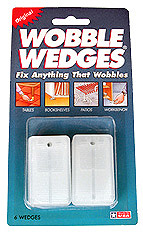
Wobble Wedges®

If one of us in the “Thursday Night Martini Gang” has jammed a book of matches or a wad of napkins under our cast-iron table at Mo Mong once these past 10 years, we’ve done it a hundred times. With the passing of matchbooks, leveling an awkward table became more of an annoyance.

Shift scene: a pub in the Brookhaven section of Atlanta, where four of us had just sat down for a couple of pints and burgers…a pleasant patio lunch on a beautiful day. And the table wobbled. Teeter. Totter. Teeter. Totter. While I was looking around for a napkin to wad up, the ever-resourceful Edith Fusillo reached into her purse and pulled out a small white plastic shim. She lifted the table slightly and shoved this thing under the leg. No more teeter-totter.

“It’s a Wobble Wedge,” she proclaimed and she and Bob beamed at us. “Every table in Venice wobbles. I found these at The Container Store and we always carry them with us.”

Sheesh! Of the hundred or thousands of useless knickknacks and gadgets in the various catalogs of the world, here are these Wobble Wedges – complete with registered trademark. So the first thing we do is go off to the nearby Container Store and pick up a couple of packages. Barbara stashed hers in various compartments of her purse. I stowed mine in…well…my man-bag. Map case. Alright, dammit, my purse.

This is word-of-mouth marketing in action. Only after I got back here to the home computer have I gone to the website; you can read all about Wobble Wedges, “the tapered plastic shims that do it all.” You should look at this site: simple, homegrown, but with all the information you’d need to realize why this is one of the world’s great inventions.

And it’s only a million or so years old. Stone Age (though I’m told that the Association of Social Anthropologists is not happy with this term). After all, the reason we’ve used matchbooks to level the damn table is because they’re wedge-shaped.

Our modern, purse-carried Wobble Wedges are made of polypropylene, tapered at a 5.75° angle with some extra features like nesting ridge teeth that make it adjustable – and so awfully handy. The Wobble Wedge is patented and manufactured by Focus 12, Inc.; conveniently packaged; it even comes with a small hole so you can tie a string to it. “Everyone needs Wobble Wedges ‘cause the world isn’t flat.” Nice line.

The only problem: you tend to forget about the Wobble Wedge when you leave the restaurant. Edith says she and Bob left dozens of them in restaurants all over Venice (the paving and flooring are so out of true, you see). Still, they’re cheap enough, three bucks per six-pack. You can get ‘em in jars of 300 in case you’re truly into leveling.

So this today’s WOM contribution: Wobble Wedges. Pass it on.

Tuesday, November 27, 2007

Door Prize

Ye don’t think we’d have a St. Andrew’s Day Party without an appropriate door prize, do ye? When you drop by the Stag’s Head Pub this Friday, you can register for our “Pairty Giveout,” a 10-year-old Black Bottle Scotch Whisky.

It wouldn’t hurt if you took a quick, visual peek at the brand’s neat, interactive website. You can even pull down a menu or two and take a look at some of Black Bottle’s advertising, though it’s a bit hard to read with its bitty type and all.

Fact is, Scotch whisky’s one of the Worldwide Web’s favorite subjects. Do a bit of Googling and find out more about Black Bottle than I could fit in half-a-dozen blog posts.

I’m going to make it easy on myself. Spirits writer Michael Lonsford jotted a column in The Houston Chronicle a couple of weeks back. The highlights:

It’s black and green, and it had a red-letter renaissance. It’s a blended Scotch whisky called Black Bottle, and its history is fascinating. Most scotch drinkers start off with the classic, popular blends — Johnny Walker Red, Dewar’s, J&B.

I did, too, later segueing to the single-malts and finally the shores of Islay, the island off the western coast of Scotland famous for its heavily peated whiskies.

If Scotch whisky aficionados fall into two camps — single-malts and blends – Black Bottle might appeal to both sides.

Where did the name come from? In the mid-1800s, the three Graham brothers of Aberdeen launched the label, a blended whisky sold in a pot-still-shaped bottle made of black glass from Germany. When England and Germany fought in World War I, the glass became unavailable. So the Grahams switched to green, which is still used.

Black Bottle is a blended whisky, but with unique Islay attributes. It makes you think of the heather shivering in the North Sea wind and wisps of smoke lifting out of Islay village chimneys.

Poetic enough (shivering North Sea wind and all) for me to steal for this post. But it’ll give you an idea of what the whisky is all about…should you happen to carry off the 10-year-old prize Friday evening. You might get away without giving everyone else a wee dram before you go.


You should thank my colleague, Rob Schoenbeck (good Scot that he is) for anointing this brand as the door prize.

Sunday, November 25, 2007

Corrigan Christmas

My God, it’s good to be back in Texas.

The past week was uproarious. Glorious. If there’s anything better than being invited to the 80th birthday of one of your oldest friends (Bob Fusillo), it’s having a groaning-board Thanksgiving with him and his family the following day. Edith Fusillo kept feeding us, feeding us. Dylan Fusillo and Janis Shen came in from New York City. I got to spend more time with him and his brother, Neil Fusillo, than at any time in the past…decade? Two decades? More?

Atlanta itself was all about shopping. Every news medium was filled with stories about “Black Friday” and “Super Saturday.” Shoppers local and national lining up at Best Buy (e.g., which is also advertising a “Cyber Monday” in the event shoppers missed their opportunities over the previous weekend) the night before stores opened, wanting to be the first in line for flat-screen TV sets and other gadgets.

Number Two story on the national TV news programs was about all the Made-in-America toys people could buy. No fears of heavy-lead paint if you buy American instead of Chinese. This is particularly piquant since Barbara finally tracked down a pair of size-15 flip-flops that was waiting for us on our front porch when we arrived home last evening. Made in China, natch: a potential new meaning for the term “leadfoot,” I suppose.

Widely remarked upon by Talking Heads – and much in evidence in stores and lots all over Atlanta – is the deceitful attempt to avoid calling those seasonal, decorated evergreens Americans enjoy buying by any other name than Christmas Trees.

It seems to have started with the Lowe’s Holiday Catalog, in which the big-box chain cravenly referred to these items as Family Trees.

In an effort to avoid the use of the term “Christmas tree,” Lowe's has renamed their Christmas trees and are now calling them “Family trees.”

In their Holiday 2007 catalog, containing 56 pages of Christmas gifts, Lowe’s advertises hundreds of gift items, including scores of “Family trees.” In fact, the word “Christmas” only appears two times in the entire holiday catalog. The ads mentioning “Christmas” cover only 12 square inches of the 5236 square inches available.


I saw signs advertising Holiday Trees, Seasonal Trees and – on one corner of the Perimeter Shopping Mall – a lot with a huge banner announcing the sale of Tradition Trees. (I’m pleased to report the apparent absence of marketing for the Hanukkah Bush, though some are available for Jewish shoppers on the Worldwide Web.)

Yesterday, we battled our way west across Interstate 20 on the drive back. Rain, more rain. Massive rain. Spot showers. Heavy misting. Plus traffic diverting from I-10 because some of this major highway is closed – see the post below. Leaving the Interstate, crossing the state line on US 79 and switching to US 59 to bring us to Houston was a wonderful relief.

Even better, we drove through the tiny town of Corrigan about 8.30 PM. There’s a lighted signboard in front of the City Hall. It announced:

Christmas Tree Lighting
& Chili Cookoff


God, it’s great to be home.

Wednesday, November 21, 2007

Blowouts Happen

The road goes ever on and on
Down from the door where it began.


And so Barbara and I expected it to be when we left for Atlanta last Sunday, from Houston.

The rain was a nice surprise. Our unexpected event was the total closure of Interstate 10 from Lafayette to Baton Rouge, LA. A 55 mile-stretch of a major interstate corridor from Houston to New Orleans will remain closed until at least December 4.

Now you know what we know: I-10 will be closed because a fire at a Bridas Energy USA natural gas well erupted last Thursday evening, before we left Houston. Bridas workers were drilling a new well and the pressure blew the line, which then burst into flames. The well is about two miles west of the Ramah/Maringoin exit on the Atchafalaya Basin floodway side – you could see the flames from the causeway.

I missed this important bit of information and so did a few thousand other holiday travelers. It may even have been in last Sunday’s Houston Chronicle, which we didn’t read before we left the house because our copy was soaked from all the rain.

You know the area, right? That long, long causeway across the flood basin, where cellphones don’t work and there’s just one or two places to stop…we’ve been taking this route to and from Atlanta for years.

Without knowing exactly why, we followed the quickly revised Louisiana Highway Department/US DOT alternate. With all the rest of the eastbound unfortunates, we went northward onto Interstate 49 at Lafayette, then east on U.S. 190 at Opelousas, through Livonia, to Baton Rouge.

This part was not an adventure: Livonia, LA, has two traffic lights and Sunday afternoon traffic was backed up for miles while the good folks of the Livonia police department tried to cope with five times the normal traffic.

Backups aside, we really had no other problems. With no loss of life that I can find, though, it’s typical that Louisiana’s governor, Kathleen Blanco, would use words like ”appalling” to describe the incident. The Gov’s hindsighted comments notwithstanding, my hat’s off to Louisiana state and parish officials and DOT for organizing the best possible solution around an awkwardly placed incident.

It’s also given “over the river and through the woods” to the Fusillos for Thanksgiving a completely new meaning. We’ll be taking another highway home to Houston this weekend.


The Advocate photo by Richard Alan Hannon, with thanks.

Friday, November 16, 2007

Andy’s Pairty*

Inspired by actual events! Sanctioned by law! Well, not our law, but still...

Join us November 30th for what might well be Houston’s best celebration of St. Andrew’s Day, as officially enacted by The Scottish Parliament just last year. A real party – and we’re counting on real Scots (as well as Anglophiles, Beer Lovers and Party Goers) to come down and help us out.

“Us” includes Cameron Wallace of Helix ESG; and Rob Schoenbeck and Richard Laurence Baron (operating under the guise of area51, our strategic marketing consulting firm). We’re setting the stage, you buy your own beer.

Party, party, party. “Scots, wha hae wi’ Wallace bled?” or in this case, “drink?”

We’re gathering at Houston’s Stag’s Head Pub. A wonderful location, Michael Holliday himself has set us up in a nice area of our own – thanks for that. There are ales and stouts, porters and ciders, lagers, even light beers. Rob’s turned Old Speckeld Hen into something of a favorite; Cameron’s likely to start with Stella Artois, the creature.

Now get this: The party’s actually on St. Andrew’s Day, Friday, November 30th, 2007, from 4-8 PM or later. Come on, it’s after Thanksgiving, no excuses and no fooling. Celebrating on Saturday wouldn’t be right.

We invite you to take advantage of your legal rights on the very St. Andrew’s Day honoured by custom and practice: Workers will be allowed to take the day off if they can swap the day for one of their existing public holidays: the most likely option is the autumn holiday in September or October, which varies from region to region.

(However, the day off will not be made statutory and it will be up to employers to decide whether they want to give staff the time off. There has been considerable doubt as to how many private companies will do so.)

But the confusion as to who would benefit from the holiday did nothing to curb the enthusiasm of MSPs [Members of the
Scottish Parliament] for the plan – all of whom will get the holiday, with the rest of the public sector.

Do NOT let this opportunity get away from you over some company quibble or more ordinary (mundane) commitment that can be fulfilled on any other day. We’re talking about the majesty of the law here. We anticipate that the beer will flow and the food will be eaten, to honor the Patron Saint of Scotland.

Spouses of all sorts entirely welcome. Scottish National Dress encouraged – sporrans optional. Designated drivers are also, perhaps, a good idea. That address again: 2128 Portsmouth, Houston 77098 – the Stag’s Head Pub, one block south of Richmond Avenue, one block east of Shepherd.

Come early. Stay late.


*According to The Online Scots Dictionary. Perhaps you would prefer the word “foy?” Our thanks to the owners, managers and staff of the Stag's Head Pub for their enthusiasm.

Tuesday, November 13, 2007

Krafty Publishing

We all know technology rushes things to death…but some things don’t die so easily.

Last week, one senior ad agency told Signalwriter that printed magazines were dead; that they couldn’t deliver the audiences any more. Felix Dennis, the Brit entrepreneur who publishes titles like Maxxim, was quoted in The Economist (September 29, 2007), saying, “It’s a long, slow sunset for ink-on-paper magazines…”

Technology is banging the business model for consumer magazines pretty hard. Print magazines are increasingly more expensive to publish (there’s only so much tech can do for printing presses and the cost of newsprint). And a lot of publications that have expanded to the Worldwide Web aren’t coining money from their sites, either. Mostly.

Still, print magazines have been in the hot seat before. Mass-circ mags seemed to be dying off – then along comes something like People and changes the model. More exhaustive databanking has meant that dozens of specially targeted niches deliver profitable audiences that could be identified and persuaded to subscribe, or buy the products advertised in these specialty magazines. F’rinstance…

We get a free magazine from Kraft Foods called Food & Family. It’s a substantial, attractive publication that involves its readers in a range of subjects revolving around “delicious ideas.” Everything in it is a Kraft brand.

By publishing and sending the magazine to homemakers without charge, Kraft generates both tactical and strategic benefits for consumers and for itself.

First, the magazine stays near to hand around the house. CPG companies learned a long time ago that recipes are ever-popular and attention-getting (that’s why you see so many recipes in magazine food ads). All the recipes involve Kraft products as ingredients: a key sales driver.

Second, Kraft gets to use its huge ad bank in the magazine: it’s filled with advertising for various Kraft brands. How many print ads do you think Kraft and its business units generate in a year? I don’t know – but it’s a lot! So in addition to running the ads in other magazines, Kraft gets extra mileage from them when they appear in Food & Family.

Third, Kraft has tied the magazine to an inviting, involving website that doesn’t simply duplicate the content of the magazine. It has promotions (of course); it also has a terrific “Welcome to Our Community” section where recipes and other household tips are shared – there’s quite a bit of sharing and it’s valuable for stakeholder involvement. All in all, the package is a good one in terms of branding, content and product sales programs.

This is hardly the only example of a magazine published for and distributed to product consumers. Car companies like Ford and Chrysler, published “owner’s magazines” for years. There’s a big difference, however, between the cost of a box of Jell-O and the price sticker on a car window…and the combination of Kraft brand ingredients makes for effective cross-selling.

Magazines’ fires are only smoored, not completely extinguished. Publisher Dennis completed his Economist quote thusly: “…but sunsets can produce vast sums of money.”

They can also generate an startling amount of reader responsiveness, whether they’re highlighting a busty starlet or a breakfast omelet that the entire family will enjoy.

Sunday, November 11, 2007

Gittelsohn’s Sermon, 1945: A Veterans Day Post.

The first Jewish chaplain the Marine Corps ever appointed, Lt Roland B Gittelsohn, ChC, USNR, was assigned to the Fifth Marine Division.

When the US Armed Forces invaded Iwo Jima in February, 1945, Rabbi Gittelsohn was in the thick of the fighting, ministering to Marines of all faiths in the combat zone. His tireless efforts to comfort the wounded and encourage the fearful won him three service ribbons.

When the fighting was over, Gittelsohn was asked to deliver the memorial sermon at a combined religious service dedicating the Marine Cemetery. Unfortunately, racial and religious prejudice led to problems with the ceremony. What happened next immortalized Gittelsohn and his sermon forever.

The Division Chaplain and Protestant minister, Cmdr Warren Cuthriell, originally asked Rabbi Gittelsohn to deliver the memorial sermon. Cuthriell wanted all the fallen Marines (Protestant, Catholic and Jewish, black and white) to be honored in a single, nondenominational ceremony. However, according to Rabbi Gittelsohn's autobiography, the majority of Christian chaplains objected to having a rabbi preach over predominantly Christian graves. The Catholic chaplains, in keeping with church doctrine, opposed any form of joint religious service.

To his credit, Cuthriell refused to alter his plans. Gittelsohn, on the other hand, wanted to save his friend Cuthriell further embarrassment and so decided it was best not to deliver his sermon. Instead, three separate religious services were held.

At the Jewish service, to a congregation of 70 or so who attended, Rabbi Gittelsohn delivered the powerful eulogy he originally wrote for the combined service:

Here lie men who loved America because their ancestors generations ago helped in her founding. And other men who loved her with equal passion because they themselves or their own fathers escaped from oppression to her blessed shores.

Here lie officers and men, Negroes and Whites, rich men and poor, together. Here are Protestants, Catholics, and Jews together. Here no man prefers another because of his faith or despises him because of his color. Here there are no quotas of how many from each group are admitted or allowed.

Among these men there is no discrimination. No prejudices. No hatred. Theirs is the highest and purest democracy! Whosoever of us lifts his hand in hate against a brother, or who thinks himself superior to those who happen to be in the minority, makes of this ceremony and the bloody sacrifice it commemorates, an empty, hollow mockery.

To this then, as our solemn sacred duty, do we the living now dedicate ourselves: To the right of Protestants, Catholics, and Jews, of White men and Negroes alike, to enjoy the democracy for which all of them have here paid the price.

We here solemnly swear this shall not be in vain. Out of this and from the suffering and sorrow of those who mourn this, will come, we promise, the birth of a new freedom for the sons of men everywhere.


Among Gittelsohn’s listeners were three Protestant chaplains so incensed by the prejudice voiced by their colleagues that they boycotted their own service to attend Gittelsohn’s.

One of them borrowed the manuscript and, unknown to Gittelsohn, circulated several thousand copies to his regiment. Some Marines enclosed the copies in letters to their families.

An avalanche of coverage was the result. Time published excerpts; the wire services spread the sermon even further. The entire sermon was inserted into the Congressional Record; the Army released the eulogy for short-wave broadcast to American troops throughout the world; and it has been read on many succeeding days that commemorate our soldiers, sailors, airmen and Marines..

It’s Veteran’s Day today – 62 years after Iwo Jima and the Rabbi’s sermon. Join me in thinking about those you know, who have served and are serving throughout the world, defending our freedoms. As long as we remember the names, they won’t fade.

Paul Hirsch Baron, Emmanuel Katz, Herman Eisenberg and Sam Slavik. Phil Slavik. Norman Sabel and Sherman Sabel. Joel Hirsch Goldberg. Thomas Biddulph, Richard Dailey, Richard Fox, Bill Gay and Richard Sutter. David Starr. Chris Hrabe. AJ Smith and Paul Hoven. Alan Vera. Nathanael Charles Yonka, Jr. Hoi Nguyen and Ellis Alexander. And the names from the Gunroom (you know who you are): Paul Johnson, KCMO, and “Charlezzzzz” Muñoz. And me.


Special thanks to Rabbi Leigh Lerner of Montreal, Canada; and the American Jewish Historical Society. Photo: Fifth Marine Division Cemetary, Iwo Jima.

Friday, November 09, 2007

Information Mismanagement*

The belt had broken on the household vacuum cleaner. The Husband knew that the part number was listed in the cleaner’s instruction manual.

Simple enough: find the manual, copy out the part number, and order it. The result would be a delivered part and a repaired vacuum cleaner. QED.

He looked for that manual in all the places where the couple filed paperwork; he was certain it was near to hand but couldn’t find it. He flipped through more files. When this failed, he called to his wife in the next room. “Dear, where’s the manual for the vacuum cleaner?”

The Wife responded, “Did you look in the file cabinet?”

“I’m in there right now.”

“It should be right in front of you,” said the Wife. “Did you look under ‘H’?”

“Huh?” The Husband shook his head. “Why not under ‘V’ for vacuum cleaner?”

“‘H’ – look under ‘H’,” the Wife called back.

The Husband wondered why the vacuum cleaner manual would be under ‘H’ - and then realized the Wife had filed the booklet under ‘H’ for ‘Hoover.’ And sure enough, he plucked out the ‘H’ file and found the manual.

He was quiet for a moment. Then: “Dear, you do realize that our vacuum cleaner is a Dyson?”

The withering silence was no more than he deserved.


*As told to Signalwriter. The Husband remains anonymous for obvious reasons.

Wednesday, November 07, 2007

Elephant Brand

One of the world’s most famous brands – or mascots, take your pick – was born 133 years ago today. The Republican Party was symbolized as an elephant for the first time. (I have been from time to time associated with it myself.)

“The Third-Term Panic” by Thomas Nast originally appeared in Harper's Magazine on November 7th, 1874. You can read all about it on the magazine’s website. Most people won’t recall that America’s then-most-famous political cartoonist was commenting on the possibility of a third term for President Ulysses S Grant.

Depending on your POV, it’s still going strong. Check it out: CaféPress says it has “over 2080 unique, Republican elephant designs on more than 51100 T-Shirts and Gifts.” That’s a plethora of pachyderms.

Conjecture: Another way to build the strength of your own brand is to found a political party. Win elections. Don’t forget to involve the public by establish a “netroots” organization – a fine new term that’s rapidly replacing “grassroots.” Put Presidents in the White House.

The American press (including cartoonists) will do the rest. Honestly, there are some days when I think it has to be easier than marketing.

Tuesday, November 06, 2007

Database Synonyms?

Your help is urgently needed.

Semanticists, IT types, even followers of William Safire are required: Signalwriter seeks a synonym for “database.”

You can’t bend your elbow without smacking it on the word “database.” It occurs 12 times in an article in The Economist’s 29 September number; my favorite’s a paragraph about the emergence of a “database state.” In another case, one client’s rough draft used the word four times in two short sentences.

The lack of a synonym threatens us all (except, apparently, The Economist writers: The article actually reads extremely well and contributes the alternative “databank”).

Still, SOMETHING MUST BE DONE.

No, you cannot offer “information silo.” It ain’t elegant. Unless I’ve missed a major source, I reckon a euphonious (nice-sounding) synonym seems to be among the missing.

I’ve trolled the Internet, wandering among online thesauruses – no luck to speak of. Try out The Visual Thesaurus (which is a mighty cute gimmick) and what you get is “database” surrounded by a modest galaxy of adjectival modifiers such as “computer” and “online.” Little help there…though it does take you from “information” to “skinny.”

Fingering through the modern mish-mash, I Googled up the National Science Foundation: One of the recent visions is that of Semantic Web, which proposed semantic annotation of data, so that programs can understand it, and help in making decisions. Right.

I even went to The Source: Mary Jo Martin, Database Goddess. After a long period of grappling with this major mystery, she asked: “Ummm, can I use two words? If I can, then I’d say Information Repository.” But, of course, observed Martin: “Richard would say that I couldn’t do that.” So the principal of Cynapsus, the marketing research firm, gave it her best consideration. After deconstructing the word and consulting with Bill’s Thesaurus in MS Word on the pieces, she offered three possibilities: The first is “factcenter.” This one is very to-the-point and descriptive, but boring. Then “statisticsource” – I love the alliteration with all those Ss rolling around. Of course, it would not be good for those with a lisp. Finally, there’s “figureheart” for the sentimentalists.

I’d enter the last one into the competition, for fun. Otherwise, can we hear a shout-out for “infosource” or “bytebank” as alternatives? Ought we to give “databank” a renewed push? I’m willing to take up the cudgels for a neologistic, pleasant-sounding synonym or two, to give doughty “database” some blessed relief.

We need the gifted Seamus Heaney, his art with “swan’s road” and “frothing wave-vat,” his supple word-hoard. A poet who can whip Beowulf into shape would be my perfect synonym-generating hero.

On the other hand, honest Anglo-Saxon may be helpless in the face of 21st Century complexity. What would Beowulf have made of “laptop?”

Saturday, November 03, 2007

Odile’s Mosaïque

For the American cousins of Odile Suganas, there’s good news and bad.

The good news: Suganas has begun a blog about what happened to her family (plus some of our) and French Jews generally during the years of the Holocaust. She, who spent so many years with UNESCO traveling the world, now travels to Poland and Lithuania, searching out the stories of our European family.

She has published a book, Mosaïque, about some of these travels and researches, with photographs of family members never seen before here in America, except perhaps by some of our very elderly relatives. Suganas visited with the Chicago part of the family last year, researching additional information. Several of us have a rough English manuscript of the book.

Now she continues to travel and lecture about the Holocaust. She’s a member of the French Committee of the Days of the Memory, which was founded on the 50th anniversary of the liquidation of the Vilna ghetto in 1943. And she blogs.

Oh – bad news. It’s in French. Some of the blog, also called “Mosaïque,” can be machine-translated; other parts are pdfs of articles and documents. But Francophone or not, check into this new blog. I think you’ll be able to get a flavor of what this very able relation of ours has to tell us and the world about a specially provocative and saddened part of Europe so many years ago.

Friday, November 02, 2007

DrillingInfo’s “Waltz”

Every year, DrillingInfo takes its show on the road and I got a chance to see one of the Houston iterations of its “Waltz Across the Patch” yesterday. As the company’s Director of Marketing would say, it was a good ‘ern.

It really is a form of dance, organizing a 10-city tour with a two-and-a-half-hour show twice a day at each stop. But as a talking platform of a particular type, getting the latest word about the company and its data products out to its customer base, it was also a neat, compact example of its type.

Doesn’t matter if you’re a large-scale exploration services company or a small G&G firm, you know that you have a stake in the usability of the products and services you work with.

You are stakeholders in the company(s) behind those products and services.

DrillingInfo has a superb open-source delivery platform for its extensive collection of land, well and production data. Director of Marketing & Planning Roger Edmondson made it clear at the outset that it was encouraging its users – landmen, exploration team members and deal-makers – to be “missionaries” for its subscription-based services. The audience responded in kind, with plenty of interaction with the speakers.

Then DrillingInfo’s CEO, Allen Gilmer, waltzed us through the company’s DI LandTrăC Unified Land and Exploration Suite and its Virtual Scout utility (which I think is particularly clever); and gave us a glimpse of the company’s forthcoming new DNA product. He tells good stories – which made it even more entertaining.

Gilmer made a significant point about oil and gas exploration: explorationists don’t take a second look at their existing properties because they’re too busy chasing new opportunities. Which means that, potentially, there’s a whole lot of production left on the table.

Well, this is really about stakeholder involvement. It’s clear that the DrillingInfo team has taken this to heart. Gilmer, Edmondson and the rest of the Austin-based team conducted a credible and well-organized event, putting their customers first on the dance card. Way to waltz, guys.