Sunday, January 22, 2006

Man Bag

Time and fashion have not only caught up with me – they’ve turned around to bite me. (No pun intended, really.) You see, I started carrying…uh…bags instead of briefcases 20+ years ago. A few reasons for this.

One: the schlep factor. I’d stuff things in one of several briefcases and carry it back and forth to work without actually ever opening it. Ever. Then there was a period when the only things in the case were a few pencils and pens, a pad or two, and whatever book I was reading at the moment.


Two: the weapon-of-personal-injury. No matter what was in it, the steel-ribbed Samsonite briefcase-as-WPI was always awkward and frequently painful, banging into my knee (or someone else’s) at unexpected moments. Plus, I never hand more than one hand free.

Three: regular European travel. That’s when I discovered a whole new set of options, ranging from over-the-shoulder bags to hand-carried models. So every time I went to a different Euro-city, I’d pick up a new model of one kind or another.

Even early on, this led to some interesting exchanges. On a vacation visit to a yarn shop (yes, yarn) in a quaint shopping area of Minneapolis, I waited patiently while Barbara and a sister-in-law picked over hanks and needles. The saleswoman looked at my bag-of-the-moment, looked at me, and said, “It’s nice to see a guy who’s so confident in his manhood that he can carry a purse.” I think that was a Czech bag I’d picked up in Prague; at that point I was calling it a map case. Sue me.

The arrival of cell phones accelerated the opportunities for hand-carried bags…my pockets became increasingly less laden with odds and end. The past few years, I’ve given up trying to disguise the fact that I have a collection of purses. Rugged-looking, yes. Manly. And there are several versions made specifically for concealed-carry purposes.

Bag-wise, I can’t think of a single adverse comment directed my way: it helps to be six-and-a-half-feet tall. But I have recently noted a rise in comments about my “man bag.” Whichever I’m carrying at the moment, I’ve gotten some nice compliments on it. It’s handy, you know: cell phone, pens, cigarettes, credit cards…all the stuff that guys stash in various pockets is handy in one place.


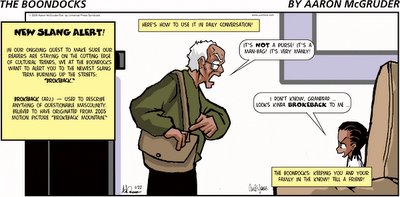
This morning in The Houston Chronicle’s funny papers, though, I read the “Boondocks” cartoon by Aaron McGruder, above. And I thought, “Hoo boy, now it’s gonna get interesting.” McGruder is interesting enough. Enjoy or be enraged by this article about him in The New Yorker. Read his strips to keep your mind aired out.

I’m not carrying his baggage, though. I have enough of my own – usually in my purse.


Cartoon © 2006 Aaron McGruder/Dist. by Universal Press Syndicate. All rights reserved.

Friday, January 20, 2006

Navigator, Sweden

How do you get nominated as Sweden’s best advertising agency? Work real hard. It’s a pleasure to share the news that one of Dialogue International’s long-time affiliates, Navigator Communications KB, has been nominated in the Superettan* class (agency income SEK 10-24 million) of Resumé magazine’s annual “Sweden’s best agency” competition.

Resumé is Sweden’s weekly journal on advertising, PR, marketing and the media. The magazine announced its selections on January 13th.

Navigator’s Managing Partner, Leif Lindau, wrote that almost 1,500 clients throughout Sweden have been asked to answer 21 questions about their agencies, covering above all their knowledge, skills and business value.

The answers have been converted into an index of client satisfaction for each agency, and the nominations are based on these opinions. The agencies have been classified according to income, and the winners in each class are to receive their awards at a big ceremony at Nalen, the historic concert and conference venue in Stockholm.

Filled with wonderful people with wonderful talents, Navigator is unusual since it lives in Malmö, across the Oresund Bridge from Copenhagen, rather than in Stockholm.

I wish I could recapture for you the warmth, the humor, and the excitement of the visits I’ve made there with so many of my colleagues, including (but not limited to) an outstanding Dialogue International Creative Forum on Corporate Citizenship in the Year 2. Navigator has been on the leading edge of marketing through Corporate Social Responsibility (CSR) for many years.

I am waiting for news of the results. Win or lose, though, hats off to Leif Lindau, Jan Berg, and all the other Navigators: friends, colleagues, and genuine professionals.

Wednesday, January 18, 2006

3rd Thursday

In addition to my traditional Martini Night, tomorrow evening is also BrandIt! Marketing’s networking get-together – the latest in a persistent series principal Tad Grow calls “3rd Thursday.”

The city (face it, the nation) is jam-packed with networking events. If you can’t find one out there every night of the week, you aren’t trying. For the socially impaired, there are online options to fit every interest.

That’s the challenge of networking these days: too many choices. Maybe that’s why the quotable Mae West said, “So many men, so little time.”

Man or woman, if you only pick one, Tad’s 3rd Thursday attracts an eclectic bunch of businesspeople orbiting around marketing and advertising. That’s tomorrow, January 19th, at Arturo’s Uptown Italiano in Uptown Park. Hours are from 5:00-7:00 pm. RSVP
Tad@BrandiTMarketing.com. Don’t worry – I’m pretty sure that that’s not Tad in the invitation costume.

Tuesday, January 17, 2006

No "Marketer?"

It’s the 300th birthday of Benjamin Franklin. I’m hard-pressed to write anything really original. Even the recognition that Franklin was America’s first marketing man isn’t new.

(See, for example, here and here. The bemusing article by James H. Morris says, “Ben is rolling over in his Philadelphia grave to see how wasteful and inefficient advertising has become.” I think Morris doesn’t quite credit that America’s population is about to reach 300 million…an utterly different market than Ben Franklin faced.)

When you read Franklin’s most recent biography, by Walter Isaacson, you discover that Franklin developed one early model for an advertising professional to follow, called “doing well by doing good.” Franklin’s publication of Poor Richard’s Almanack, for example, combined the promotion of virtue with the making of money. An old T-shirt of mine proclaimed, “Profit is not a dirty word.” Benjamin Franklin could have said that among the hundreds of other proverbs, sayings and observations.

One more thing he did say speaks directly to people who communicate about features rather than benefits: “If you would persuade, you must appeal to interest rather than intellect.”

So Happy birthday to the Patron Saint of Advertising - even if the Post Office didn't issue a stamp captioned “Benjamin Franklin, Ad Guy.”


New-issue commemorative stamps, USPS.

Monday, January 16, 2006

First Marathon

His knees ache big time. Nevertheless, our son Doug Nytes completed his maiden marathon yesterday. He finished this year’s Chevron Houston Marathon with an official time of 4 hours, 38 minutes. (His unofficial time was 4:34 – it took him and running partner Chris Blume four minutes to reach the starting line from their position back in the pack.)

I almost missed him between Miles 17 and 18 – it’s hard to pick individual runners out of the pack and Doug had gotten a buzz cut just prior to the race. But he heard me cheering on the runners, stopped about five yards past me, turned around and came back for a manly hug.

Post-race, Barbara and I posed with him for this triumphant photo op. We joined the marathoners and their families for seared mammal flesh and margaritas at the Blumes’ home inside the Loop. Chris and Doug said that now they’d run a marathon, they’d never do it again. I bet Chris $10 they’d run next year.

The men’s winner of the 26-mile-385-yard race was an invited runner, David Cheruiyot, in 2:12:02. Only a smidge faster than Doug. But give the lad time to mature and he’ll be a front-runner.

Note the official T-shirt. The finisher’s medal. The big smile. The proud ‘rents. There’re ain’t many things that compare with completing your first marathon (and he's carrying on a family tradition, too).

Congratulations, Doug. You earned it mile after mile!


Photograph by Donna Nytes.

Sunday, January 15, 2006

Moose, Volcanoes

Cyclist, friend and former client Scott McKinley has settled into his new ConocoPhillips assignment in Alaska. Here’s his most recent communiqué to the Lower 48.

Dorothy once said, “Toto, I've a feeling we're not in Kansas anymore.” A quick look around is all it takes to get that Dorothy feeling:
  • Mountains and seawater everywhere you look
  • No traffic jams
  • Moose on the occasional street corner
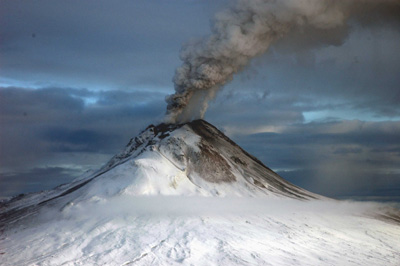
  • Volcanoes erupting (see Augustine above, 171 miles from Scott’s home).

After all the hubbub of traveling, moving and unpacking, it’s nice to finally settle back into something routine. Routine? Yes, I work Monday-Friday, 8-5. Just about everything else, however, is requiring a fun and challenging learning curve.

  • The New Job…anybody know the best key performance indicator for measuring drilling rig efficiency?
  • The Drive…an 18-minute commute unfortunately limits the opportunities to learn how to best spin the car through icy corners.
  • Wintertime Hobbies…hiking in snow requires certain equipment that you just don’t realize you need until you’re on the trail (like a basket on a hiking pole).
  • House Maintenance…when the neighbor comes by to offer advice on how I might better snow-shovel my driveway.

Back to Dorothy’s comment. Had Dorothy stepped off a plane in Anchorage, picked up a local paper and read the headlines, she may have looked down at Toto saying, “Toto, I KNOW we're not in Kansas anymore.” Here’re a few headlines from December issues of the Anchorage Daily News: helpful indicators this is a unique locale.

“Workers Prepare Ponds for Ice Skating” (12/2/05)…Anchorage’s Park System actually smoothes the frozen surfaces on ponds and lakes for public ice skating.

“Two Men Found Frozen to Death in Valley” (12/1/05)…Getting “fall-down” drunk in Alaska can have fatal effects, as these two blokes never made it inside their home before passing out from alcohol consumption; the cold temperatures did the rest.

“Beached Baby Beluga Whale Dissected in Public School Parking Lot” (12/1/05)…I thought it was cool to be able to dissect a frog during 9th grade biology…but a whale?!?

“High School Skiing Is Off To The Races” (12/4/05)…Spending your afternoons on the slope practicing your skiing under the auspices of a school-sponsored sport. Nice.

“In Juneau, All That Glitters Really Is Gold” (12/7/05)…Construction workers moving earth at a project stumbled on a vein of gold recently, setting off a rash of lunchtime prospecting. Ever think about prospecting over your lunch hour?

“Sunrise – Sunset 10:14 a.m. - 3:41 p.m.” (12/8/05)…The paper publishes this on its front page. The days do become short in the wintertime.

“Volcano Camera Lets Anyone Eye Augustine” (1/11/06)…One of the many ‘local’ volcanoes erupted on Wednesday with an ash plume. See it live
here.

Scott didn’t include it, but I know he’d want you to have your own set of instructions for collecting ash samples from the Augustine Volcano. So when you visit him, you’ll know just how to do it.

Image taken by Game McGimsey, USGS/AVO, January 12, 2006.

Saturday, January 14, 2006

Parker Again

If you have paid any attention at all to the politics of the past few years, you’ve noted that what people have written in the past doesn’t stay in the past. Thanks to the Internet, it’s still floating out there in cyberspace, waiting for someone to make an embarrassment out of it.

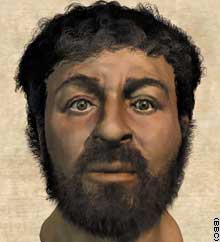
I suppose I shouldn’t have been surprised, then, when a friend of a friend (etc.) passed another one of Kathleen Parker’s odd columns, from April 2001. Her piece is about a BBC reconstruction of how Jesus might have looked, as you’ll see on the right.

Who knew the kinds of things that spilled out of Kathleen Parker’s pen? “The willowy, long-haired figure who in picture books attracted children the way Cinderella drew flocks of bluebirds and singing rodents now looks like the kind of guy who wouldn't make it through airport security.”

And “It's hard to suddenly embrace some new dude who looks mostly like my proctologist's great-great-great-great-great-great grandfather after a visit to Carmen's Hair Salon and Spa. Or Charlie Manson's first cousin. Take your pick.”

Two thoughts this morning. First, there’s a wide tonal gulf between the CNN article and Ms. Parker’s. This is the problem with ad hominem rants that you publish: they return like those long-dead, revenge-seeking sailors in “The Fog.”

Second, when you’re too egocentric -
or ethnocentric - life is bound to fool you. It’s a shock to wander through European museums and realize that those larger-than-life knights in shining armor were, mostly, about a foot shorter than we are.

One legacy of Western Civilization: it is difficult for us to reconcile the idea that God made man in his own image with the recognition that humanity comes in so many different sizes, shapes, and colors. Perhaps Ms. Parker has never Googled “Black Jesus?”


Image © BBC. All rights reserved.

Tuesday, January 10, 2006

Turkish Delightful

Unbelievable to find a quiet restaurant in Houston on a Friday night. Yet here we are at Turquoise Grill with Mary Jo and David Martin; owner/chef/host Yilmaz “Jim” Dokoyucu (left) and his father; Barbara and I. Nobody else. It isn't instantaneously noticeable. Although the address is 3701 Kirby, Turquoise is actually just around the corner on Norfolk, east of Kirby – the site’s map is more reliable than Mapquest’s. The simple, attractive place is dominated by Jim’s brick oven – and his gregarious nature.

Houston is filled with Middle Eastern restaurants, many of them very good. This is Turkish, similar in some ways (e.g., hummus), slightly different in others, with some touch-ups added by Jim. The dishes are rich and savory, not especially spicy-hot, with an abundant use of vegetables and everything FRESH.

The bread is fresh-baked. The stuffed grape leaves we had as an appetizer are a familiar menu item, but Jim’s combination of rice, pine nuts, olive oil, and herbs was wrapped in tart, vinegary leaves that were palate-teasing. The fried filo pastry rolls called Sultan’s Cigars, Sigara Böreği, are a specialty of Antalya – Anatolia – on Turkey’s “Turquoise Coast.” They are stuffed with feta cheese and parsley…and melted in the mouth.

It’s true, several of us had shish kabobs. They were nice. But two of us opted for the manly, rugged, lamb version of Jim’s Taurus Mountain Stew, Toros Güveç: fresh tomatoes, chunks of garlic, strips of red and yellow peppers and a homemade sauce baked in small clay pots in that clay oven of his. Made fresh as well (about 20 minutes), they came out temperature-hot but not overtly spicy, and rich-tasting. Minor complaint: the mouths of the pots are a bit too small to dip the fresh bread in the sauce…a minor matter for someone who’s not afraid to look clumsy. And after all, who was there to see me?

Unlike most (but not all) Middle Eastern restaurants here, Turquoise Grill has a modest selection of wines. Many of these are from Turkey's Kavaklidere Winery originally established in 1929 near Ankara, but under “new” management since 1989 and the country's largest winery.

The three we sampled and drank (one white, two reds) are modestly good. But I recommend the Öküzgözü varietal – somewhat similar to a Shiraz – for the heartier stews.

You won’t see many restaurant reviews on Signalwriter, Turquoise Grill is worth a visit before it finds its audience and gets too busy for Jim to explain everything. So? Go.

Thanks to the Atami Hotel for additional grape information.

Monday, January 09, 2006

Brand Stuck

Your company’s clipping right along. You’re pedal-to-the-metal, lights flashing, siren blaring. If you were a K-9 unit, your dog’s head would be out the window, ears flying in the wind.

Suddenly, you’re not moving at all. Morale collapses. Sales stop. What happened? And you think (cupping a hand over your mouth and exhaling), “Could it be…my brand?” Not likely, according to Bob Lamons. He thinks B2B marketers have a hard time with branding, ‘cause a lot of business marketers started on the tech side of their businesses, like engineering or science. In his view, they tend to fixate on “features and benefits.”

I’ll support Bob this much. In the classic Features-Advantages-Benefits (FAB) triad, a large cohort of clients rush to F and A, but forget about the B. Customers do want to hear about the B – what’s in it for them? Lamons does equate brand with emotion: B2B buying decisions are made as much today by gut feel as the result of some detailed evaluation.


Susan Kirkland, veteran ad designer, responded, “Brilliant – what says we can’t manipulate that ‘gut feel’ much the same as we manipulate a hernia? Isn't that what ‘grab 'em by the balls’ means? Pardon my French.”

In a Wall Street Journal piece last month, Leslie Gaines-Ross, chief knowledge and research officer (CKRO – whew!) for Burson-Marsteller reported that in an ongoing survey of 685 global business leaders in 65 countries, 81% reported that there are more “company reputation” threats today than two years ago. She listed seven warning signs of a company reputation in trouble. Of these, Number 6 was the most telling to me: “Employees stop telling positive stories about the company.”

(You may be particularly vulnerable to the brand attack blog. One example: “Verizon Sucks” entered into Yahoo nets 473,000 sites dedicated to exposing brand deficiencies.)

It takes an internal audience to repair this kind of damage. Your stakeholders ought to believe and should have real reasons to do so. Fast damage control: re-energize your internal audiences and unleash the troops.

Quick, Robin, back to the metaphor! You’re hubcap deep or out of gas. You have to get out and push. And if you live in a nice town, you suddenly find that a couple or three or half-a-dozen other people have gotten out of their vehicles and are helping you muscle your car out of the muck.

In B2B buying decisions, the company behind the product or service is a genuinely critical decision factor. Re-build an emotional attachment with customers and prospects, by all means.

But start with your managers, your employees and their families, your retirees, your stockholders. When they believe, when they are missionaries (or in today’s term, “marketing buzz agents”), you not only get help that advertising and PR can’t buy. You re-empower your company with a potentially inexhaustible supply of emotional energy that’s worth millions.


Sunday, January 08, 2006

Spoiled Bloggers

On your left is Kathleen Parker, syndicated pundit. She recently penned a piece titled “Lord of the blogs” that appeared in the Orlando Sentinel. You should read the entire column here.

The Houston Chronicle reprinted it under a different title on January 1. I read it and sent the editor a letter. It appeared this past Friday, January 6, with minor edits. I made several arguments:

In Kathleen Parker's column about blogs, she says we can't silence the ‘Spoiled and undisciplined’ blogs, though we should ignore them not only for the sake of civilization, but for "the integrity of information by which we all live or die."

This is po-faced hooey. Readers of newspapers (her chosen profession) are canceling their subscriptions in significant numbers, not least because many papers have been found guilty of adjusting facts and presenting partisan opinions. Unlike the news/opinions publications of the past 150 years, though, the Internet greatly empowers access to, and creation of, alternative viewpoints – even when sometimes expressed unwisely.

Does her wish to silence the spoiled and undisciplined extend to the celebrity magazines, too? The supermarket tabloids?

As I tried to come to grips with Parker's column, my wife made the most telling point: Unlike the vast majority of bloggers, she gets paid for her opinions. Unlike her ‘new enemies,’ Freedom of the Press appears to apply only to those who earn a salary at it.

I appreciated seeing my letter in print. (PT Barnum said, “I don’t care what they print about me as long as they spell my name correctly.”)

What I genuinely object to, however, is Parker’s apparent presumption that only paid journalists “who suffer near-pathological allegiance to getting it right” are qualified to dispense news and opinions. They can communicate with us – we aren’t qualified to communicate with them.

Yes – this is about communication and (by extension) public relations and advertising. I think the Worldwide Web and the Internet enable more access to information than at any time in human history. Blogs are one new form that lets us communicate more broadly, influence opinions…even promote products and services.

So, does Parker contend that journalism is automatically more worthy? What happens when, say, PR-type communications are used to transmit editorial-style messages? Are the newspaper writers who pick up news releases journalists or flacks? So read her column. Read my letter. Let us both know if I am over-reacting. (E-mail Ms. Parker at kparker@kparker.com.)

Kathleen Parker photograph and column © 2005 Tribune Media Services, Inc.

Saturday, January 07, 2006

Prisoner’s Dilemma

How in the world does the Prisoner’s Dilemma game theory relate to Houston traffic jams? And cooperating with other freelancers or ad agencies on a client project?

Oh-so-familiar scene yesterday: bumper-to-bumper coming back to the office from a meeting. A 24-mile cross-town trip that took an hour and a half in the late afternoon – I made virtually the same trip in 20 minutes at 11PM last evening.

Patience and politeness are the keys to surviving Houston t-jams. Despite the potential for anger and frustration, the drivers around me were courteous (mostly), refrained from blocking intersections (in the main), let other drivers squeeze in front of them when the lanes narrowed (generally).

It wasn’t ‘til this morning that I realized Houston drivers are pretty good at playing the Prisoners’ Dilemma. Click above to read the Wikipedia article about it. Briefly though, two prisoners can gain better jail sentences if they cooperate than if they rat each other out – even though ratting out is the most common and self-interested result, and one prisoner goes free.

By chance, I have read about this zero-sum game in two different novels this week. Bright and early today, I found a fine description of its traffic application in one of them, the 2004 Kim Stanley Robinson book Forty Signs of Rain. One of the main characters is stuck on the Washington, DC, Beltway:

“By and large Beltway drivers were defectors. In general, drivers on the East Coast were less generous than Californians, Frank found. On the West Coast they played tit for tat, or even firm but fair, because in moved things along faster…and so in California cars in two merging lanes would alternate like the two halves of a zipper, at considerable speed, everyone trusting everyone else to know the game and play it right.”

Houstonians, I think, make the same kind of choices in traffic back-ups, generally cooperating out of some instinct that “if we all could just get along,” we’d move faster and generally do despite the horrible traffic. (Except for the bubbas in giant pickups who cut out of the lanes and across the boundary strips to reach a sort of freedom on the access roads.)

Transfer this example to competing ad agencies or freelancers who are teamed on the same client project. If you play the zero-sum game and betray your team-mates, you will do better. You will get more than your share of the work, more of the budget…or even all of it. The other guy (or gal) is the loser, cut out of the opportunity to contribute value and earn a fair share of the money.

At some point, this is going to catch up with you. You will finally run across a client who doesn’t like this kind of behavior and won’t reward it. You will become known as a selfish SOB who doesn’t play well with others. You may make more in the short term but, as Roger Edmonson puts it, “Pigs get fed; hogs get slaughtered.” Eventually.

Oh yes, this is goody-two-shoes stuff. And we all know a lot of practitioners who have retired to their Galveston beach homes or Hill Country hideaways behaving just this way. But if reputation is one of the things you’re selling (as a freelancer), then fairness and amiability will guide your actions. Cui bono? Who benefits? The client does. Maybe you do, too. Happy Saturday.


© Photographer Sparky 2000 Agency Dreamstime.com.

Friday, January 06, 2006

The Angel

This story from Bob Fusillo in Atlanta didn’t arrive in time for the holiday itself. But today is Epiphany, which signals the end of the 12 Days of Christmas. (I have known him for so many years, I’m certain it must be true.)

Santa was in a bad mood. Two reindeer were sick. Several gnomes had hangovers from too much wassail and couldn't help pack presents. Mrs. Claus was on the warpath…something about muddy deer tracks in the kitchen. Santa had heartburn from all those cookies.

Then there was a knock on Santa’s door: An angel appeared. “Here’s a nice Christmas tree for you, Santa. Where should I stick it?”

Which is why you always see an angel on the top of a Christmas tree.

Thursday, January 05, 2006

Hook 'Em!

What a game! Did you watch it? The University of Texas Longhorns edged out University of Southern California 41-38 and clinched the National Collegiate Athletic Association football championship at the Rose Bowl last night. The victory marks UT’s fourth national title and its first since 1970. Texas completed a perfect 13-0 season, the most wins in school history.

I traded text messages with Linda and Greg Krupps, who were at the game in Pasadena. Much tension – much fun. The UT Tower in Austin was lighted utterly orange last evening to celebrate the Horns’ national championship victory at the 92nd Rose Bowl game in Pasadena, Calif. The Tower will be lighted entirely orange with the #1 displayed again today, and it will stay lit through the weekend. I guess most of the UT alums will stay lit, too.

Hook ‘em, ‘Horns!

Tuesday, January 03, 2006

Web Pusher

Everybody wants credit for inventing the Worldwide Web and the Internet – even Al Gore. Despite these claims, the WWW has some genuine fathers. I always felt that a Minneapolis-based science fiction writer, Gordon R. Dickson, pre-visioned it in 1984, when he published a novel about a galaxy-wide confrontation called The Final Encyclopedia. Amazon describes it this way:

“At the center of this galactic conflict is the Final Encyclopedia, a huge space-station in orbit of Earth, that contains all the knowledge of the human race. Whoever controls the Encyclopedia will control the fate of humanity.”

Nobody that I recall imagined the space station-load of all knowledge would include advertising. And you hardly need to be told that the Internet is a major advertising medium. I’m sharing a couple of key points because some industrial firms might not be giving it strong enough consideration in 2006.

There’s a lot of hoopla about “consumer advertising” rather than business-to-business advertising on the Worldwide Web. The financial facts are pretty important. See the latest figures here. National advertisers’ 2005 budgets only grew 3.7% overall in their traditional media (vs 2004), but grew 15% in Internet expenditures. The big guys are spending about $8 billion on Web advertising in one form or another. In 2006, the consumer advertisers are expected to grow that spend another 10%...the highest rate of increase among all advertising media.

Most business-to-business advertisers haven’t come anywhere close to matching that rate of increase – except for the very largest.

I think there’s a good reason for this and you can leave aside the “old guys don’t understand new technology” stuff. It's trite. Author and marketing communications futurist Seth Godin spoke to an interviewer recently who asked two questions:


1. Should every business use the Internet to communicate?
2. What are the basics of an Internet communications strategy?

Godin said, “You should only use the Internet if you want your communications to be FAST and you want to reach LARGE NUMBERS with no intermediaries. If you can't handle that, though, you shouldn't try.”

Sean Finnegan, US director of i-agency Digital/OMD, modifies this in the right direction. The Web is a mass medium, he says – but it’s an excellent way to reach an engaged “consumer” looking for a deeper bond with your brand.

In tightly focused B2B markets such as restaurant management software or drilling muds, for example, companies do use the Internet to communicate, but most often it’s via their Web sites – a pull medium when they can get their specialy focused prospects and customers to view them. They do not make as much use as they could of “push” advertising on the Web...and they could use it if it is strategically and tactically well-executed.

Unlike Dickson’s imagined encyclopedia, there is no “final” in the expanding world of online media. It’s devilishly hard to stay ahead of the curve. For most of us, keeping up is way better than catching up.


Advertising professionals like me want to continue to support clients effectively. This year, I’m going to be an enabler. I want to (first) show clients how to get more out of the digital channels they are already using, to push their prospects and customers into closer, more valuable relationships. And (second) I intend to help them implement these new and continually changing channels. Happy New Year’s resolution.

Book cover © the publisher. All rights reserved.

Friday, December 30, 2005

Time Piece

Just in time for the new year, Deepwater Specialists, Inc. (DSI) has a brand new ad. With concept and copy by Richard Laurence Baron – that would be me – and Joe Woods, art direction and design by Steve Stanley, DSI has launched an advertisement that's deceptively simple and different than the normal run of ads in the Oil & Gas trade mags.

There’s a way-too-familiar ad format in this market. It’s called “the rig in the sunset.” Sometimes, it seems like every company in the oil patch, whatever its specialty, has an ad with an oil rig or a platform, on or offshore, with either a sunrise or a sunset in it. And it does run in waves.

There are often creative upsurges that make the advertisers (and the publications) sparkle…and plenty of good advertising practitioners that make ads really stand out, inside and outside of the oilfield companies.

Then the dramatic breakers subside, and the industry’s tide turns to showing photos of oil rigs or production platforms again. Sometimes, this is warranted. Example, when a particularly significant advance in technology should be shown. For the oilfield service companies, this is often more difficult, because they don’t have the products per se…they do the work (which leads to cliché #2, crews in hard hats working on the rig or the platform).

DSI has become the world’s leading provider of the arcane and extremely complex service of commissioning facilities that are going to produce oil and gas from wells in some of the deepest parts of the ocean. You can read more about it here. But the facts are simple.

1. Offshore oilfield facilities are among the most complicated “machines” created by human beings today.


2. Exceptionally expensive, they have to operate efficiently and safely in very tough ocean conditions.

3. The longer it takes for a deepwater facility to get built, prepared, towed into position, and producing hydrocarbons (sometimes years), the more expensive it is for the facility owners and operators.

That’s why the ad’s timepiece doesn’t show minutes and hours. Look closely. You’ll see that the watch face shows days, weeks, months, and years – with a window that displays the cost of getting the facility into production.

Time is money…lots of it. Instead of focusing on what its services look like, DSI’s new ad spotlights customers’ major preoccupation: how long will it take before the facility produces “first oil.” The benefit: DSI helps shorten the time involved.

Congratulations, DSI, on the newly launched ad – and thanks for letting me be part of the effort.


Ad courtesy of Wood Group. All rights reserved.

Thursday, December 29, 2005

Hanukkah Feedback

Before I posted “Achieving Hanukkah” (see Sunday, December 25), I wrote to Leigh Lerner for some historical checking. My oldest friend, he’s also a Rabbi in Canada. The rest of this post is his.

“Please excuse the slow response. We just returned from Israel last night on a flight plan which could only be described as anti-Semitic. (Hotel wake-up, 12:30 AM, leave hotel 1:30 AM, leave Ben Gurion 5:30 AM, arrive Zurich 9 for 4-hour layover, arrive home with luggage in hand at 5:30 PM, precisely 24 hours after the wake-up call.)

“It was so punishing that I now believe all my sins are forgiven for the year to date, so I plan to shorten Yom Kippur services by 25%.

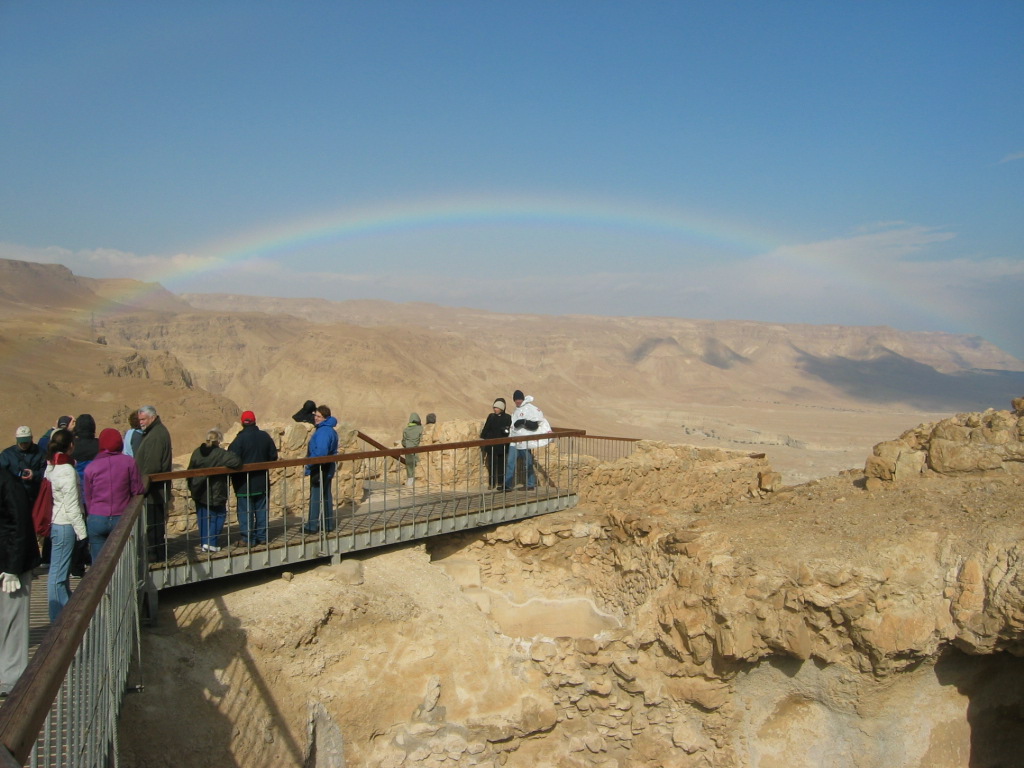
“Weather department: on our visit to Masada, it rained. I’ve got shots of rainbows taken from its heights (see above). The place averages 40mm a year.

“My math on Alexander’s date agrees with yours, 3429. The ‘since creation’ dating system is a product of medieval scholarship, however. It’s usually listed as (e.g.) 5766 A.M., anno mundi.

“Your question brings up a very little-known fact: Alexander himself is the reason for a certain Jewish dating system, minyan ha-shtarot, the dating for documents: Not the arrival of Alexander in Israel, but the control of it by his general Seleucus, progenitor of the Seleucid dynasty centered in Syria and Babylonia, was taken as Year 1 for this dating system, which is 312 BCE. There are still Jewish communities which date all their documents, like Jewish marriages and divorces, by this system. For an interesting reference which concerns the Jews of India, see
http://emganin.tripod.com/home/id3.html.

“Back to Israel: there’s so much new in the state that it’s dizzying. Hanukkah’s town, Modi’in, is probably Israel’s 5th largest city now, soon to pass Be’ersheva. It’s right between Tel Aviv and Jerusalem on the freeway, and a fast train is going in that reaches them both, so many secular Jews are leaving Jerusalem to live there (it’s only about 22 miles away, and you can see Tel Aviv on the far horizon). Couples who have one spouse working in T.A., and one in Jerusalem, live there, too. Last time we visited, 10 years ago, Modi’in did not exist as a city.

“We walked the entire length of the Western Wall, thanks to a tunnel that was dug alongside it. This is the tunnel the Palestinians claim goes under the Temple mount, violating their territory. I can testify that it does not go under the Temple mount. You can see Herod’s stones the entire length of the way. We had one fellow with claustrophobia who barely got out, so we had to walk through the Muslim quarter, as opposed to turning around and going back through the tunnel. The army accompanied us. Such is life there.

“We saw the fence/wall while traveling a new toll road which bills drivers via transponders. It abuts the Green Line for many miles, so the fence/wall is quite evident. It’s mostly a fence with electronic movement detection equipment, but when it approaches a town, it becomes a wall that looks a lot like sound barriers on a typical US urban freeway. Road blockades are more of a problem for Arabs, I should think, and they exist wherever there is transit from Israel to potential Palestinian Authority territory. Having traveled the length of the Jordan River to return to Jerusalem, I was glad to see the blockades in place for our own safety.

“P.S. There has long been an Israeli fence along the Jordan River, and the Hashemite Kingdom of Jordan, according to all accounts I heard, loves it. It keeps the Palestinians out of Jordan and saves them from having to declare more Black Sundays. All best for lots of light, Leigh.”

Wednesday, December 28, 2005

Propertied Portfolio

For three decades, I worked in them. Office buildings. Some were high (though not as you might say “skyscrapers”). Some were low. Some attractive, some not so much.

I’ve stayed in hotels – I’ve done that. Multi-star, big-name hotels here and abroad. Discrete art hotels. Tiny, off-the-main-drag hotels, like the one in Paris with a shower stall so compact that I had to turn off the water and get out of it to retrieve the soap I dropped.

Despite all the time I’ve spent in advertising, though, I never had commercial properties or hotels as clients. Architectural and building products, yes indeed. The buildings themselves, no.

Until this year. I’ve added a new category to my portfolio, thanks to relationships as near by as Katy and as far away as Russia. With the help and cooperation of some very talented people, my sample case is a little richer with TV commercials, brochures, and ads.

One on the newest (left) is an ad for Laguna Bay Condominiums on South Padre Island. Others have been for classic restored properties like the five-star Corinthia Nevskij Palace Hotel in St. Petersburg: quite a place, which I hope to visit sometime soon.

Commercial property people and hoteliers have internalized a wealth of knowledge and understanding. You may not think it’s rocket science…but it is specialized and based on years of experience. I’m looking forward to learning more about all of it.

I also look forward to trying more of those hotels I mentioned. Even the one in London that had common bathrooms for each floor rather than one per room. (That’s another story; Roger Edmondson will be glad to tell you about it.) Meanwhile, happy Wednesday.

Tuesday, December 27, 2005

Company Policies

File under “Labor, Dignity of.” Entitled 2005 Most Unbelievable Workplace Events, global outplacement firm Challenger, Gray & Christmas, Inc., has released the following copyrighted list of stories that are most likely to make you ask, “Can a company actually do that?” Or, “You can’t beat these stories with a stick.”

• The Whine-Free Policy. A German company initiated a strict no-whining policy. Negative Nellies and other boat rockers are under a two-moans-and-out rule. According to the company, several workers have quit and two others have been fired for violating the whine-free policy.

• No Slack for War Wives. A Michigan woman was fired from her part-time receptionist job after failing to show up for work the day after seeing her husband off to war as a National Guard member.

• We Are Family, Only. DaimlerChrysler’s transmission plants in Kokomo, IN, have designated 80% of their employee parking as reserved for Chrysler vehicles only. Any non-Chrysler vehicle parked in a reserved area will be towed to Indianapolis, 50 miles away, where the employee will have to pay $200 to get his or her car back.

• Executive Whipped into Shape. An executive for a foundation that funds heart disease research was accused of embezzling more than $237,000 and using some of the money to pay for the services of a dominatrix.

• Rescue Squirrels on Your Own Time. A woman says she was suspended from her job for spending too much time trying to rescue a squirrel trapped in the ceiling of the library where she works.

• Anyone Desperate For a Job? The National Labor Relations Board refused to strike down a security company’s rule that prohibits employees from getting together away from work. The policy forbids workers from going to lunch together, attending each other’s weddings, or doing anything else they might want to do with each other outside of work.

• Productivity vs. Religion: And the Winner is… Thirty Muslim workers were fired from a major computer manufacturer’s Nashville, TN, plant for adhering to religious doctrine that requires them to pray daily at sunset.

• Forgot To Wrap That Can! A worker with a good record and no problems with his supervisors was unexpectedly fired from his job with a beer distributor. While no reason was given, the firing occurred on the same day a picture of the worker drinking a competitor’s beer appeared in a local newspaper.

• No Hablas Español. Two Spanish-speaking hair stylists in Chicago, IL, claim in a federal lawsuit that the company they worked for strictly banned the use of Spanish, even when employees were on their breaks. A sign at the establishment read, “Speaking a language other than English is not only disrespectful, it’s also prohibited.”

Thanks to Challenger, Gray & Christmas, Inc., you can find additional employment info about the workplace here. And continued seasonal wishes to workers of the world.


“Confrontation between a policeman wielding a night stick and a striker during the San Francisco General Strike.” By an unknown photographer, 1934, from National Archives, Records of the US Information Agency, with appreciation.

Monday, December 26, 2005

Boxing Day

It has dawned cool and utterly clear. The moon is waning and it’s Boxing Day. It puzzled the Anglophile in me for many years. Being primarily an English (and Commonwealth) holiday, Elaine Berger has a lovely British explanation here, but Stephen Bentley has made understanding it easy in today’s “Herb & Jamaal” comic strip.

The Pastor, unlocking the poor box, says, “Today is the Feast of St. Stephen, the first Christian martyr...a day some folks call ‘Boxing Day.’ Some say the term comes from opening the church poor box and giving to those in need.” Herb’s response is, “I thought it meant the day that people fight to exchange gifts at the mall.”

Me - I always think of the carol:

Good King Wenceslaus looked out on the Feast of Stephen,

When the snow lay round about, deep and crisp and even.
Brightly shone the moon that night, though the frost was cruel,
When a poor man came in sight, gathering winter fuel.

“Hither, page, and stand by me, if you know it, telling,
Yonder peasant, who is he? Where and what his dwelling?”
“Sire, he lives a good league hence, underneath the mountain,

Right against the forest fence, by Saint Agnes’ fountain.”

“Bring me food and bring me wine, bring me pine logs hither,
You and I will see him dine, when we bear them thither.”
Page and monarch, forth they went, forth they went together,
Through the cold wind’s wild lament and the bitter weather.

“Sire, the night is darker now, and the wind blows stronger,
Fails my heart, I know not how; I can go no longer.”
“Mark my footsteps, my good page, tread now in them boldly,
You shall find the winter’s rage freeze your blood less coldly.”

In his master’s steps he trod, where the snow lay dinted;
Heat was in the very sod which the saint had printed.
Therefore, Christian men, be sure, wealth or rank possessing,
You who now will bless the poor shall yourselves find blessing.

Boxing Day is the second of the Twelve Days of Christmas. When you add in Hanukkah (see post below) this year, and Kwanzaa, makes for a very long season of holy days and holidays. Makes it easy to begin keeping Christmas in your heart for all of 2006, don’t you think?


Sunday, December 25, 2005

Achieving Hanukkah

Happy Hanukkah, everyone. Most Americans know there’s a “Jewish Christmas” that comes around this time of year. Many Americans and virtually all Jews know tonight is the start of the Festival of Lights – the night we light the first candle in the menorah.

Most Jews can tell you why Hanukkah is celebrated for eight days. It’s here, but the short form goes like this. Alexander the Great conquered Syria, Egypt, and Palestine in 332 BC – that’s circa the year 3429 in the Jewish calendar (if I’ve got my numbers right). He allowed the conquered peoples to keep practicing their own religions.

More than a century later, Antiochus IV, one of Alexander’s many successors, controlled the region. In 167 BC, he occupied Jerusalem; decreed the abolition of the Jewish religion; and desecrated the Temple by requiring the sacrifice of pigs, a non-kosher animal, on the altar. Jews who resisted were subject to execution.

Several Jewish groups, including one led by Judah Maccabee and his four brothers, revolted against both assimilation of Jews into Hellenistic culture and oppression by the Seleucid Greek (now mainly Syrian) government. The revolution succeeded. The Temple was rededicated. The priests discovered there was very little oil left that hadn’t been defiled by the Greeks. The oil was needed for the Temple’s menorah, which was supposed to burn throughout the night every night.

Here’s the spine of the traditional Hanukkah story. There was just enough oil to burn for one day. But miraculously, it burned for eight days, the time needed to prepare a fresh supply of oil for the menorah. An eight-day festival was declared to commemorate this miracle.

Judah Maccabee is a hero to every Jewish kid who’s every gone to religious school – we learn about him, sing songs about him. But the same Web source, Judaism 101, will tell you, “Note that the holiday commemorates the miracle of the oil, not the military victory: Jews do not glorify war.”

With respect, this is disingenuous. Judah conducted what some historians view as a brilliant guerilla war against the Syrians for two years. He and his tiny Jewish army defeated Syrian generals time after time, culminating (for the moment) in his victory at Beth Zur near Hebron in 165. After Beth Zur, he captured Jerusalem and liberated the Temple.

Two years of tough fighting led to the miracle of eight days’ worth of oil.

This wasn’t the end of the story – the Jews had to keep fighting. Judah was killed in the Battle of Elasa in 161 BC. His brother, Jonathan, took up the struggle and the conflict continued for 18 years more before he was killed. Another Maccabee brother, Simon, became King of Judea in 143, under the Syrians. But there were repeated invasions and sectarian violence until Rome stepped in and imposed peace on Palestine in 64 BC.

Most of you won’t remember what Franklin Delano Roosevelt called “The Four Freedoms.” (His January 6, 1941, speech is here.) The second one is the freedom of every person to worship God in his own way – everywhere in the world. Take a good read and tell me we shouldn’t be thinking about our servicemen and servicewomen tonight, when we light the first candle, and for all the nights thereafter.

There’s often not much glory in war. But the real lesson of Hanukkah is lost on anyone who doesn’t believe in fighting for freedom.

Additional reading? Try Eliezar Segal here and here. And best wishes for the entire Festival of Lights.

Here is the story of The Statue of Liberty Hanukkah Lamp, above,
from the Library of Congress exhibition,
“From Haven to Home,” third panel, with thanks.