 This morning’s HEART OF THE CITY cartoon shows precisely why Mark Tatulli is much loved around this house. Who else would not only remember the Pythons’ “Ministry of Silly Walks” sketch, but put it into a cartoon strip? Thanks, Mark, for keeping pop culture just a little wittier than Madonna’s next adoption and Paris Hilton.
Sunday, October 29, 2006
Silly Walks
This morning’s HEART OF THE CITY cartoon shows precisely why Mark Tatulli is much loved around this house. Who else would not only remember the Pythons’ “Ministry of Silly Walks” sketch, but put it into a cartoon strip? Thanks, Mark, for keeping pop culture just a little wittier than Madonna’s next adoption and Paris Hilton.

Thursday, October 26, 2006
Mother’s Day
Did you hear the one about the new Marketing Director at an oilfield equipment company who, after interviewing several design firms to select a “marketing partner” for the company, hired his mother for the work instead?
Top of the world, Ma!
Top of the world, Ma!
Tuesday, October 24, 2006
Healthcare Videos
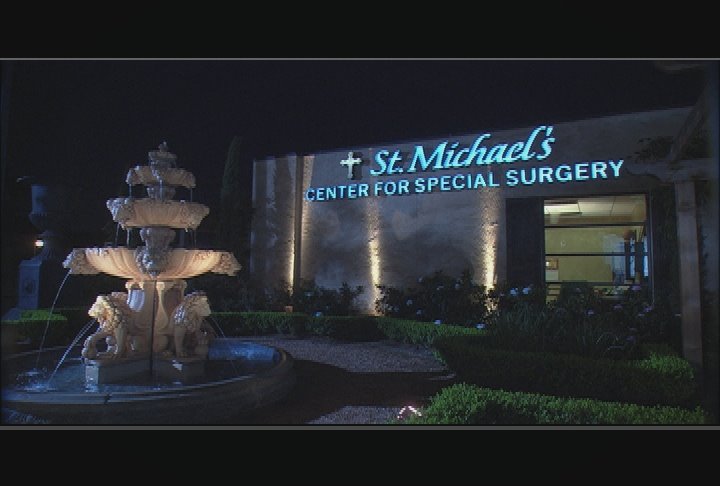
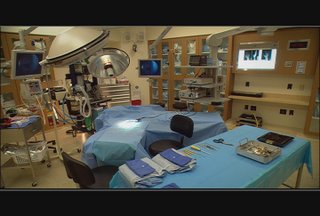 New videos for St. Michael’s Center for Special Surgery are in the can and appearing in doctors’ and patients’ hands throughout Houston. I was “above the line” – the copywriter for Locke Bryan Productions on these projects.
The establishing shot for each video (the night shot of the façade of the Center) is the tone-setter. Dr. Michael Brown has created an outstanding facility for specialized day surgery.
St. Michael’s is quite a combination: a surgical center than feels more like a luxury retreat than a hospital, advanced medical and surgical equipment, and one of the most dedicated group of healthcare professionals I’ve every worked with. In fact, both videos rely heavily on interviews with the nurses, OR technicians and support staffers. Even though you’re looking at two “facility” stills from the videos (above), about half of each video is filled with interviews with the St. Michael’s team.
Without prompting, every one of the staffers we interviewed for the videos emphasized that the patient always comes first. Edgar Duran, one of St. Michael’s surgical scrub technicians, said, “The patient is number one here…is of paramount importance. We want to make sure that the patient’s stay here is pleasant.”
Working with Stryker surgical lighting systems and C-arm fluoroscopy was worthwhile; working with the St. Michael’s people was better…and it shows in Locke’s close-ups. These are the money shots.
(I’m sprinkling movie-writing terms throughout – it’s an affectation, true, but fun! The St. Michael’s videos have strategies and objectives, just like other marketing communication projects: we left the character arcs and plot reversals for Hollywood.)
More than 15 years ago, Health Industry Today forecast that interest in freestanding surgical centers was expected to keep going up during the “next decade” because the number of both centers and specialized procedures was continue to grow. Now it’s 2006. The pace has accelerated, Have you seen the new specialty hospital or clinic that’s going up in your neighborhood?
Surgical centers offer additional ways for doctors to deliver healthcare to their patients, not stealing market share from major hospitals but supplementing the healthcare system with extra efficiencies and amenities – especially when a center like St. Michael’s raises the bar in terms of quality patient care and optimized efficiencies.
And when today’s healthcare system problems are genuinely offset by the people who deliver the healthcare, then making video’s for St. Michael’s has been an exercise in beneficial communications.
Thanks to Dr. Brown, Crystal Rideau and the staff of St. Michael’s, and to Locke Bryan and his team, too. I enjoyed adding two more examples to my healthcare portfolio.
“Music up. Fade to black.”
Coming soon: “Creating New Healthcare Marketing Opportunities by Leveraging Technology Innovations,” the upcoming AMA Healthcare SIG seminar. Opening Thursday, November 16th. Sign up at www.regonline.com/110834 today.
Saturday, October 21, 2006
Carol Radsprecher
 I have added the painting above to our collection – by adoption. It’s been a learning experience and a joyful one.
First, I better tell you about FAAN – the Fine Arts Adoption Network. It has been initiated by artist Adam Simon with a mission to connect artists and potential collectors.
Adoption means acquiring an artwork without purchasing it, through an arrangement between the artist and collector. FAAN’s goal is to help increase and diversify the population of art owners and to offer artists new means for engaging their audience. The copyright is owned by the artist, of course. The collector owns the painting itself.
First, there’s the “arrangement.” FAAN asked me to initiate an e-mail conversation with the artist whose work I selected. I wrote an introductory note to Carol Radsprecher about her painting, “Carcinaquaria with Toys.” She e-mailed back – from the Brooklyn Public Library. We’ve traded e-mails a dozen times, getting used to one another, exploring each other’s quirks.
She wrote me, “I am the most citified human on earth, at least as regards New York City. I was born and remain in Brooklyn, as my bio said; Brooklyn Heights, actually, which is very much Manhattan in terms of the inhabitants.”
Carol got her MFA in painting from Hunter College, CUNY, in 1988, after receiving a BFA in painting from Hunter in 1985. She’s painted for many years and had solo exhibitions in the Pierro Gallery at South Orange (New Jersey); the Garrison Art Center (Garrison, NY); Get Real Art Gallery (New York City); and Thompson Park Art Exhibition Series (Lyncroft, NJ). You can see her list of shows and juried exhibitions here and more of her pieces here.
Then I got the word from FAAN: Congratulations on adopting “Carcinaquaria with Toys” by Carol Radsprecher!
“Carcinaquaria” is part of an on-going series of oil paintings on canvas (like her “White Floaters” on this page). Sexuality is explored, as well as playing around with line. Carol’s statement on NeoImages explains the general background of the series:
Everything—everything—on earth has a shape, whether we can see it naturally or with the help of microscopes and other mechanical means. This idea that nothing physical can exist without having taken a shape (usually comprised of smaller shapes) is the impetus behind many of these paintings. I begin each painting with a series of repetitive lines, aiming for a complex field of linear and color-formed shapes.
“…playing around” is a key phrase – and it has taken me a couple of days to get used to having a genuine Radsprecher painting here in Houston.
If somebody (maybe Bob Fusillo) has already said that art teaches you about yourself, then I apologize to him or her. But continually looking at "Carcinaquaria" for the past three days has informed me considerably.
I discovered that I am used to, and gravitate toward, the dramatic in modern painting. Carol’s painting has less drama than I expected…but much more sly humor in it and that makes me smile.
Barbara insists the light comes from the lower left (if there is indeed an imaginary light casting shadows); I believe it comes from upper right. And maybe there is no light at all. The title helps: does it have something to do with smoking? I haven’t confirmed this yet with Carol.
Thanks to FAAN for facilitating and Carol for letting me adopt her painting and bring it south, because I'm increasingly seduced by its technique, its charm and its crafty ways.
“Carcinaquaria with Toys” by Carol B Radsprecher, oil on canvas, 20 x 20 inches. Now in the Collection of Richard Laurence Baron & Barbara Nytes-Baron.
Wednesday, October 18, 2006
Brand Murder?
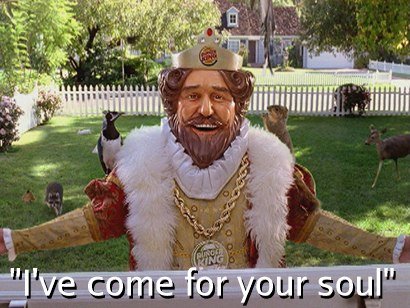 There’s mudslinging. Character assassination. Sex. It’s not even about politics. It’s what’s happening to brands these days.
There has been a lot of chat lately about giving your customers some control over your brand. The “experts” have been saying that the youngest members of a company’s customer base aren’t likely to be persuaded by traditional interactions with a company and its products. You’re supposed to be experimenting, using new media, accepting new attitudes. Aren’t you?
An article by Rance Crain called “How Do You Get Control Back If You Cede Brands to Consumers?” was just published in the October 15th issue of Ad Age. Part of what Crain wrote:
Here's a question: With all this talk about consumers taking control of brands, how do you get control back again if you decide to change direction? Or once you open the gates, is your brand's destiny out of your hands forever?
Right now, Burger King’s bad-boy promotions are built around its creepy King character and aimed at male teenagers. But that doesn’t give the restaurant chain much to build on if it decides to play nice or to expand its pitch to other target groups….Russ Klein of Burger King said turning your brand over to the consumer enables “social connectivity” as a means of empowerment.I couldn’t help think but what a dangerous game he’s playing.
The current BK strategy is for it to develop “social currency,” and Mr. Klein said to achieve this aim, “it's more important to be provocative than pleasant.”
Crain’s ultimate point is that Burger King is losing control of its brand, rather than providing that social connectivity. If you don’t believe that, go here (or Google “Burger King Commercial” and select “Banned Burger King Commercial” – but be careful, this one is more than a little disturbing).
You can watch the real Burger King commercials here – something for everyone, from chickens with attitude to the “Stackers Union” spot, or (in the BK® Table Guests section) conversations with models from Maxxim magazine.
It’s like Burger King Meets Las Vegas – you know, the place where what happens there stays there. Except for Burger King, it doesn’t: the results are all over the web, quite aside from your TV sets.
Michael Fielding, writing in the American Marketing Association’s Marketing News this month, says that brand owners are already…uh…screwed. “Companies no longer control their brands: Joe Chemo, Camel’s sickly camel stricken with lung cancer? Burger King’s mascot in an salacious visit to a couple’s bedroom? (See above.) An ad hoc commercial for Chevy Tahoe saying ‘global warming is here’?”
Don’t think, colleagues and clients, that the problem is confined to consumer brands. There’re many companies that have been hammered by what Marketing News calls “doppelgangers” – the websites and blogs that have been created by citizens with intentions either parodic or just plain nasty.
Not only media commentators, but bloggers too, have analyzed commercials from firms like Halliburton and BP (for example). These commentators reach a lot of consumers…maybe even your customers.
The current thinking: don’t fight back..mostly. Susan Fournier, quoted in the Marketing News article (page 15), says that fighting the doppelganger is against the entire new marketing paradigm; that co-creation is the key to creating brands.
I think you should find ways to fight. The Internet, blogs, texting – the new media offer ways for disgruntled people to strike at your brand and spread the word…often so fast that you may not even be aware of the negative imagery. You cannot control it, no matter how angry you and your senior management get. But you can moderate the negatives. Tell your side of the story. Interact with your markets in a positive way.
Do not, as Honeywell did years ago in response to a negative article in Fortune, pull all your advertising from the offending magazine(s) and go sit in your “quiet place.”
Do not let other people dictate how your brand is perceived. Fight the good fight.
Thanks to Rob Schoenbeck for kicking this one off. Photo taken from home.blarg.net/.../blosxom.cgi/2005/Apr/ with apologies. Google/Image for “Burger King” and you’ll see quite a few more.
Saturday, October 14, 2006
Minnesota Blues

Won’t you come home, Barb Baron?
Won’t you come home?
I’ve moaned the whole month through.
I’ve done the laundry, honey,
I’ve paid the bills.
I’ve plain been missing you.
You remember that sunny morning,
I dropped you off, to fly away and see your mom?
I know you love snow – I can’t take no mo’.
Barb Nytes, won’t you please come home?
Won’t you come home, Barb Baron?
Won’t you come home?
New Prague’s a long, long way.
You’ve done mom’s packing, honey,
So she can move.
What more can Rosie say?
You’ve had your snowfall, baby,
You’ve had your cold, and now that your sinuses are clear,
Please come back to me – it’s not so winter-y,
But Barbara, won’t you please come home…
That’s back to Houston, sweetheart…
Dear Barbara, won’t you please come home!
Louis Armstrong is turning in his grave. Atmosphere-establishing photo courtesy of www.homes.com
Friday, October 13, 2006
USS Clinton
 By this time, you probably already know that the US Navy has introduced a new class of aircraft carrier into the fleet. The USS William Jefferson Clinton (CVS 1), above, set sail from its home port of Vancouver, British Columbia in June, 2006.
According to many reports on the Web, the ship is the first of its kind in the Navy and is a standing legacy to President Bill Clinton “for his foresight in military budget cuts” and his conduct while president. The US Naval Sea Systems Command (NAVSEA) emphatically denied that the new carrier is part of the Navy's “21st Century Aircraft Carrier Project.”
While this is not the first major US warship named after a president - e.g., USS Ronald Reagan (CVN 76) - it is the first carrier in recent memory that is constructed entirely from recycled aluminum. Its cruising speed (unclassified) is five knots. Its airwing is comprised of one (unarmed) F-14 Tomcat or one (unarmed) F/A-18 Hornet aircraft. Although they cannot be launched or recovered on the 100-foot flight deck, former National Security Advisor Sandy Berger says they “form a very menacing presence. Really.”
It does share the distinction (with USS Reagan and USS Jimmy Carter - see below) of being named after a person who was alive at the time of its christening. It was built in just 14 months and launched to pre-empt the introduction of USS George H W Bush (CVN 77), the Navy’s newest Nimitz-class nuclear-powered carrier, into the fleet. The Democratic National Committee declined to comment on Clinton’s hurried construction.
As a standing order, no firearms allowed on board. The 20-person crew is fully diversified and includes members of all races, creeds, sex and sexual orientation. An unidentified Naval spokesman denied there was an additional order that “if the boat is rockin’, don't come knockin’.”
The crew, like the much larger complement embarked on USS Jimmy Carter (SSN 23), is specially trained to avoid conflicts and appease any and all enemies of the United States at all costs.
USS Clinton will boast the ability to steer a course straight down the middle, but will have a tendency to veer to the left or toward large sums of money. Unlike the much larger Nimitz-class carriers, it will be powered by an unending supply of overconfidence, which perpetually replenishes itself; but may use hamburgers as an alternative fuel. Critics say that maintenance of this class of carrier will be difficult, as items will constantly disappear from the aircraft and wardroom furniture will mysteriously vanish.
An onboard Type One DNC Universal Translator can send out messages of apology in any language to anyone who may find America offensive. The number of apologies is limitless; though some may sound hollow and disingenuous, the Navy advises all apologies will sound very sincere.
The ship’s mission is not defined as a unit of national defense under the Navy’s “Forward…from the Sea” strategic deployment vision. Instead, in times of conflict, USS Clinton has orders to seek refuge in Canada. The ship will be initially deployed near the Democratic National Party headquarters on Capitol Street in Washington, DC, for photo opportunities; and can be used extensively for social experimentation.
The official launching included speeches by former presidents, the US Marine Corp Band and a wet T-shirt contest.
Old news revised. Thanks and a tip of the Hatlo hat to www.blustarchronicles.com and Paul Hoven. Writers for Conan O'Brien assisted in compiling this article.
Friday, October 06, 2006
Essential Punctuation
 Dude – where’s my “s?”
In an otherwise interesting billboard on Interstate 10 just west of Studemont, whomever is doing the outdoor for the American Chemistry Council (ACC) has decided to follow a punctuation stylebook of his own.
The possessive form of Texas is supposed to be Texas’s.
The headline on the right should read, “$72 billion of Texas’s economy?”
The beginning of the question is “what’s essential2” on the left-hand side of the board.
It’s part of a new $35 million dollar public education campaign started about this time last year by the ACC, the trade association for the world's leading companies engaged in the business of chemistry. It’s designed to increase awareness of the chemistry industry’s contributions to modern life, from innovations in everyday products to the US economy overall.
The integrated “essential2” campaign uses advertising, public relations, a new website and employee communications. It was created in conjunction with Ogilvy & Mather, Ogilvy Public Relations Worldwide and APCO Worldwide.
I earn part of my living from my work with the chemical industry and have done so for years. Still, it hasn’t escaped criticism: the ACC has been caught doing some not-quite-right things over the years.
Nevertheless, I applaud the campaign effort – particularly the billboard design, which has the potential (in other executions) to drive home strong economic facts about the contributions of the chemical industry.
In this one, though, the copywriter is using some less rigorous style book. Or the art director ran out of room on the board and decided to eliminate the extra “s” in Texas.
My dear old Fowler’s Modern English Usage (Second Edition) states on page 46: “…elsewhere we now usually add the s and the syllable.”
I also offer Garner’s recent Dictionary of Modern American Usage, page 509: “To form a singular possessive, add –‘s to most singular nouns – even those ending in –s and –x (hence witness’s, Vitex’s, Jones’s, Nichols’s.)”
Alright, so it’s the pea under my mattress today. But this is an important campaign for the chemical industry. Why screw up a perfectly nice billboard with incorrect English usage?
Campaign theme is Photograph courtesy of Paul Leigh. Materials © 2006 American Chemistry Council, Inc.
Tuesday, October 03, 2006
Raising Empyrean
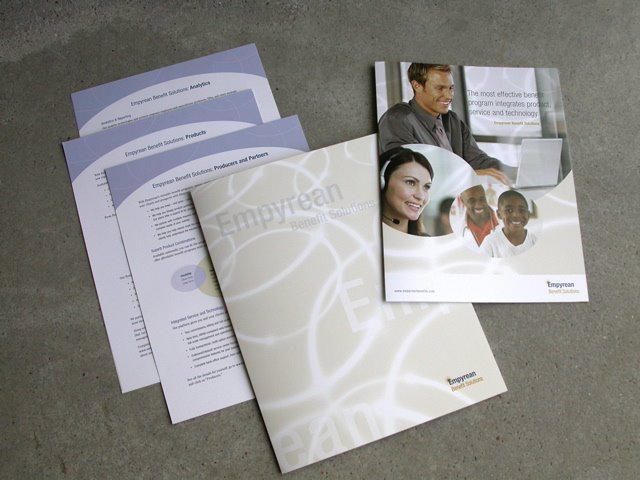 How do you transfer the vision of combining health benefit “products,” customer services and information technology to paper? You distill the convergence into words and graphics – like this new brochure set for Empyrean Benefit Solutions does.
Kathy Mackey, Empyrean’s Manager of Marketing Communications, wrote, “Thanks for creating the three-dimensional product, service, and technology idea. It has defined our company.”
Prism Design made it all look even better: a graphic concept capitalized on the overlapping nature of Empyrean’s interlocking implementation strategy. It brings an upscale look to the very crowded health benefits marketplace. At the same time, the design’s colors (corporate but warm) and sympathetic photos promote accessibility, whether you’re a broker, an HR manager or an employee.
Mackey continues, “Thank you and Prism Design for creating a perfect representation of Empyrean Benefit Solutions. The process of creating brochureware is not an easy task. We are delighted with the results. I value your experience, professionalism and dedication to the field.”
I worked tight with Empyrean to frame its vision in a discrete set of words. The company’s insistence that contemporary health benefits cannot be delivered cost-effectively except by information technologies is highlighted in these materials.
There’s no longer any real doubt that interactive health communication, patient-centric portals, online doctors’ visits, personalized disease management and wellness programs, individual education and web-enabled CRM will deliver cost and quality transparency to consumers – US healthcare has grown too complicated and too costly.
The Wall Street Journal is co-sponsoring a global forum about healthcare innovation and technology. The write-up is filled with jargon, like “Navigating the Information Age,” “eHealth and the Consumer Driven Movement” and “Patient Centric Approach.”
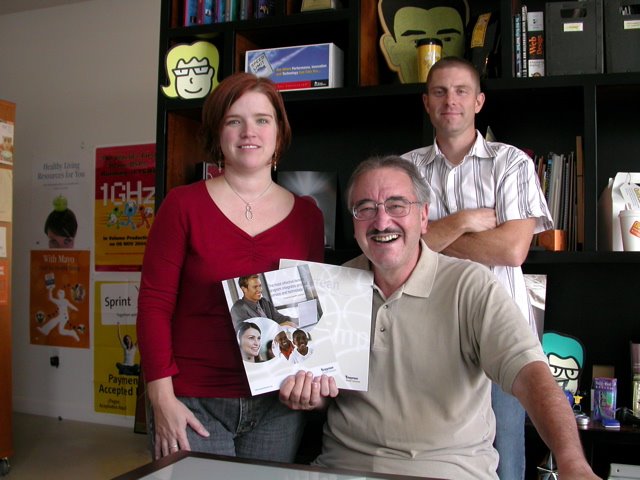 With Empyrean, we avoided the buzzwords. The brochureware has to speak to several audiences, including insurance brokers (now called producers), company and association benefits managers and individual consumers. We distilled the company’s message to simplify the presentation and raise its profile.
We also avoided a corporate slogan or tag line. It’s difficult enough to drive a new brand in today’s marketplace without extra baggage. I think the company’s name carries the message.
Simple is better than complex.
Bottom photo, standing: Anne Stovall, Designer & Terry Teutsch, Chief Designer, Prism Design, Inc. Seated: moi. Appreciation to the Empyrean Benefit Solutions team for perseverance and good words.
Friday, September 29, 2006
Instant Missionary
 Yesterday morning, before the AMA Houston Tech SIG seminar, I was e-mailing my client about an upcoming project. She replied instantly, “I’m still in Colombia, at Monserrate, 10330 ft above sea level and gasping.”
 I keyed in my message on the computer. She texted her reply from her Blackberry.
No road warrior will think this unusual these days. I didn’t think much about it myself – until about an hour-and-a-half later. One of the Tech SIG’s speakers, David Pulaski, opened up some new windows for me. Pulaski is the CEO of IMEinstein, a corporate name that’s just been adopted (and one of the more interesting brand identities I’ve noticed lately).
Part of his message yesterday morning is that companies should be using instant messaging – IM – far more than they already are.
He suggested that IM represents the next organized level of relationship marketing. Past marketing efforts represent Push: marketers and advertiser push their products, services and brands to their customers and prospect via traditional (and even non-traditional) methods. The present is represented by Search. Prospects search for vendors on the Internet.
The future, for Pulaski, is going to be composed of Presence-Based Communities in the form of desktop and mobile communications…not just to keep in touch, but to market and sell products and services by harnessing the mega-trend of the world’s largest instant messaging mechanisms. That means much more active and managed use of Yahoo!, AOL, MSN, Google Talk and other services to provide presence-based networking.
He urged us as marketers to find ways to add value to our prospects, in a way that includes us in his or her “community.” Well, I use this blog as a way to engage my community. But what if I’m in Colombia, 10,000 ft above sea level? I need more information. I need more toys.
The Tech SIG wanted to help us explore new technologies that present “marketers with unprecedented capabilities to reach their target audience in real-time, with messages tailored for that person and that moment. Instant messaging, cell phones, blogs and interactive websites enable us to engage our prospects in direct, person-to-person communications.”
Other speakers included Vui Le, President and CEO of Vuico, Inc.; and Jim Cahill and Deborah Franke of Emerson Process Management. All of them made dynamic presentations: Le about cellphone texting marketing opportunities and Cahill and Franke about corporate blogs. (You’ve read about Jim’s work with www.EmersonProcessXperts in previous posts.)
Pulaski tied IM into the real-world demands of corporate organizations – the management, the control, the measurement. You can access his Top Reasons to Use IM in the Enterprise here.
I’d like to get Pulaski to speak for himself about corporate use of IM, so watch this space. “Instant Messenger” is already an AOL trademark. He’s really more like an Instant Missionary.
Thanks to Geoff Webb at geoffw@futuresoft.com and Roberto Brunel at roberto_brunel@bmc.com for a great seminar. Graphic from Microsoft’s “10 tips for safer instant messaging,” here.
Tuesday, September 26, 2006
Pharma, RFID

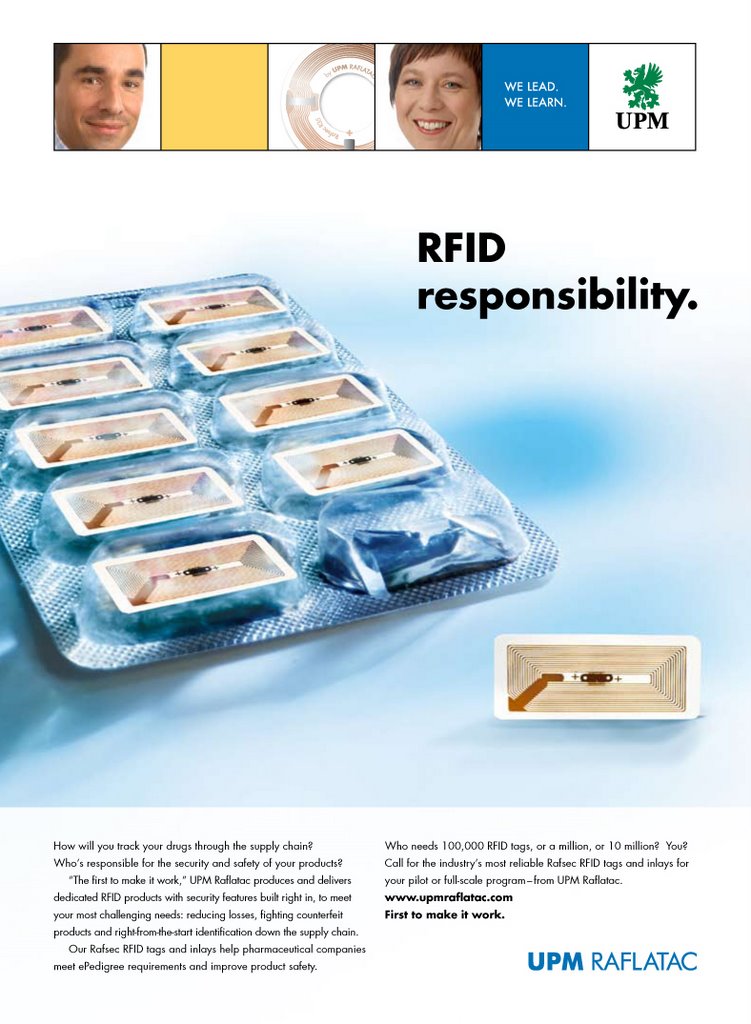 No, no: it’s not a “rural free delivery” address. RFID means radio frequency identification. For pharma, it’s a critical topic.
I can show off these new ads thanks to Konsepti in Helsinki. The great Finnish agency created the concept for its client, UPM Raflatac. I wrote the headlines and copy. The ads are running now in their first US magazine, Pharmaceutical & Medical Packaging News.
Konsepti’s Timo Kivi brought me in on the project for the US market. What he told me:
RFID in the pharmaceutical industry is already a common issue. Opportunities and benefits are well known among very important top officers. Legislation is driving the development and there are numerous ongoing pilots. However the technology standard (UHF or HF) has not been defined yet.
The most important drivers behind RFID in pharma are patient safety, counterfeiting, retailer mandates (Wal-Mart) and finally FDA recommendations to implement RFID.
[But] Pharma differs from other RFID applications. In other retail applications pallet-level tagging is enough at the moment. In pharma item-level tagging is needed from the very beginning. That means bigger volumes.
Both pharmaceutical manufacturers and packagers get their questions answered in our campaign.
We generated alliterative headlines like “RFID Relief,” RFID Responsibility” and “RFID Reliability.” Then every ad’s copy stresses the reliability of UPM Raflatac technology – plus the company’s ability to solve problems from flexible packaging options to big, big volumes, like in the millions-of-units.
The main copy points and the tag line, “First to make it work,” are based on the fact that UPM Raflatac tags have been the most reliable ones in many research reports.
Each ad execution follows the UPM Raflatac corporate graphic standards: you can see how the standards play out here.
I said “our” campaign. It’s really UPM Raflatac’s, and Konsepti’s. I got the chance to make a contribution in (for me) a growing market: healthcare and medical...via the technology door. And internationally, to boot.
For pdfs of these ads, drop me a note. I’ll send them along to you so you can read all the words.
Konsepti Oy is a member of Dialogue International. Big-time thanks to Minna Liukkonen [Art Director], Satu Yliskylä [Account Executive] and Timo Kivi [Account Director].
Tuesday, September 19, 2006
Pirate King
Arrr! I had to be reminded. Today is National Talk Like a Pirate Day.
No proper Pirate I – but ‘twas saved by the mental acuity of a good woman. (Julie Stastny deserves the thanks of a grateful nation.)
Read all about it here, me hearties! Meantime, sing the words from a lyricist who never ever talked like a pirate, but I thought it would make a good celebratory gesture for you all. All together now!
Oh, better far to live and die
Under the brave black flag I fly,
Than play a sanctimonious part,
With a pirate head and a pirate heart.
Away to the cheating world go you,
Where pirates all are well-to-do;
But I’ll be true to the song I sing,
And live and die a Pirate King.
For I am a Pirate King!
And it is, it is a glorious thing
To be a Pirate King!
For I am a Pirate King!
No proper Pirate I – but ‘twas saved by the mental acuity of a good woman. (Julie Stastny deserves the thanks of a grateful nation.)
Read all about it here, me hearties! Meantime, sing the words from a lyricist who never ever talked like a pirate, but I thought it would make a good celebratory gesture for you all. All together now!
Oh, better far to live and die
Under the brave black flag I fly,
Than play a sanctimonious part,
With a pirate head and a pirate heart.
Away to the cheating world go you,
Where pirates all are well-to-do;
But I’ll be true to the song I sing,
And live and die a Pirate King.
For I am a Pirate King!
And it is, it is a glorious thing
To be a Pirate King!
For I am a Pirate King!
W S Gilbert lyrics from Boise State University.
Saturday, September 16, 2006
Hispanic Assimilation
The study I referred to below is “Linguistic Life Expectancies: Immigrant Language Retention in Southern California,” by Rueben G. Rumbaut, Douglas S Massey and Frank D. Bean. It has appeared in this month’s Population and Development Review and it’s available as a PDF download here, or go to the Princeton University site.
Its first sentence: “Empirical research generally supports the view that Latin Americans in the United States assimilate linguistically.”
Although it has just been released, this paper is already having a major impact on public policy discussions (as I mentioned). It’s not as though the study’s authors – academics all – are trying to play into some anti-immigration agenda. Browsing among their credentials and writings doesn’t place them on the right of the political spectrum, but rather more on the left, IMO.
Rumbaut, Massey and Bean portray shifting ground here, since the study would seem to indicate that the “American Melting Pot” gets every immigrant group sooner or later. It doesn’t have an immediate effect on marketing or advertising to first- or second-generation Hispanic-Americans…right now. It does support learnings from other sources, though, that Hispanic-American kids are more likely to be reached in English – again, IMO.
The study also suggests that when you choose to market to Hispanics in the US, you should choose your demographics carefully, the same way you’re supposed to do it for any other marketing effort.
What do you think?
Its first sentence: “Empirical research generally supports the view that Latin Americans in the United States assimilate linguistically.”
Although it has just been released, this paper is already having a major impact on public policy discussions (as I mentioned). It’s not as though the study’s authors – academics all – are trying to play into some anti-immigration agenda. Browsing among their credentials and writings doesn’t place them on the right of the political spectrum, but rather more on the left, IMO.
Rumbaut, Massey and Bean portray shifting ground here, since the study would seem to indicate that the “American Melting Pot” gets every immigrant group sooner or later. It doesn’t have an immediate effect on marketing or advertising to first- or second-generation Hispanic-Americans…right now. It does support learnings from other sources, though, that Hispanic-American kids are more likely to be reached in English – again, IMO.
The study also suggests that when you choose to market to Hispanics in the US, you should choose your demographics carefully, the same way you’re supposed to do it for any other marketing effort.
What do you think?
Friday, September 15, 2006
El Grito
 ¡Mexicanos, viva México! Every year at midnight on September 15, Mexicans shout El Grito de Dolores.
This title is a pun in Spanish. Grito de Dolores can mean “The Shout from (the town of) Dolores” as well as “The Cry of Pain,” signifying the pain that the rule of Spain caused Mexico for three centuries.
Just before dawn on September 16, 1810, Miguel Hidalgo y Costilla made a decision that revolutionized the course of Mexican history.
A Catholic priest in the village of Dolores, Hidalgo ordered the arrest of Dolores’s native Spaniards. Then he rang the church bell as he usually did to call the Indians to mass.
The message that Hidalgo gave to the Indians and mestizos called them to retaliate against the hated gachupines or native Spaniards “who had been exploiting the wealth of the Mexican people with the greatest injustice for three hundred years.” Hidalgo’s fervent Grito was a passionate, unplanned decision.
Although a movement toward Mexican independence was already in progress since Napoleon’s conquest of Spain, Hidalgo urged the exploited and embittered Mexicans to recover the lands that were stolen from their forefathers. He called these people to revolution – a radical change in the original, more gradual plot devised by the criollos (Mexican-born Spaniards).
Hidalgo and El Grito spurred a long, violent social earthquake, almost without precedent in New Spain or the Americas: the Mexican War of Independence – a truly popular movement led by four hundred armed parish priests.
¡Mexicanos, viva México!
El Grito has particular significance today. First, Mexico is still roiled after its recent, contested presidential election. “Leftist protests forced Mexican President Vicente Fox to abandon plans to lead a traditional ceremony in the capital on Friday, the eve of independence day, the Interior Minister said.
“Fox, targeted by leftists angry at what they say was fraud at July's presidential election, will instead hold the highly-symbolic cry of independence in the central town of Dolores Hidalgo, minister Carlos Abascal told reporters on Thursday.”
Second, there’s the report from Princeton University and UC Irvine on Wednesday: “A few generations after families move to the United States from Latin American countries, fluency in Spanish dies out and English becomes the dominant language, according to a new paper published by sociology professors from New Jersey and California.” (See post above, Saturday, September 16.)
The report has raised its own ruckus…but not if you believe that America is really a melting pot (instead of a tossed salad). Almost 200 years after Padre Hidalgo in Dolores, El Grito still has meaning, still has force – it’s becoming part of our own national fabric as well as Mexico’s.
History inevitably connects us all. Better study it so you know what really moves people.
¡Mexicanas y Mexicanos, viva México!
Sources: the outstanding Mexico: Biography of Power by Enrique Krauze; Wikipedia; Reuters; International Herald Tribune. Illustration from www.redescolar.ilce.edu.mx.
Thursday, September 14, 2006
“Downsizing” Home
 This is “Downsizing at the Call Center” by Howard Sherman, mixed media on canvas. Now it’s been added it to the Baron collection. At 60” x 50” it is the largest piece we’ve every acquired.
Howard has said, “In my recent artwork, I have surged between abstraction and representation. More specifically, I have integrated biting comedy, social criticism, and gestural expressiveness.”
You want to see gestural expressiveness? You should have watched me trying to get this painting back to West Houston from The McMurtrey Gallery.
A surprising number of vehicles have a 48”-wide diagonal opening – I measured Barbara’s Prius, the neighbors’ Ford Explorer and a colleague’s SUV. Howard’s painting is 2” wider (wildly expressive gestures here). I was finally able to borrow the same neighbors’ giant Chevy pick-‘em-up.
If there is one thing more ridiculous than watching me drive a stick-shift reinforced half-ton across town and back, it’s showing up at a high-toned art gallery. And then bringing out the huge, contoured bed sheet with the daffodil pattern to use as a dust cover for the painting on the way home.
Roni McMurtrey was perfectly ladylike about the whole thing (achieved by ignoring the sheet altogether). Pick-up truck, sheet and painting finally rattled home. One of these objects will be hung once I get some picture hooks, etc.
The neighbors from whom I borrowed the pick-up are extra nice - we’ve known them a long time - but I could see they were baffled by the painting. (I can almost hear Debbie telling Joe, “If you ever bring that kind of thing into our house..!”)
Nevertheless, it’s here and I’m getting the hooks today (and possibly a derrick to lift it onto the wall). Pleased to have another Sherman. I have been standing in front of it and making…expressive gestures. Drop by and make your own.
Thanks and a tip of the Hatlo hat to the Houghtalings for “Rolling Thunder.”
Monday, September 11, 2006
Radio Mustang
 “I think the primary function of radio is that people want company.” Elise Nordling said this. She is a well-known indie radio music director and DJ who spoke at this year’s SXSW in Austin.
She could’ve been talking about the Mustang Engineering radio commercials that have just finished running in the Houston area.
This radio campaign has just galloped across the finish line with great success. You know a radio campaign is a success when the client tells you how many people heard the spots and how it helped generate a huge turnout at the company’s career open house: almost 1,000 people showed up.
You read the start of this story last April when I blogged about “The Mustang Experience.” This post is about how Mustang and I took that experience to the air.
Putting Mustang on the radio took some twists and turns. Can you “visualize” radio? We initially visualized the radio campaign as pure recruitment commercials – every firm in the oil patch trying to hire exactly the right kind of people to keep up with the growing demand for services. Radio commercials offered Mustang a much broader reach for prospective hires.
Our creative discussions turned more and more to brand advertising: what makes Mustang Engineering a unique company. Listeners would hear the same people who appeared in the OTC video: we would splice one individual Mustanger’s key comments from the audio track with a booth announcer in every spot.
As the spots turned from recruiting to brand, the announcer (another Mustanger, Chad Supan) would ask questions that related more to Mustang Engineering as a company rather than just a place to come to work.
When we finished more than a dozen 30s and 60s for two different radio stations, our intentions had merged. The reasons Mustang is a remarkable “brand” are the same ones that make Mustang a remarkable employer.
To paraphrase Nordling, radio worked for Mustang because people wanted to hear about this company. Mustangers themselves gave listeners company.
Real Mustang people asked and answered questions about the company. We created time-critical Career Open House spots at the same time, announcing the date and location of the function. We ran the Open House versions on both KODA-FM and KILT-AM up through the day of the career fair.
The Career Open House was also supported by print ads in the Houston Chronicle prior to the event.
An outstanding turnout at the company’s first-ever Mustang Engineering Career Open House was our first measure of success. There were between 800-1000 people who stopped by to see what Mustang is all about. According to the managers, there were some unexpectedly high-quality individuals in attendance (“...with at least 830 of them being potential candidates”) and Mustang anticipates adding 40-50 people from the event alone.
Our second success metric was the positive feedback Mustangers got from people who said they heard the spots on the radio – over and over again.
Again, a lot of people helped make the 30-second and 60-second commercial campaign a succes: Chad Supan, Allison Miller, Brian Hadley, Tina Kutach, David Williams and Heather Broeder: The “voices” of Mustang in our campaign.
Mustang’s Dena Lee, Sharon Paul and Mark Payton have always been 110% supportive of the work needed to get the spots on the air.
Hats off to Jim Spurlock of Spur Texas, our rock-solid producer, switching easily between the booth announcer and audio clips and combining them into seamless commercials.
And extra thanks to our media reps – professionals who hardly ever get credit but deserve it for their patience and their guidance: Denise Partridge (KODA-FM) and Julie Stastny (KILT-AM Sports 610).
Radio Mustang has been a broadcast campaign with the heart of a winner. I’m glad I had a role to play in it.
Tuesday, September 05, 2006
Hispanic Direct
 Coming late to the Hispanic market? The Selig Center for Economic Growth, at the University of Georgia, has just reported that in 2006 the purchasing power of the Hispanic market will match that of African-Americans. In 2007, Hispanics as a group will surpass all minorities.
At 12.4 percent, Latinos are the nation’s largest minority group, according to the US Census Bureau. It’s also the fastest-growing minority group, with economists predicting Latinos’ purchasing power will reach $1 trillion by 2008.
Jeff Humphreys, the Selig Center’s director, points out that Hispanics’ economic impact has risen from $212 billion when he started the assessments in 1990 and he expects it to be $1.2 trillion in another five years.
This “news” is not a surprise to marketing people who’ve been watching the growth of Hispanic-American communities and their buying power – even direct marketers. Despite the hindsighted nature of the Selig Center’s report, however, it’s causing some people to pose questions:
A broadcast producer and sports announcer in Omaha, Roy Coffman, recently asked, How is this going to change our Marketing and Advertising attitudes? Do we start paying a little more attention to Hispanic publications and broadcast media? Or do we simply continue down our familiar Yellow Brick Road?
We are seeing an ever-increasing number of Hispanic individuals moving into one section of the city. There they live, own their own businesses, shop in their own stores and their kids go to school, when they aren’t running back to Mexico to visit family members. Now how does the rest of the business community reach out to this demographic, or do we just sit back and watch? At least here in the Midwest this will be an ever-increasing question.
These questions have already been answered.
How and when? The facts have been staring most marketers in the face since at least the last census six years back. It’s not the “growing” Hispanic market that’s arresting – it’s already grown.
Marketers in Hispanic-Americans’ early, high-growth areas like California, Florida, New York, and Texas already know the right questions to ask, and have developed or adopted ways to reach these Hispanic markets, which are hardly monolithic.
Whether you come to it late or early, research has proven over and over again that Hispanics’ attitudes and feelings are currently based on different priorities than “mainstream” America – different cultural values that mean sales messages ought to be cast in different ways, in different voices. You have to think about communicating in someone else’s culture.
Meantime, is direct mail to Hispanics being overlooked?
I met Beatriz Mallory, CEO and chief strategist of New York agency HispanAmérica, when she spoke to an AMA group here in Houston last year. In Chief Marketer, she says, “I would say that the biggest misconception about the Hispanic market is that we don’t respond to direct marketing, that we don’t buy that way. But there’s plenty of evidence that we do. There’s client-based experience – [companies] like GE Consumer Finance have entire Hispanic marketing divisions set up to support [the] areas of their business [that] market direct to consumers.”
Today, in terms of direct mail or direct response marketing:
---The process of acculturation does influence Hispanic consumers’ perception of direct marketing. (Assimilation, however, is growing and that will affect the market’s future.)
---While most general market consumers dismiss direct marketing materials as “junk mail,” Hispanics (particularly recent immigrants) welcome it as a means of becoming a more informed consumer.
---Overall, Hispanic households are 3.5 times more likely to respond to a direct mail solicitation than non-Hispanic households.
---72% say they always read their mail, including direct marketing.
---60% of the direct mail sent to homes is in English.
---52% of the respondents speak only Spanish in their homes.
Companies like GE Consumer Finance, Kaiser Permanente and Reliant Energy have already been taking advantage of the statistics above and boosted their mailings to Hispanic households. So even if you can’t write in Spanish, you can aim for Hispanic markets. You need to have both an understanding of and practice in addressing Hispanic consumers’ wants and desires.
In the American here and now, direct mail to Hispanics is growing.
Thanks and a tip of the Hatlo hat to Direct Marketing Network, Houston, for the Reliant Energy direct mailer. Concept by Charles Eldred and Richard Laurence Baron.
Sunday, September 03, 2006
Simply…Simple
 Dear Ed: You asked, “if you run across a web site(s) that you particularly like, or that you think works with the copy you’ve written send it on over.” I can offer the one but not necessarily the other – perhaps it’s a start.
Barbara has been buying a couple of products called “Simply Orange Juice” and “Simply Lemonade” lately, from a company called Simply Orange Juice located near Apopka, FL. These are excellent products. As I usually do, I checked out the company; sometimes it’s a good thing to invest in companies whose products or services you really like.
You’ve probably heard of the products; they’ve been around for about five years.
I went to the company’s website. Ed, this demonstrates the kind of simplicity and elegance that I think would have a strong impact on your own brand thinking. I have been talking about maintaining a lot of white space. Simply Orange Juice does this very thing – but with the color orange. Orange is the white space.
Unlike some of the recent site samples you and I have reviewed, it is deceptive in its sophistication…and as you might expect, there’s a great deal more to the story than this apparently simple look.
First, Simply Orange Juice sounds small, but it’s actually a part of Coca-Cola. A story in The New York Times tells us that Coca-Cola created this brand to compete with Pepsi’s Tropicana Premium Pure line. Originally, it was supposed to be distributed through the company’s Minute Maid channels – but I don’t find a mention of the brand on the Minute Maid website. There have been a lot of changes at Coca-Cola North America. Simply Orange Juice appears on the Coke corporate site.
Second, there’s an fine write-up about the case from The General Center for Internet Services in Canada. You should read it. The case history points to some very clear issues that Sharpe Partners in New York City, the creators of the Simply Orange website, derived from research and addressed in the site’s design.
Marlena Schwarz, director of client strategy at Sharpe Partners, is quoted this way: “It’s a great example of how a marketer can build a website that is brand-appropriate as well as consumer-appropriate without having to spend $1 million, or even close to that. Forrester Research recently did a study asking consumers what they look for on packaged goods websites and then looked at what the sites are actually providing, and there is a disconnect going on.”
Among other things, the Forrester research indicated that consumers DID NOT want games, activities and “lifestyle” information…they want facts, free samples and special offers.
By cutting back on clutter and focusing purely on the “freshness” and “simplicity” of the brand, Simply Orange’s website pulls off what I think is a tour de force. Not so many bells and whistles. Not so many constant updates, or fighting to get the website to the tops of search engines.
I Googled “orange juice.” Simply Orange Juice has to settle for #7 on the first Google search engine page (Tropicana is #1) – so Coca-Cola is obviously doing extensive work behind the scenes to keep Simply Orange Juice right up there.
No, I don’t think this exact design style will work with the copy I wrote (unless we transform quite a bit of it into downloadable pdfs). Your brand is a business-to-business play. But I think that being guided by Simply Orange’s…simplicity…is a very good thing. And it may serve perfectly for your next brand concept.
Hats off to Sharpe Partners and Simply Orange Juice Company for an outstanding website.
Wednesday, August 30, 2006
“Business Development”
 I was just introduced to an articulate, fascinating man whose primary work is “business development.” What does that term mean? I asked. When his comments were boiled down, his view of business development involved some very detailed work on healthcare information technologies: IT.
Our conversation wasn’t a dialogue. In that time and place, two people were talking about different things. He was all about features.
My POV was benefits – what’s the value of the technologies for the consumer (whoever the consumer might be: patients, doctors, nurses, medical administrators, hospital managers)? There was no common frame for us, black versus white. Business development (or IT, in this case) versus marketing.
Maybe you’ve confronted this challenge before. I have, in my work for some clients. It’s worth re-examining it right now. Anthony Huang, Chairman of Techxans, said in a recent e-mail, “As the Texas market is thriving once more, the demand for information technology resources are again on the rise.” That’s a little formal, statement-wise; but there is a growing level of IT activism (again) all over the country, fueled by new government regulations covering everything from corporate governance to doctors’ prescriptions.
The painful disconnects between IT deliverables and marketing are once again a hot topic – especially if you’re one of the companies (or agencies) suffering from them.
Fortunately for us (IT business developers and marketers), this is a path that’s already been explored. I want to refer you to an excellent article in CIO Magazine, by Lee Pender. Even though it appeared five years ago, in June of the Year 1, it is still relevant – and the cases it highlights are still apt.
Pender made some major points:
1. Gung ho salespeople make deals that IT can’t support. Marketing professionals want sexy new features installed on their companies’ web pages immediately. Companies lose deals because marketing's glossy image doesn't always accurately represent IT’s back-end capabilities. And IT professionals don’t always have the communication skills or clout in their company to withstand marketing’s demands.
2. As technology becomes more and more central to the operation of many companies, it is increasingly imperative that IT and marketing heal this longstanding rift.
3. The root of the problem is that CIOs and marketers have strikingly different job mandates and personalities. Marketers think about opportunities: raking in revenue with new accounts, promising new and more exciting services, dreaming up bold new images for the company. CIOs, by contrast, constantly deal with limitations: a nagging lack of IT resources, financial barriers to implementation of new systems, the frequent need to sacrifice exciting new projects in order to keep legacy systems up and running.
Pender included solutions-by-example, with stories from companies like Northrop Grumman, MCI and Thomson Multimedia. After five years, it’s more than likely that the people have changed jobs and the companies have certainly changed too.
The “how-to” of solving the IT development/marketing interface problem is just as valid here and now as it was in 2001.
“Oh,” you say, “our situation is completely different.” Is it? Are you (and I) condemned to repeat mistakes because we haven’t learned from our predecessors? I don’t think so.
IT can bring more pieces to the game than ever before. I suggest to clients that their IT people need to be involved with marketing plans; that Marketing people needs to talk with their IT departments to make sure they can deliver what we’re creating in terms of new sales channels; that we make a team effort out of the project. Everybody plays on the same board.
That way, “business development” is made whole – everybody benefits.
Saturday, August 26, 2006
Elderberry Syrup
 The bare facts are these. Barbara has been cleaning and rearranging the kitchen cupboards. She discovered a cache of fruit syrups put up by her sister, Stephanie Murphy, and given to us as Christmas gifts. In 1991.
I just tried the 15-year-old elderberry syrup on waffles. Not only is the elderberry syrup outstanding, it has turned into a liqueur. [See Note 3, below.] So I used more elderberry syrup on my waffles. And more. It’s outstanding! For somebody from Minnesota, however, such straightforward praise is a little over the top.
So it seems appropriate to try translating this series of events into Minnesotan*. Follow along closely so you don’t miss the action.
Barbara: “Hey, hon, look what I found?
Richard: “What is it, then?”
B: “Steph’s elderberry syrup. Don’t know how long it’s been back there. Kinda funny what gets pushed into the back of the shelf, doncha know?”
R: “It says ‘elderberry syrup’ right there on the label, sure enough.”
B: (removing the obligatory scrap of decorative cloth on the Mason jar’s lid.) Will you look at this. Steph put this up in 1991.”
R. “That’s different.”
B. “Wonder if it’s still good?”
R. “Well, if a guy was to try it, maybe he’d find out whether it’s still okay or not.”
[Note 1: The elderberry syrup was NOT found during breakfast. Even though we now live in Texas, one of us still follows “Minnesota Rules” during breakfast time, mostly: You get up and sit in your bathrobe and stare until the coffee is done. Maybe you have a doughnut with your second cup. When the other members of your household wander in, you don’t speak unless spoken to.† Barbara would never have discovered Steph’s syrup during breakfast – it’s just not done. Back to our story.]
B. “You don’t have to do that.”
R. “It’s no problem. I was going to have waffles anyway.”
B. “No, I wouldn’t want to put you out. I’ll just open it up and see – it’s probably gone off or something.”
R. “You don’t have to go and do that. I’m going to have the waffles…may as well try a spoonful, just to see if it’s any good – not that Steph doesn’t make great syrup.”
B. “Well, if you’re going to do it, let me just pry off that lid. Seems a little stuck.” (She does so, using a ‘church key’ imprinted with the logo of the 1981 Bemidji, Minnesota, Wild Rice Pageant and pouring the syrup into a bottle.) “There you go.”
R. (Pours some syrup over his waffles. Takes a bite.)
B. “Well, how is it, then?”
R. “Seems kinda different, you know? In a good way, though.” (Takes a few more bites of the waffles.) “A guy could maybe get to like this.”
B. “You thinking about trying some more?”
R. “I don’t need it, really. But hey, as long as the bottle’s right there, maybe I could have just a little more of it.”
B. “I guess it’s the least you can do, seeing that Steph went to the trouble of making it.”
R. (Pouring about half the bottle over the remains of the waffles.) “Yeah, well, boy!”
B. “I guess it’s okay, then?”
R. “It sure beats some of that other stuff we been paying 20 bucks a bottle for down at Spec’s.”
[Note 2: Spec’s is a Houston institution, an immense liquor store that has about a thousand different wines, whiskeys, beers and liqueurs – not the kind of exotic retailer you’d ever find in Minnesota, whose inhabitants are suspicious of excess.]
B. “Well, that’s a keeper, then?”
R. “Not to bad a deal, really. Kind of a shame it’s gone, mostly.”
B. “There’s another jar here with the same date on top, only it’s strawberry.”
R. “Heckuva deal.”
[Note 3: In 2006, an elderberry liqueur with 17% alcohol won a Silver in the Great Taste Award run by the Guild of Fine Food Retailers. These awards are regarded as the “Oscars” of the fine food world and recognize the exceptional standard of food and drink available in Britain, which is somewhere over thataway with people who kind of sound just like Minnesotans, only different.]
B. “What are you going to do for the rest of the morning, hon?”
R. “Think I’ll go out back and cast for some walleyes.”
B. “Are you all right, Richard? I can’t recall there’s ever been any fish in our swimming pool.”
R. “Whatever.”
*We moved to Houston in ’84, so it has been quite a long time since I spoke Minnesotan. I used a book by Howard Mohr called How To Talk Minnesotan: A Visitor’s Guide as a kind of a reference guide. It’s about 20 years old now and I guess it’s a pretty good book, thought Barbara doesn’t find it nearly as funny as I do. But that’s because I was never a real Minnesotan in the first place. Maybe you’d like it, or not.
†This part is an exact quote from Mr. Mohr’s book. I wouldn’t want him to think I was trying to get away with anything here. He might still be alive.
Photograph © 2000 Rosie Lerner, Purdue University.
Subscribe to:
Posts (Atom)

