Monday, September 11, 2006

Radio Mustang

“I think the primary function of radio is that people want company.” Elise Nordling said this. She is a well-known indie radio music director and DJ who spoke at this year’s SXSW in Austin.

She could’ve been talking about the Mustang Engineering radio commercials that have just finished running in the Houston area.

This radio campaign has just galloped across the finish line with great success. You know a radio campaign is a success when the client tells you how many people heard the spots and how it helped generate a huge turnout at the company’s career open house: almost 1,000 people showed up.

You read the start of this story last April when I blogged about “The Mustang Experience.” This post is about how Mustang and I took that experience to the air.

Putting Mustang on the radio took some twists and turns. Can you “visualize” radio? We initially visualized the radio campaign as pure recruitment commercials – every firm in the oil patch trying to hire exactly the right kind of people to keep up with the growing demand for services. Radio commercials offered Mustang a much broader reach for prospective hires.

Our creative discussions turned more and more to brand advertising: what makes Mustang Engineering a unique company. Listeners would hear the same people who appeared in the OTC video: we would splice one individual Mustanger’s key comments from the audio track with a booth announcer in every spot.

As the spots turned from recruiting to brand, the announcer (another Mustanger, Chad Supan) would ask questions that related more to Mustang Engineering as a company rather than just a place to come to work.

When we finished more than a dozen 30s and 60s for two different radio stations, our intentions had merged. The reasons Mustang is a remarkable “brand” are the same ones that make Mustang a remarkable employer.

To paraphrase Nordling, radio worked for Mustang because people wanted to hear about this company. Mustangers themselves gave listeners company.

Real Mustang people asked and answered questions about the company. We created time-critical Career Open House spots at the same time, announcing the date and location of the function. We ran the Open House versions on both KODA-FM and KILT-AM up through the day of the career fair.

The Career Open House was also supported by print ads in the Houston Chronicle prior to the event.

An outstanding turnout at the company’s first-ever Mustang Engineering Career Open House was our first measure of success. There were between 800-1000 people who stopped by to see what Mustang is all about. According to the managers, there were some unexpectedly high-quality individuals in attendance (“...with at least 830 of them being potential candidates”) and Mustang anticipates adding 40-50 people from the event alone.

Our second success metric was the positive feedback Mustangers got from people who said they heard the spots on the radio – over and over again.

Again, a lot of people helped make the 30-second and 60-second commercial campaign a succes: Chad Supan, Allison Miller, Brian Hadley, Tina Kutach, David Williams and Heather Broeder: The “voices” of Mustang in our campaign.

Mustang’s Dena Lee, Sharon Paul and Mark Payton have always been 110% supportive of the work needed to get the spots on the air.

Hats off to Jim Spurlock of Spur Texas, our rock-solid producer, switching easily between the booth announcer and audio clips and combining them into seamless commercials.

And extra thanks to our media reps – professionals who hardly ever get credit but deserve it for their patience and their guidance: Denise Partridge (KODA-FM) and Julie Stastny (KILT-AM Sports 610).

Radio Mustang has been a broadcast campaign with the heart of a winner. I’m glad I had a role to play in it.

Tuesday, September 05, 2006

Hispanic Direct

Coming late to the Hispanic market? The Selig Center for Economic Growth, at the University of Georgia, has just reported that in 2006 the purchasing power of the Hispanic market will match that of African-Americans. In 2007, Hispanics as a group will surpass all minorities.

At 12.4 percent, Latinos are the nation’s largest minority group, according to the US Census Bureau. It’s also the fastest-growing minority group, with economists predicting Latinos’ purchasing power will reach $1 trillion by 2008.

Jeff Humphreys, the Selig Center’s director, points out that Hispanics’ economic impact has risen from $212 billion when he started the assessments in 1990 and he expects it to be $1.2 trillion in another five years.

This “news” is not a surprise to marketing people who’ve been watching the growth of Hispanic-American communities and their buying power – even direct marketers. Despite the hindsighted nature of the Selig Center’s report, however, it’s causing some people to pose questions:

A broadcast producer and sports announcer in Omaha, Roy Coffman, recently asked, How is this going to change our Marketing and Advertising attitudes? Do we start paying a little more attention to Hispanic publications and broadcast media? Or do we simply continue down our familiar Yellow Brick Road?

We are seeing an ever-increasing number of Hispanic individuals moving into one section of the city. There they live, own their own businesses, shop in their own stores and their kids go to school, when they aren’t running back to Mexico to visit family members. Now how does the rest of the business community reach out to this demographic, or do we just sit back and watch? At least here in the Midwest this will be an ever-increasing question.

These questions have already been answered.

How and when? The facts have been staring most marketers in the face since at least the last census six years back. It’s not the “growing” Hispanic market that’s arresting – it’s already grown.

Marketers in Hispanic-Americans’ early, high-growth areas like California, Florida, New York, and Texas already know the right questions to ask, and have developed or adopted ways to reach these Hispanic markets, which are hardly monolithic.

Whether you come to it late or early, research has proven over and over again that Hispanics’ attitudes and feelings are currently based on different priorities than “mainstream” America – different cultural values that mean sales messages ought to be cast in different ways, in different voices. You have to think about communicating in someone else’s culture.

Meantime, is direct mail to Hispanics being overlooked?

I met Beatriz Mallory, CEO and chief strategist of New York agency HispanAmérica, when she spoke to an AMA group here in Houston last year. In Chief Marketer, she says, “I would say that the biggest misconception about the Hispanic market is that we don’t respond to direct marketing, that we don’t buy that way. But there’s plenty of evidence that we do. There’s client-based experience – [companies] like GE Consumer Finance have entire Hispanic marketing divisions set up to support [the] areas of their business [that] market direct to consumers.”

Today, in terms of direct mail or direct response marketing:
---The process of acculturation does influence Hispanic consumers’ perception of direct marketing. (Assimilation, however, is growing and that will affect the market’s future.)
---While most general market consumers dismiss direct marketing materials as “junk mail,” Hispanics (particularly recent immigrants) welcome it as a means of becoming a more informed consumer.
---Overall, Hispanic households are 3.5 times more likely to respond to a direct mail solicitation than non-Hispanic households.
---72% say they always read their mail, including direct marketing.
---60% of the direct mail sent to homes is in English.
---52% of the respondents speak only Spanish in their homes.

Companies like GE Consumer Finance, Kaiser Permanente and Reliant Energy have already been taking advantage of the statistics above and boosted their mailings to Hispanic households. So even if you can’t write in Spanish, you can aim for Hispanic markets. You need to have both an understanding of and practice in addressing Hispanic consumers’ wants and desires.

In the American here and now, direct mail to Hispanics is growing.

Thanks and a tip of the Hatlo hat to Direct Marketing Network, Houston, for the Reliant Energy direct mailer. Concept by Charles Eldred and Richard Laurence Baron.

Sunday, September 03, 2006

Simply…Simple

Dear Ed: You asked, “if you run across a web site(s) that you particularly like, or that you think works with the copy you’ve written send it on over.” I can offer the one but not necessarily the other – perhaps it’s a start.

Barbara has been buying a couple of products called “Simply Orange Juice” and “Simply Lemonade” lately, from a company called Simply Orange Juice located near Apopka, FL. These are excellent products. As I usually do, I checked out the company; sometimes it’s a good thing to invest in companies whose products or services you really like.

You’ve probably heard of the products; they’ve been around for about five years.

I went to the company’s website. Ed, this demonstrates the kind of simplicity and elegance that I think would have a strong impact on your own brand thinking. I have been talking about maintaining a lot of white space. Simply Orange Juice does this very thing – but with the color orange. Orange is the white space.


Unlike some of the recent site samples you and I have reviewed, it is deceptive in its sophistication…and as you might expect, there’s a great deal more to the story than this apparently simple look.

First, Simply Orange Juice sounds small, but it’s actually a part of Coca-Cola. A story in The New York Times tells us that Coca-Cola created this brand to compete with Pepsi’s Tropicana Premium Pure line. Originally, it was supposed to be distributed through the company’s Minute Maid channels – but I don’t find a mention of the brand on the Minute Maid website. There have been a lot of changes at Coca-Cola North America. Simply Orange Juice appears on the Coke corporate site.

Second, there’s an fine write-up about the case from The General Center for Internet Services in Canada. You should read it. The case history points to some very clear issues that Sharpe Partners in New York City, the creators of the Simply Orange website, derived from research and addressed in the site’s design.

Marlena Schwarz, director of client strategy at Sharpe Partners, is quoted this way: “It’s a great example of how a marketer can build a website that is brand-appropriate as well as consumer-appropriate without having to spend $1 million, or even close to that. Forrester Research recently did a study asking consumers what they look for on packaged goods websites and then looked at what the sites are actually providing, and there is a disconnect going on.”

Among other things, the Forrester research indicated that consumers DID NOT want games, activities and “lifestyle” information…they want facts, free samples and special offers.

By cutting back on clutter and focusing purely on the “freshness” and “simplicity” of the brand, Simply Orange’s website pulls off what I think is a tour de force. Not so many bells and whistles. Not so many constant updates, or fighting to get the website to the tops of search engines.

I Googled “orange juice.” Simply Orange Juice has to settle for #7 on the first Google search engine page (Tropicana is #1) – so Coca-Cola is obviously doing extensive work behind the scenes to keep Simply Orange Juice right up there.

No, I don’t think this exact design style will work with the copy I wrote (unless we transform quite a bit of it into downloadable pdfs). Your brand is a business-to-business play. But I think that being guided by Simply Orange’s…simplicity…is a very good thing. And it may serve perfectly for your next brand concept.

Hats off to Sharpe Partners and Simply Orange Juice Company for an outstanding website.

Wednesday, August 30, 2006

“Business Development”

I was just introduced to an articulate, fascinating man whose primary work is “business development.” What does that term mean? I asked. When his comments were boiled down, his view of business development involved some very detailed work on healthcare information technologies: IT.

Our conversation wasn’t a dialogue. In that time and place, two people were talking about different things. He was all about features.

My POV was benefits – what’s the value of the technologies for the consumer (whoever the consumer might be: patients, doctors, nurses, medical administrators, hospital managers)? There was no common frame for us, black versus white. Business development (or IT, in this case) versus marketing.

Maybe you’ve confronted this challenge before. I have, in my work for some clients. It’s worth re-examining it right now. Anthony Huang, Chairman of Techxans, said in a recent e-mail, “As the Texas market is thriving once more, the demand for information technology resources are again on the rise.” That’s a little formal, statement-wise; but there is a growing level of IT activism (again) all over the country, fueled by new government regulations covering everything from corporate governance to doctors’ prescriptions.

The painful disconnects between IT deliverables and marketing are once again a hot topic – especially if you’re one of the companies (or agencies) suffering from them.

Fortunately for us (IT business developers and marketers), this is a path that’s already been explored. I want to refer you to an excellent article in CIO Magazine, by Lee Pender. Even though it appeared five years ago, in June of the Year 1, it is still relevant – and the cases it highlights are still apt.

Pender made some major points:

1. Gung ho salespeople make deals that IT can’t support. Marketing professionals want sexy new features installed on their companies’ web pages immediately. Companies lose deals because marketing's glossy image doesn't always accurately represent IT’s back-end capabilities. And IT professionals don’t always have the communication skills or clout in their company to withstand marketing’s demands.


2. As technology becomes more and more central to the operation of many companies, it is increasingly imperative that IT and marketing heal this longstanding rift.

3. The root of the problem is that CIOs and marketers have strikingly different job mandates and personalities. Marketers think about opportunities: raking in revenue with new accounts, promising new and more exciting services, dreaming up bold new images for the company. CIOs, by contrast, constantly deal with limitations: a nagging lack of IT resources, financial barriers to implementation of new systems, the frequent need to sacrifice exciting new projects in order to keep legacy systems up and running.

Pender included solutions-by-example, with stories from companies like Northrop Grumman, MCI and Thomson Multimedia. After five years, it’s more than likely that the people have changed jobs and the companies have certainly changed too.

The “how-to” of solving the IT development/marketing interface problem is just as valid here and now as it was in 2001.

“Oh,” you say, “our situation is completely different.” Is it? Are you (and I) condemned to repeat mistakes because we haven’t learned from our predecessors? I don’t think so.

IT can bring more pieces to the game than ever before. I suggest to clients that their IT people need to be involved with marketing plans; that Marketing people needs to talk with their IT departments to make sure they can deliver what we’re creating in terms of new sales channels; that we make a team effort out of the project. Everybody plays on the same board.

That way, “business development” is made whole – everybody benefits.

Saturday, August 26, 2006

Elderberry Syrup

The bare facts are these. Barbara has been cleaning and rearranging the kitchen cupboards. She discovered a cache of fruit syrups put up by her sister, Stephanie Murphy, and given to us as Christmas gifts. In 1991.

I just tried the 15-year-old elderberry syrup on waffles. Not only is the elderberry syrup outstanding, it has turned into a liqueur. [See Note 3, below.] So I used more elderberry syrup on my waffles. And more. It’s outstanding! For somebody from Minnesota, however, such straightforward praise is a little over the top.

So it seems appropriate to try translating this series of events into Minnesotan*. Follow along closely so you don’t miss the action.

Barbara: “Hey, hon, look what I found?

Richard: “What is it, then?”

B: “Steph’s elderberry syrup. Don’t know how long it’s been back there. Kinda funny what gets pushed into the back of the shelf, doncha know?”

R: “It says ‘elderberry syrup’ right there on the label, sure enough.”

B: (removing the obligatory scrap of decorative cloth on the Mason jar’s lid.) Will you look at this. Steph put this up in 1991.”

R. “That’s different.”

B. “Wonder if it’s still good?”

R. “Well, if a guy was to try it, maybe he’d find out whether it’s still okay or not.”

[Note 1: The elderberry syrup was NOT found during breakfast. Even though we now live in Texas, one of us still follows “Minnesota Rules” during breakfast time, mostly: You get up and sit in your bathrobe and stare until the coffee is done. Maybe you have a doughnut with your second cup. When the other members of your household wander in, you don’t speak unless spoken to.† Barbara would never have discovered Steph’s syrup during breakfast – it’s just not done. Back to our story.]

B. “You don’t have to do that.”

R. “It’s no problem. I was going to have waffles anyway.”

B. “No, I wouldn’t want to put you out. I’ll just open it up and see – it’s probably gone off or something.”

R. “You don’t have to go and do that. I’m going to have the waffles…may as well try a spoonful, just to see if it’s any good – not that Steph doesn’t make great syrup.”

B. “Well, if you’re going to do it, let me just pry off that lid. Seems a little stuck.” (She does so, using a ‘church key’ imprinted with the logo of the 1981 Bemidji, Minnesota, Wild Rice Pageant and pouring the syrup into a bottle.) “There you go.”

R. (Pours some syrup over his waffles. Takes a bite.)

B. “Well, how is it, then?”

R. “Seems kinda different, you know? In a good way, though.” (Takes a few more bites of the waffles.) “A guy could maybe get to like this.”

B. “You thinking about trying some more?”

R. “I don’t need it, really. But hey, as long as the bottle’s right there, maybe I could have just a little more of it.”

B. “I guess it’s the least you can do, seeing that Steph went to the trouble of making it.”

R. (Pouring about half the bottle over the remains of the waffles.) “Yeah, well, boy!”

B. “I guess it’s okay, then?”

R. “It sure beats some of that other stuff we been paying 20 bucks a bottle for down at Spec’s.”

[Note 2: Spec’s is a Houston institution, an immense liquor store that has about a thousand different wines, whiskeys, beers and liqueurs – not the kind of exotic retailer you’d ever find in Minnesota, whose inhabitants are suspicious of excess.]

B. “Well, that’s a keeper, then?”

R. “Not to bad a deal, really. Kind of a shame it’s gone, mostly.”

B. “There’s another jar here with the same date on top, only it’s strawberry.”

R. “Heckuva deal.”

[Note 3: In 2006, an elderberry liqueur with 17% alcohol won a Silver in the Great Taste Award run by the Guild of Fine Food Retailers. These awards are regarded as the “Oscars” of the fine food world and recognize the exceptional standard of food and drink available in Britain, which is somewhere over thataway with people who kind of sound just like Minnesotans, only different.]

B. “What are you going to do for the rest of the morning, hon?”

R. “Think I’ll go out back and cast for some walleyes.”

B. “Are you all right, Richard? I can’t recall there’s ever been any fish in our swimming pool.”

R. “Whatever.”

*We moved to Houston in ’84, so it has been quite a long time since I spoke Minnesotan. I used a book by Howard Mohr called How To Talk Minnesotan: A Visitor’s Guide as a kind of a reference guide. It’s about 20 years old now and I guess it’s a pretty good book, thought Barbara doesn’t find it nearly as funny as I do. But that’s because I was never a real Minnesotan in the first place. Maybe you’d like it, or not.

†This part is an exact quote from Mr. Mohr’s book. I wouldn’t want him to think I was trying to get away with anything here. He might still be alive.

Photograph © 2000 Rosie Lerner, Purdue University.

Thursday, August 24, 2006

F Minus

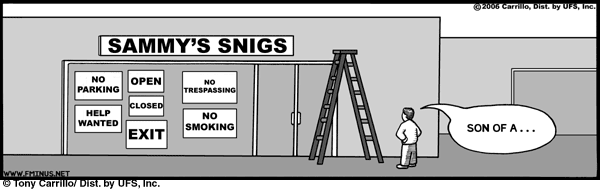
The ladder. That’s what I noticed about this cartoon strip from Tony Carrillo. “F Minus” has been picked up by the Houston Chronicle recently – United Media just syndicated the strip this past April.

I enjoy it. Minimalist and funny. But here the cartoonist’s blatant disregard for the basics of workplace safety…well, it’s shocking. Shocking.

A major consumer organization, which must remain nameless because of its rigorous and heavily enforced policy of complete independence, issued a compelling review of ladders in its magazine: the September 2006 number, pages 42-44. Clearly, Carrillo’s ladder wouldn’t meet the standard of the American National Standards Institute (ANSI). No spreaders. Of course, the article quotes a leading ladder expert who said that side-stability tests haven’t been substantially updated for more than 25 years.

The standard is older than the cartoonist.

Then there’s the American Ladder Institute; don’t get me started about it. It claims there’s a revised ANSI 14 Standard available. You should download its “Ladder Safety & Education” single-sheet here right away.

Today’s CONSUMER WARNING: Don’t let Carrillo’s image of the ladder lead you astray. At least follow the consumer organization’s three how-to-choose steps:

1. Look beyond the label.
2. Consider the material.
3. Try before buying.

Oh, yeah: the artist misspelled the word “Signs.” Maybe that’s his idea of a gag. Humph!

Strip ©Tony Carrillo/Distributed by UFS, Inc. Please, Mr. Carrillo, don't take it out on me.

Monday, August 21, 2006

AKBank Ad

Watch this TV commercial for AKBank in Turkey. It’s called “Akbank Türkiye’nin Yenilikçi Gücü” and it’s terrific: must-see advertising.

Stop reading for a minute and go to the bank’s website; click on the picture from the commercial (or try this), and run the commercial for yourself.

The commercial’s in Turkish. Normally, that’d be a problem for me. But first, AKBank has an English version of its website. It’s clear the bank is committed to supporting the growth of Turkey and Turkish business…particularly the technology sectors…and you can get this conceptually from the outstanding commercial without understanding a word of the language.

Fortunately, Renan Tavukcuođlu explained it all to me. The “back story” is always the extra added attraction. Renan is Stratejik Planlama at Oyku, our Dialogue International affiliate in Turkey.

He told me that the objective of the commercial was not to bring in new AKBank customers, but a work of image with great messages. It’s a brand spot. Renan gave me the translation of the Turkish titles:

To grow
To be innovative
To support
To give energy
To be creative
To move forward
For Turkey
To grow and to help you grow

He added these additional notes:
...The TV spot aired during World Cup 2006

...It enjoyed great success in terms of repeat views
...150 South African dancers took part
...It was shot in South Africa in five days
...The music (which played a major role in success) is by Ömer Ahunbay
...Penny Jones, creator of the opening ceremony of the Olympic games, made the preparations for the shoot.

Its music aired on radios and everybody knew what commercial it was. The campaign used all media (print, outdoor, etc.) during World Cup 2006 and now it’s over.

You can still watch it on the bank’s website. See some innovation and energy – and pure visual fun – from the Turkish advertising industry.

Many thanks to my colleagues at Oyku in Instanbul and Ankara.

Saturday, August 19, 2006

New Above

What’s in your attic? In ours, it’s a new Ruud 5-ton furnace, complete with fan drive. (This is the important bit - read on.) About 8.30 Wednesday night, the air conditioning system gave a mortal groan…and stopped. Our a/c went u/s…out of service. Kaput. Joined the Choir Invisible.

Thursday here it was 105°F. For two days, the temperature in the house rose in direct proportion to the day’s heat index and beyond. On Friday afternoon, it was actually cooler outside than inside.

Makes you wonder how William Faulkner actually got any writing done, back in the drip-sweat-on-the-paper days before home air conditioning. I didn’t, much; which is probably why I’m a somewhat-known ad-guy instead of a famous novelist.

Fortunately, our long-time HVAC service company, Sun Air Conditioning & Heating, came out on Thursday afternoon. Unfortunately, after a lot of banging about, Richard Socha (the Sun service tech) made his way down our rickety ladder bearing an immense double-shafted electric motor with two blowers attached. Further unfortunately, the manufacturer of this particular apparatus itself went belly up about five years ago. Replacement unit not available. We were double-shafted ourselves.

Thursday evening was not comfortable. It took three Martinis to get me into a soaking sleep. But the Sun team came out again on Friday with our new upstairs thing. It took three of them to hoist the thing up into the attic. And by 5P, we were back in business. In my case, you should take that literally.

Thursday and Friday were the times that try men’s souls. Barbara wasn’t too happy either. And yes, it took a certain level of…investment…to get ourselves back into the comfort zone.

Thanks to Sun, we're once again the height of cool. A good thing, too: above 100°F, photographic film (remember that?) turns reddish. The coatings of pills melt. The energy starts to drain from batteries. Barbara glows. Richard sweats all over the keyboard. That’s just plain Ruud.

Photo of a completely different but decorative piece of machinery by Sten Porse, Jutland, from www.commons.wikimedia.org. With thanks.

Wednesday, August 16, 2006

About Kin

The moderator of the AdRants section of SoFlow asked a question that generated more than 50 responses. The question was, “Is it fun being you?” My answer (short form): “Yes.” Part of the fun is the people I know. Part of the fun is thinking about the people I know. Which generated the lines below – the porch is in Atlanta and belongs to Bob and Edith Fusillo.

Fourteen Lines About Kin

Locusts sing in the daytime.
They sit in the sun and fiddle madly
Knowing that their lives are short.
They don’t care.
It’s their song in the sun.

Cicadas sing at night.
Can’t you hear them when the breeze is still
And the pines are tall and dark?
They don’t care.
It’s their song in your sleep.

Locusts sing in the daytime,
Cicadas sing at night,
Edith told us sitting on her porch.
“One touch of nature makes the whole world kin.”

Copyright © 2006 by Richard Laurence Baron. May Shakespeare forgive me.

Monday, August 14, 2006

Nucor Ads

A small note in today’s Business Section pointed out that Nucor (NYSE: NUE), the steel company, had just announced outstanding quarterly results – 21% revenue growth and a 40% rise in operating income. Superb numbers from what’s supposed to be a “dead” industry here in the US.

It also reminded me of Nucor’s fine ad campaign, which should be filed under “ads I wish I’d done.”


The ad agency, though, is Eric Mower & Associates Group B2B, an outstanding shop with a great track record. You can see the whole portfolio of Nucor ads here. The campaign’s been featured in the September, 2005, issue of US Ad Review. Just as important, the ads’ look and feel have been carried over to Nucor’s website and other materials.

You know it’s hard to connect business results with advertising, especially in industrial categories. But the industry, at least, has noticed: Traci Purdum bylined an article in Industry Week a few months back that specifically highlighted the ties between Nucor’s advertising claims and Nucor’s performance. The same ad campaign has to have had its effects on investors in this industry segment as well.

Give Mower and Nucor a big round of applause for bringing (and sustaining) a fresh look in an “old economy” industry. Can you say the same for your advertising?

Nucor ad from www.mower.com, with thanks.

Thursday, August 10, 2006

Inventor Dies

James A. Van Allen, 91, who invented the famous white belt that made the polyester leisure suit the hallmark of the early ‘70s, has died after a heart attack August 9 at a hospital in Iowa.

Van Allen’s creation actually allowed the leisure suit to reach its fullest potential, the Full Cleveland. As one commentator has noted, “…your basic 70s traveling salesman stereotypical getup [included a] brightly-colored polyester leisure suit, shiny white belt and shoes, clashing colors...”

Mild and unassuming, the inventor/scientist was always secretly disappointed that he did not get credit for his fashion statement. He had to settle for his fame as the discoverer of the Earth-circling radiation belts that bear his name. He also sent spacecraft instruments to observe the outer reaches of the solar system. Far better known as an early pioneer in US space exploration, his obituary is here.

Photo from www.illawarrabowlsshop.com.au with thanks.


Tuesday, August 08, 2006

Markus Natri

When Dialogue International had its first Managers Meeting in Helsinki, Finland, years ago, that’s when I met Markus Natri. We sailed across to Suomenlinna Island and Fortress, where the Finns introduced us to the world’s largest sauna (originally designed to contain a Finnish Army infantry platoon). The idea: get all these agency managers into the sauna, let them wrap themselves up in sheets, then run ‘em down to the rocky shoreline and push the lot into the Baltic.

Truth: even in June, the Baltic is bloody freezing, breath-stopping cold. The Finns got a big yuk out of that. I think I was brave enough to do it once. Karl Woerlen, CEO of WWW (our German member agency in those days) did it three times – one tough guy.

The entire gang (which included Barbara and Rachel) warmed up considerably on the sail back across the harbor to Helsinki with food and drink – lots of drink. And songs and stories led by Markus. This is the same trip Markus and the Konsepti team introduced me to Lapinkulta beer and a particularly staunch liqueur called Salmiakki Kuso…if I needed more hair on my chest, this would have grown it. The Finns thought that was pretty funny, too.

Now Konsepti, one of Dialogue International’s original and longest-term members and Finland’s best independent agency, has announced: “Markus Natrista Konseptin uusi toimitusjohtaja.” For us English speakers, it means Markus has just been appointed Konsepti’s new Managing Director.

In making this appointment, Martti Viitamaki and Timo Kivi have established new leadership for this outstanding agency in Helsinki. For me, it means seeing a friend and colleague achieve a considerable position in his career – one that he deserves and will fill the post with energy and good humor.

Best wishes for a great future, Markus, for you and for Konsepti. And keep that sauna fired up – I hope to be coming back to Helsinki someday soon.


Suomenlinna photo by Tomtom-Paris, with thanks.

Friday, August 04, 2006

Dear Howard

Walking into the McMurtrey Gallery here and seeing your newest work covering the walls was as fulfilling an experience as I have had in weeks.

The colors, the liveliness – the lives of your paintings – gave me a sense of history. Too exaggerated, maybe, but it’s how I feel. Since I bought your figurative “Moment of Clarity” four years ago, you’ve given me the chance to see an artist develop his work into new and more expansive expressions. Usually, I get snapshots of artists’ careers: the single piece here and there in a gallery and museum; then the occasional retrospective that lets me see how a painter grows and changes over the years.

These are different times, especially for the occasional collector who doesn’t live in art-centered New York City, San Francisco or London. You’ve not only continued to develop (in leaps and bounds). You’ve communicated that development actively with your friends and collectors.

When I talked with Roni McMurtrey yesterday, she went considerably beyond her role as gallery director. She was as proud of you and your “Venti Americano” show as any parent and with good reason. The fact that every piece (except one) had little red “sold” dots beside it is just part of it. The two stunning new works you’d just brought in – and which were already spoken for – was another. She was particularly thrilled with the idea that your talent has been increasingly recognized, and that new fellowships are coming your way.

I don’t have the eye or the vocabulary to have written a review like the one by Keith Plocek in the Houston Press. My own efforts (like this past post) haven’t conjured up the descriptive imagery he used: “Happy, violent, dark, bright, expressive…”

I do know that the McMurtrey intends to hold your show over for at least another week, ‘til August 12th, and that most of the patrons have agreed to leave their Howard Sherman pieces on her walls until the show is over.

I’ll pass the word in the usual way, because other people should see the exhibition in this outstanding space. I hope others will look at your new works on the interactive portion of the gallery’s website.

Keep it up. All the best from your hometown…and one of your early fans.


“DMO,” mixed media on canvas, 60” x 50”, Howard Sherman. Courtesy of McMurtrey Gallery, 3508 Lake Street, Houston, TX.


Thursday, August 03, 2006

AWNA Announced

NEW LAW PROPOSED: AMERICANS WITH NO ABILITIES ACT

WASHINGTON (August 3) - Congress is considering sweeping legislation, which provides new benefits for many Americans. The Americans With No Abilities Act (AWNA) is being hailed as a major legislation by advocates of the millions of Americans who lack any real skills or ambition. It is widely seen as one remedy for the complaint that Americans cannot do low-paying or “demeaning” jobs.

“Roughly 50 percent of Americans do not possess the competence and drive necessary to carve out a meaningful role for themselves in society,” said Barbara Boxer (D-CA). “We can no longer stand by and allow People of Inability to be ridiculed and passed over. With this legislation, employers will no longer be able to grant special favors to a small group of workers, simply because they do a better job, or have some idea of what they are doing.”

Former President Bill Clinton pointed to the success of the US Postal Service, which has a long-standing policy of providing opportunity without regard to performance. Approximately 74 percent of postal employees lack job skills, making this agency the single largest US employer of Persons of Inability.

Private sector industries with good records of nondiscrimination against the inept include retail sales (72%), the airline industry (68%), and home improvement “warehouse” stores (65%). State DMVs also have a great record of hiring Persons of Inability (63%).

Under AWNA, more than 25 million “middle man” positions will be created, with important-sounding titles but little real responsibility, thus providing an illusory sense of purpose and performance.

Mandatory non-performance-based raises and promotions will be given, to guarantee upward mobility for even the most unremarkable employees. The legislation provides substantial tax breaks to corporations which maintain a significant level of Persons of Inability in middle positions, and gives a tax credit to small and medium businesses that agree to hire one clueless worker for every two talented hires.

Finally, the proposed new law contains tough new measures to make it more difficult to discriminate against the Nonabled, banning discriminatory interview questions such as "Do you have any goals for the future?" or "Do you have any skills or experience which relate to this job?"

“As a Nonabled Person, I can't be expected to keep up with people who have something going for them,” said Mary Lou Gertz, who lost her position as a lug-nut twister at the GM plant in Flint, MI, due to her lack of notable job skills. '”This new law should really help people like me.” With the passage of this bill, Gertz and millions of other untalented citizens can finally see a light at the end of the tunnel.

Said Senator Ted Kennedy (D-MA), “It is our duty as lawmakers to provide each and every American citizen, regardless of his or her adequacy, with some sort of space to take up in this great nation.”

Thanks and a tip of the Hatlo hat to Rob Schoenbeck and The Onion.

Monday, July 31, 2006

StormWarning Mailed

Every story should have a beginning, middle and end. This one has a past, a present and a future.

A lot of clients had field teams and other personnel working in remote locations in the Gulf Coast and lost track of some of them during 2005’s big hurricanes, Katrina and Rita. The landscape looked like a war zone – or Noah’s flood. Thousands of people evacuated without ways to contact their companies or families. Conscientious companies took out “Contact Us” ads and ran them in area newspapers.

People down here know this is serious. I started working with disaster communications ideas this past spring (see “Employees First,” here). Research aside, I thought there might be other ways to help companies keep in touch with their employees during an area-wide emergency. There was.

For the 2006 hurricane season, the president of Premier Company, Martha Justice, and I invented the StormWarning* package. We think it’s an easy way firms can help employees and customers stay in contact in any emergency, not “just” a hurricane.

This is a two-part piece, a self-mailer with a Wallet Card inside. The self-mailer format is the delivery vehicle. Your company can customize it with your own message and mail it to employees and their families, even customers.

(Last year, cell towers were knocked out, landlines drowned, computer systems failed – and mail couldn’t be delivered. That’s why we hope companies will get their own StormWarning cards out before the next storm hits.)

Personalize the detachable Wallet Card with your company’s emergency contact info: phone and fax, pager and Skype, special website urls – you name it. Your people can keep these vital cards close by, in their wallets or purses, if a storm or an evacuation prevents people from getting at their own information sources (like the emergency numbers taped onto a refrigerator in a flooded home).

Justice put Premier’s printing and mailing capabilities into the project, I wrote the copy and Design at Work created the arresting “sample” mailer and card you see above. 4,000 StormWarning packages (delivery mailer + Wallet Card) have already been mailed to corporate decision-makers at companies throughout the Gulf Coast.

Doing your own StormWarning package is easy because we designed it to be. E-mail Premier the unique text and contact info you want to include on the mailer and Wallet Card; as well as your own employee or customer database. Premier will take it from there to print; then address and mail the pieces.

Now about good timing: Tuesday, August 9th, the American Marketing Association-Houston luncheon will feature Mike Strecker, Director of Public Relations at Tulane University. His subject is “Crisis Communications: Keeping Your Head above the Water.”

I’m going to hear what he has to say and you should too: there are more ideas out there for companies who want to safeguard their employees’ safety and well-being.

To get all the details, click on the link in the paragraph above or e-mail Amanda P. Gatell at
amanda.gatell@weatherford.com. To get your own StormWarning sample, e-mail Mark Sullivan at Premier, msullivan@premiercompany.com.

The future’s going to blow in any day now at 100 miles per hour. Be prepared.

*“StormWarning” is a trademark. All rights reserved. Thanks to Premier Company and its team. Excellent.

Saturday, July 29, 2006

Pizza Palace

Thanks to people who shall remain nameless (Bob Lytle and his friends, a list of whom is available with the presentation of a warrant) for sending this as a public service. It’s both video and audio so turn your speakers on.

Not too loud, though, or the NSA will pick it up. You can't be too careful these days. But hey, check out the agency’s CryptoKids!

Wednesday, July 26, 2006

No Grail

Measuring advertising has been the Holy Grail of marketing and marketing communications people for, oh, a couple or three decades. Hundreds of marketing professionals (including me) have beaten the Grail like a tin drum.

“If only we could get our clients to measure the effects of the advertising,” we’ve pronounced, “they would know why they should spend their money on marketing.” On advertising. On promotional events. On us!

I’m changing my mind.

What if the secret of getting value for one’s intellectual or creative activity isn’t mathematical but chemical?

Mathematics (measurement) is an exact science. (Ignore quantum mechanics for the moment.) True, you can change a variable. But maybe our ability to get greater value (more money) for our ideas depends on our understanding that human relationships are intimately involved in each exchange. Relationships equal chemistry and human chemistry can vary the result a lot.

Two articles that address the basic idea of money and advertising came across my computer. I got the first one from John Reeves: “Advertising's Tangled Web” by Jim Cramer, a financial columnist.

Basically, Cramer (who last predicted the immediate demise of newspapers 10 years ago and admits he got it wrong) suggests why the old-line media are no longer able to command such hefty prices for ads and therefore for their programs. He believes it’s the “lack of accountability.”

Cramer’s piece has a lot to do with media costs and not so much with the prices we charge for the intellectual property of our creations. In fact, I wonder if there is an inverse relationship at work: as the cost of media (in general) is going down, should we “thinkers” bid our prices up?


When the ad biz started, the creation of the ads was given away as part of the newspaper ad sale. That’s what advertising agencies were originally: newspaper ad sales offices. Now, as media proliferates and the choices are more numerous, placement costs may go down – a big if since most web-delivered media cannot “prove" their circulation figures.

That was the first step. Then Joe Fournet wrote “Will Ad Agencies Continue to Look Like Grocery Stores?” which you can read here. In part, Joe said:

We must deliver viable solutions to the client’s business problem and demonstrate a return on investment in the process. Houston advertisers, for the most part, don’t do a good job of differentiating themselves from their competition. Their advertising message contains no big idea, no distinctive selling points to attract the consumer enough to act and, thus, buy. Very seldom are there parameters set by which to measure a campaign’s success.


Is it any wonder then why advertising doesn’t work under these commoditized circumstances?

Fournet uses words like “return on investment” and “measure a campaign’s success.”

What if we’re wrong? Or partly wrong? What if our clients are more likely to spend money with us because of our human connections, one to the other? Because they like us, trust us to do a good (valuable) job for them?

Lois McMaster Bujold
, in her book A Civil Campaign, wrote, “A hundred objective measurements didn't sum the worth of a garden; only the delight of the users did that.”

We already admit that, when a client-agency relationship comes apart, it’s because of “bad chemistry.” One element of a long-standing relationship is “good chemistry.” It’s better that the client is…happy. That the client’s emotional objectives (and internal clients) are satisfied.

Measurement isn’t the Grail we’re after. Better things for better living through chemistry* is a more human motto – and model.

Detail: “The Achievement of the Grail” (1891-4), Tapestry by Edward Burne-Jones, Museum and Art Gallery of Birmingham. *E I du Pont de Nemours and Company.

Monday, July 24, 2006

Heineken Scam

Or, look before you reap. Last week, an odd e-mail cropped up in my Junk folder. It was from Heineken, the beer in the green bottle…so I opened it. This e-mail said I was the lucky winner of a “football pool” (= soccer for US readers) promotion run by Heineken in the UK. As a result, I soon would be receiving the magnificent sum of 385,000 British pounds.

One quick trip to the currency calculator later, I discovered I’d be getting about $714,000 in real money. Holy moley! I thought about rushing to tell Barbara that our money worries were over. Then I thought that if it’s too good to be true, then it ain’t true. (One virtue, I suppose, of being an adult.)

I Googled Heineken and found its US headquarters in good old White Plains, NY. I dialed the telephone number and ended up speaking with Miriam Veloz. I explained what was in front of me. She asked me to send her a note while she did some checking…but she said smelled a rat. I wrote:

Good morning. I have received an e-mail about something called “THE HEINEKEN INTERNATIONAL WORLD CUP PROMOTION.” It informs me that I have been selected as a winner for a considerable amount of money (in British pounds). It is from winnersupdate@heinekenintlpromo.info. It requests a response to roodneywalter_claims2@yahoo.com, who is identified as “HEINEKEN INT-L CLAIMS AGENT.”


Furthermore, a second address is included: “All replies must be directed to roodneywalter_claims@k.ro.”Although I have visited your website on several occasions, I don't recall a World Cup-related promotion. Is this legitimate? Or is it a scam? I'd appreciate hearing from someone “official” in the Heineken organization about this. Many thanks in advance.

Miriam wrote back within the half-hour:

Dear Mr. Baron,


Many thanks for your mail and for informing us. It is indeed a hoax. The Heineken brand name is often being fraudulently used for activities in which Heineken is not involved whatsoever. Also in the case of the mail you received, we would like to emphasize that Heineken is neither related to the described lottery nor is it connected to the alleged organization. Heineken would never conduct a lottery like this.

We are currently investigating the origin of this and other e-mails and will take appropriate measures. Miriam Veloz, Corporate Relations, Consumer Affairs.

I felt a small loss (£385,000 isn’t exactly tiny, though I would have settled for a year’s supply of beer). On the other hand, I’d gotten a straight – and quick – answer from a major multinational corporation. So thanks to Ms Veloz and the Heineken US organization, which like many major brands is a target for all kinds of nasty tricks.

And on the gripping hand, I solved a little mystery. Uncovered a scheme that wasn’t immediately attached to someone whose uncle was the former Transportation Minister of Nigeria. Smoked out a scam.

Nobody’s going to give me money I don’t work for. You either. To paraphrase Sgt. Phil Esterhaus, be careful out there on the Worldwide Web.

“EMPTY” © Josefstuefer, www.Dreamstime.com


Sunday, July 23, 2006

Carter’s Dive

Back from a diving trip, Mary Jean Carter of Veolia Water here sent this photo along with a note:

Don’t know if you've been following the story of the Navy sinking the USS Oriskany to make the world’s largest man-made reef.

I dove it a few weeks ago. We were among the first to dive it since the sinking. Prior to the trip, I did a lot of research on the history of the “Mighty O” – sister ship to the “Bonnie Dick” (USS Bonhomme Richard), Senator John McCain's ship, the fire. My dad had friends stationed aboard while he was on the BHR.

During predive briefing, we were told another dive shop had already hung an American flag off the top of the island. But you can’t imagine, or rather you can imagine the enormous wave of emotion felt as we descended the line and first saw that huge flag waving above her deck! Chilling!

I touched the flight deck at 138’ and briefly thanked all the men and women who served aboard the “Mighty O” and other ships.


Tuesday, July 18, 2006

Vision Reservoir

Presenting my newest website project. Take a look.

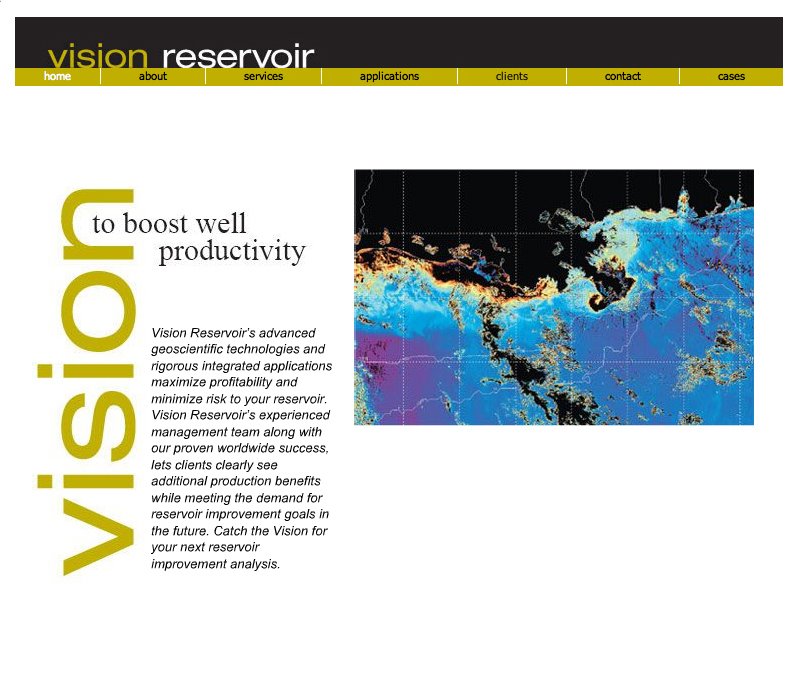
Working for CMS, designer/art director Kay Krenek and I delivered Vision Reservoir’s new site cum simplicitate…simple rather than complex; readable rather than dense…lots of white space. Instead of data-heavy, it’s brand-oriented.


The geoscientific marketplace is an issue. It’s jam-packed. There are a number of well-known oilfield exploration and production software companies that have spent years accumulating products and data. And they put everything on their websites. Everything.

Vision Reservoir’s site is…cleaner. The company was renamed, shortening a much longer and more technologically complex name (see below). To break through the clutter, we extended this concept to emphasize what the company means by the word “Vision.”

The home page rotates among four different views, from earth orbit to deep geology: a satellite photo of an offshore field right down to a stratum of rock…to which we have added four different headlines. Each headline highlights a different role the company plays in reservoir remediation and productivity. Each one is founded on “Vision” for brand reinforcement.

We continued the concise design and copy throughout the site, emphasizing the brand name. There is enough information to explain but not overwhelm. (First, build the house; then decorate it. CMS’s Donna Giles did the hard-slogging work of assembling and organizing.)


Christine Reel, CMS Principal says: Actually, Kay Krenek (designer extraordinaire) provided the impetus to either: a) shorten the really lengthy corporate name that no one used; or b) add substance to the short four initials that were used with no reference. Her suggestion proved to be the cornerstone for a very effective re-branding initiative.

The most memorable and delightful vignette of the process was the presentation of four web concepts – each considered to be perfect and wonderful by the client. The “Vision” concept ultimately won out and is now providing a visually arresting and compelling site.

This is one of those client projects that went so well we can all bask in the afterglow.

Borrowing a line from another design industry professional, Susan Kirkland: “There are many things an art director relies on other professionals for, but none of them should involve decisions about how art supports copy or copy supports mission.”

In the new Vision Reservoir website, design and copy both support...clarity. With an afterglow.


Saturday, July 15, 2006

Niki's Stuff


Now that Blogger is allowing photos again, here are a pair of pix from our visit to the exhibit at the Atlanta Botanical Garden. At the top, Bob and Edith Fusillo stand beneath one of the giant, mirror-covered figures...the Firebird. Its proper title: Oiseau de Feu sur l’Arche Evening, 1991. Bottom, one of the Nanas giving birth to...me.

Want to see more of Niki de St. Phale? Wikipedia has a broad selection of entries, links and photographs. You can read about her creation of the Nanas, which are such signature pieces for her.

In the post below (July 13th), I mentioned how well I thought Atlanta had done with the promotional aspects of this show. A quick glance at Google shows not just extensive local coverage, but articles about it from as far away as Colorado, and in publications like The Economist. That’s quite a publicity machine Atlanta’s got. Doesn’t hurt to have the Turner organization behind this one.

Joe Beck, who blogs on art-quarter.com, has said, “Many artists don’t know exactly why they do what they do when performing their art, but they know it’s important that they do it. It is important for the art consumer, too, or society, but often hard to see for them.” The Atlanta Botancial Garden has delivered a chance for “society” to see a huge range of work from a great artist. Thank you.

Friday, July 14, 2006

Carla's Joke

Just along I-12, traveling westward, Barbara and I spotted a small notice on one of those Interstate “Food Here” signs: Abita Brew Pub. We’d been looking for a place to have a late lunch, and here we were within a couple of minutes of some fine beer. So we pulled off right quick.

A little ways north of the Interstate (about four miles), we came into Abita Springs, Louisiana: “Welcoming Tourists Since 1867.” The Abita Brew Pub’s on the left, before you get to this historic town’s one traffic light. The café and the brewery are in the same little building. It’s a great stop for a fine pub lunch (a wide-ranging menu) and a few beers.

Abita Brewing Company’s probably most famous for its Turbodog, a pretty darn great dark brown ale. Number 2 on my hit parade is its Purple Haze, “a crisp, American style wheat beer with raspberry puree added after filtration.” Very, very good on a hot summer day in southern Louisiana. Barbara and I had a number of different samples along with our lunch, which caused an excessive number of potty stops as we drove on to Houston.

Now before I forget, here’s the joke that our waitress, Carla, told us – if you’re concerned about language, you should probably stop right here.

In all of St. Tammany Parish, you couldn’t find three better friends that Boudreau, Pierre and Thibodeaux. Why, they grew up together, they ran around together. They were just plain inseparable.

One day, though, Pierre was killed when he fell out of the Bobcat he was driving and it ran right over him. The coroner called on his two best friends to come identify the remains.

Boudreau and Thibodeaux went over to the parish morgue. The coroner pulled back the sheet and asked Boudreau if the corpse laying on the table was his friend Pierre. Boudreau looked the corpse over pretty good, then asked the coroner to turn the body over. He looked close, then stepped back from the body saying, “Nope, that ain’t Pierre.”

The coroner asked Thibodeaux if he could identify the body. Thibodeaux looked real close and then asked the coroner if he could turn the corpse over as well. Thibodeaux took a squint at the body’s lower half, stepped back and agreed with Boudreau: “Nope, that sure enough ain’t Pierre.”

The coroner was real puzzled. “Look,” he said, “we got the man’s driver’s license right here out of his back pocket, with his picture on it. How come you can’t identify this body as Pierre’s?”

“Pierre’s got two assholes.” said Boudreau. “This here body’s got only one!”

“Two? How do you know that?” asked the coroner.

“Cause everywhere we went,” answered Thibodeaux, “people were always saying, ‘There goes Pierre with them two assholes.’”


Visit Abita Springs when you’re over that way. You get excellent beer and entertainment along with it.

Thursday, July 13, 2006

Bounteous Promotion

Here’s a city that really knows how to get the most out of its public attractions…especially one backed by Turner Broadcasting. So Fusillos and Barons went off to see the Atlanta Botanical Gardens on Tuesday.

The area has changed radically since I was a kid. I left Atlanta in 1968 so I missed it: the Gardens were started in ’73. Now at the north end of Piedmont Park, the Botanical Gardens are vivid and accessible. It’s not just the shrubs, trees and flowers – although the Orchid House is pretty damned outstanding all by itself.

For about the next six months, The Botanical Gardens feature Niki in the Garden, the largest exhibition of outdoor sculptures by internationally renowned artist Niki de Saint Phalle ever presented. The sculptures are huge! Wondrous! The artist’s signature Nanas are everywhere – powerful, exuberant women celebrating life, dancing, usually (but not always) in ponds and pools with water spouting everywhere.


The big garden spaces are great settings for mythical figures. Enormous animals. Athletes and totems. Some of them “reach as high as 18 feet and span up to 25 feet long.” They’re brilliantly colored or enameled. Covered in glass. Ceramics. Semi-precious stones and mirrors. So you get colors and textures and jangly slashes of reflected light.

The kids love every one of them…hundreds of children this past Tuesday AM, arriving in great fleets from daycare centers, brought in small squadrons by moms. All goggle-eyed at the fantastical art pieces, climbing over and around and underneath most of them.

I wonder where Houston would put something quite like this? I wonder if Houston could promote on this scale – especially if there’s no automatic national TV coverage like the Super Bowl? I do wish we’d give it a try. Thank you, Bob and Edith: it was a wonderful day.

PS: Bob sent pictures, but Blogger is having trouble with photos again. I'll try first thing in the AM.

Monday, July 10, 2006

Nempnett Thrubwell

It is difficult, (especially after a couple of gin Martinis), to convey the esoteric nature of our discussion about this small English town just south of Bristol – and the outright hilarity as well. This is especially true when we Googled up that Nempnett Thrubwell is the site of an ancient British barrow (or burial mound) knows at the Fairy Toot…which set off another round of giggles.

No, it's impossible. But Bob and Edith Fusillo and Barbara and I have now covered the subject in depth anyway.

Bob discovered that the name of this little 300-soul community was originally made famous by The Wurzels – the very same Brit scrumpy and western band whose top-selling single was “The Combine Harvester.”

(I have just been informed by Bob that Nempnett Thrubwell is at the top of a very steep hill. “Don’t tell I, tell ‘ee,” says Edith.)


It can't be got to, you know. Lying north of Blagdon Lake, Nempnett Thrubwell is isolated (but has a fine water pump). It‘s inside a network of little roads bounded by the A38, A368, B3114 and B3130. However, "whilst signposted from each of these major routes, a lack of any further signposting makes it difficult to locate the village when arriving by road." [My emphasis added.] Must be a state of mind.

A Bristol-living friend of the Fusillos, Sue Stops, originally told them about…uh, Nempnett Thrubwell. So what better way to celebrate a Monday than to sing a snatch of the Wurzels’ song, thank Sue second-hand, and pretend that we can talk with a Somerset accent as well as Bob can. (Which we can’t, but Bob and Edith are too polite to correct me.) On to dinner! This is what vacations are for.

Gracious thanks to www.bathnes.gov.uk for the photo. Ta, luv. No critical examination of Nempnett Thrubwell can be undertaken without recourse to Nempnett Thrubwell: Barrows, Names and Manors, by Richard Dunn. Highly recommended, £14.95: Somerset Records Office (Taunton).

Sunday, July 09, 2006

Visiting Fusillos

Squirrels, squirrels, birds, squirrels. Birds, birds, squirrels. Chipmunk!

Martinis, martinis, squirrels. Squirrels. Birds. Pines, sweet gums, tulip poplars. Chicken salad. Yorkshire pudding. Coffee, cheese grits, eggs – over easy, sunny side up, scrambled. Naps.

Champagne. Squirrels, squirrels, birds, birds, mosquitoes. Family trees. Martinis. Chipmunk. Petite syrah. Squirrels, birds, spiders. Hydrangea. Squirrels. Fig preserves. Sugar cane syrup. Fireworks!

Saturday, July 08, 2006

Eating Vicksburg

The best lobster ravioli I have ever eaten is served at the north end of Washington Street in downtown Vicksburg, MS.

I know – this is supposed to be about advertising. I already made careful notes as we drove out of Houston: the curious truck marked “Dog Wash on Wheels” on Beltway 8 and the “Last Step Deer & Hog Processing” sign we passed in Livingston.

Good food on the road goes to the head of the line. As we have discovered over the last two years, the AAA guidebooks turn up some pretty good places to eat in off-the-Interstate locations. Rusty’s Riverfront Grill is one of those. An awful lot of tourist pass through Vicksburg…coming to tour the battlefield and see some fine antebellum homes.

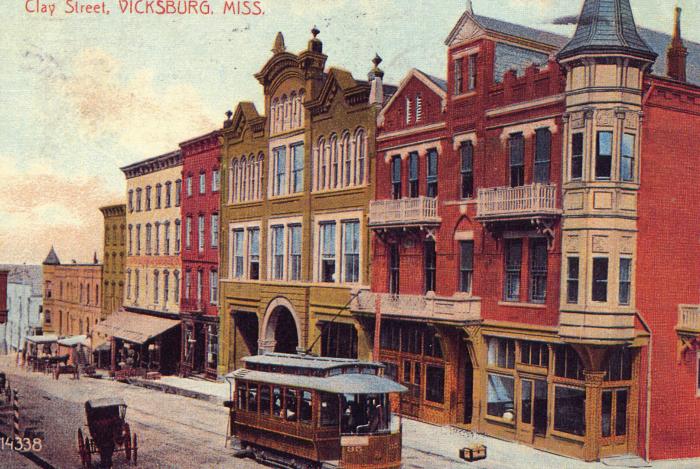
So Barbara and I spent the night in Vicksburg, and were guided to Rusty’s. It’s named after the owner/chef, Rusty Larsen, and hangs out in the former grocery store that’s been on Washington Street for at least 70 years…that would be to the left of the streetcar in the old postcard above.

Long story short: Rusty serves up a much more eclectic menu than most of his customers want, but for the few who do, there’s some pretty good eating. The salad dressings are homemade. Barbara ordered the crab cakes, with a remoulade that was somewhat spicy for her taste. And the aforementioned ravioli…superbly done. We got in early. Rusty’s is a big favorite of the locals and their kids. But most of them chow down on the steaks and the chicken. I also want to compliment the service. And the cold beer.

Nice place to visit, Vicksburg. Outstanding restaurant to enjoy. So if you’re passing through, try some of Rusty’s specials. There, you see? It's about advertising after all.


Postcard credited to Wayne Roberts Collection from www.davesrailpix.com.

Tuesday, July 04, 2006

Bates’s Beauty

O beautiful for spacious skies,
For amber waves of grain,
For purple mountain majesties
Above the fruited plain!

America! America!
God shed His grace on thee,
And crown thy good with brotherhood
From sea to shining sea!

O beautiful for pilgrim feet

Whose stern impassion'd stress
A thoroughfare for freedom beat
Across the wilderness.

America! America!
God mend thine ev'ry flaw,
Confirm thy soul in self-control,
Thy liberty in law.

O beautiful for heroes prov'd
In liberating strife,
Who more than self their country loved,
And mercy more than life.

America! America!
May God thy gold refine
Till all success be nobleness,
And ev'ry gain divine.

O beautiful for patriot dream
That sees beyond the years
Thine alabaster cities gleam
Undimmed by human tears.

America! America!
God shed His grace on thee,
And crown thy good with brotherhood
From sea to shining sea.

The author of this poem, Katherine Lee Bates, wrote it in 1893, rewrote it in 1904, then issued a final version in ’13. The oh-so-familiar tune is “Materna,” composed by Samuel A. Ward in 1882, a decade before the poem itself was written.

What’s not so familiar are all the words of her poem – some of which I have put in boldface. They demand real thoughtfulness about what our Nationhood means (and should mean) even now, 113 years after she wrote it. Happy 4th of July, America! Remember that we stand for freedom, liberty and brotherhood.

Sunday, July 02, 2006

Joel's Joke

Bubba was bragging to his boss one day, “I know everyone there is to know. Just name someone, anyone, and I know ‘em.”

Tired of his boasting, his boss called his bluff, “Okay, Bubba how about Tom Cruise?”

“Hell, yes, Tom and I are old friends, and I can prove it.” So Bubba and his boss fly out to Hollywood and knock on Tom Cruise’s door, and sure enough, Tom Cruise shouts, “Bubba! Great to see you! You and your friend come right in and join me for lunch!”

Bubba’s boss is pretty impressed but still skeptical. After they leave Cruise’s house, he tells Bubba that he thinks Bubba’s knowing Cruise was just lucky.

“No, no, just name anyone else,” Bubba says. “President Bush,” his boss quickly retorts.“Yep,” Bubba says, “I know him. Let's get ourselves to DC.” And off they go.

At the White House, the President spots Bubba on the tour and motions him and his boss over. “Bubba! What a surprise,” Mr. Bush says. “I was just on my way to a budget meeting, but you and your friend come on inside. Let’s have a cup of coffee first and catch up on the latest news.”

Well, the boss is very shaken by now, but still...not completely convinced. After they leave the White House grounds, he expresses his doubts to Bubba, who again implores him to name anyone else. “The Pope,” his boss replies.

“No problem,” says Bubba. “I've known His Holiness a long time.” So off they fly to Rome. Bubba and his boss are assembled with the masses in St. Peter’s Square when Bubba says, “This will never work. I can’t catch the Pope’s eye among all these people. Tell you what, I know all the guards. So let me just go upstairs and I’ll come out on the balcony with the Pope.”

And he disappears into the crowd headed toward St. Peter’s Basilica. Half an hour later, Bubba emerges with the Pope on the balcony.

But by the time Bubba returns to the Square, he finds that his boss has had a heart attack and is surrounded by paramedics. Working his way to his boss’s side, Bubba asks him, “What happened?”

His boss looks up from the ground and says, “I was doing fine until you and the Pope came out on the balcony and the Japanese tourist next to me asked, “Who’s that on the balcony with Bubba?”

Thanks and a tip of the Hatlo Hat to Joel Sabel for this classic – and to this Sunday’s “Crankshaft” cartoon for reminding me about it.

Friday, June 30, 2006

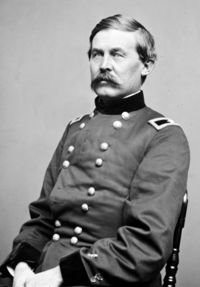
Buford's Cavalry

Headquarters First Cavalry Division,
Gettysburg, June 30, 1863.

I entered this place to-day at 11 a.m. Found everybody in a terrible state of excitement on account of the enemy’s advance upon this place. He had approached to within half a mile of the town when the head of my column entered. His force was terribly exaggerated by reasonable and truthful but inexperienced men. On pushing him back toward Cashtown, I learned from reliable men that [RH] Anderson’s division was marching from Chambersburg by Mummasburg, Hunterstown, Abbottstown, on toward York. I have sent parties to the two first-named places, toward Cashtown, and a strong force toward Littlestown. Colonel Gamble has just sent me word that Lee signed a pass for a citizen this morning at Chambersburg. I can’t do much just now. My men and horses are fagged out. I have not been able to get any grain yet. It is all in the country, and the people talk instead of working. Facilities for shoeing are nothing. Early’s people seized every shoe and nail they could find.

I am, very respectfully, your obedient servant.

Jno. Buford
Brigadier-General of Volunteers.

[P.S.] The troops that are coming here were the same I found early this morning at Millersburg or Fairfield. General Reynolds has been advised of all that I know.


Dispatch courtesy of www.bufordsboys.com

Thursday, June 29, 2006

Badger Congress!

Correct-o-mundo. E-mail, call or write your Senators. Tell them to vote to keep the Internet neutral. Then tell them again. Today.

If you use the Internet for commerce, if you blog, you need to find out more. If you use the Internet for your telephone service, you definitely should be on top of this issue. First, read the blog piece by Susan Kirkland. That’ll get you fired up. Then read “Save the Internet” on the Free Press website.

It’s critical – and complicated. In a tense tie vote yesterday, a US Senate committee rejected an amendment that would have preserved the status quo of equal pricing for all Internet traffic…that’s network neutrality.

It’s about money, of course. The big telephone and cable companies want to kill net neutrality. For example, if net neutrality disappears and you are using VoIP, your phone call could be dropped because it doesn’t meet “their” quality standards. These companies don’t want to give up the long-distance revenue that VoIP is draining from their bank accounts.

Wikipedia says here: Neutrality regulations require network providers
(
ISPs) to transport all packets on a first come, first served basis except for Denial of Service Attacks, to offer service plans distinguished only by bandwidth, and to refrain from billing third parties for network services.

Think about it this way. A vote to keep the net neutral is a vote for keeping the Internet free of regulation (and the kinds of predatory pricing that phone and cable companies just adore). And speaking of money, lawmakers on both sides of the aisle are uneasy about “controlling” the Internet – especially since this is an election year and this has become a hot issue.

This is no “free press” deal – it’s a freedom-of-speech issue. Find your Senator’s e-mail address
here. Want to include your Congressional Representative? Find his or her e-mail address here. Do NOT do nothing. Contact your politicians until they agree that the Internet should stay neutral.