Tuesday, June 27, 2006

Martins Back

Having spent the last week or so touring Alaska, Mary Jo and David Martin have come back home to the south. Here’s a picture of David seeking protection from the Alaskan mosquitoes. True or not, I really couldn’t resist the photo: he says the musk ox robe is about as silky as you’d wish – and warm with it. But not something he’s likely to need here in Houston.

Mary Jo said they enjoyed the entire trip, but her and David’s best adventure was in Fairbanks. They spent hours in the University of Alaska’s Museum of the North – a small but perfect place, designed by architect Joan Soranno, to learn and experience. The website notes:

The Museum's mission is to acquire, conserve, investigate, and interpret specimens and collections relating to the natural, artistic, and cultural heritage of Alaska and the Circumpolar North.

According to the Martins, it’s unique. Mary Jo was especially impressed by The Place Where You Go to Listen, a sound and light environment created by composer John Luther Adams. It’s a “musical ecosystem” where visitors are surrounded by the rhythms of daylight and darkness, the dance (and recording sounds) of the aurora borealis, and the seismic vibrations of the earth, in real time.

Glad they went. Glad they’re home. And next time, David, bring back the whole ox.

Sunday, June 25, 2006

Creeped Out

For only five payments of $25.99, you can purchase a doll that looks like a prematurely birthed baby. True fact. This strikes me as seriously weird.

Early this morning, I was paging through one of Barbara's magazines. Good Housekeeping. Redbook. One of those. And among the half-dozen or ten other The Ashton-Drake Galleries ads was this one, on the left. “This doll is not a toy, she is a fine collectible to be enjoyed by adult collectors.” Uh-huh.

This unusual piece of art is created by “renowned doll artist Tinneke” (who in real life is Tinneke Janssens) under the trademarked product line “So Truly Real.” There must be 300 hits on Google for the doll series and the artist. This is serious business...another one of those niche markets that I usually enjoy talking about. There are thousands of doll collectors worldwide. They have their own associations. You can even order a doll that looks like you, or a son or a daughter or a grandchild.

I have lived in such glass houses, so I can't really throw stones. There's not much intellectual distance between military miniatures, for example, and dolls. I understand the appeal of collecting all sorts of things.

Still, I hadn't even had my first cup of coffee yet. Art aside, it creeped me out to discover Little Grace lying there all pink on the page. Maybe I am too sensitive, but to see a doll that represents a preemie seems a bit off. Not true for you? It can be yours for only $129.99.

Photo from www.collectiblestoday.com.

Monday, June 19, 2006

Employees First

Last year, Hurricane Katrina and Hurricane Rita caught a lot of us with our pants around our ankles in terms of emergency communications – with employees, customers and many other audiences.

So last Friday, Mary Jo Martin of Knowledge-Based Marketing and I finished a small qualitative survey among businesspeople in our area about disaster communications planning. It's titled “Are You Ready?” Here are a couple of highlights.

Unlike a general Houston Business Journal survey
here, our smaller sample says 80% of our respondents do have a disaster communications plan in place. And 51% update their plans once a year (27% update more frequently).

Two-thirds of the respondents said they update their plans because of “weather-related changes.” That phrase is directly related to (and compared with) last year's hurricane season.

Most critical? Employees come first: 82% of the respondents said their most important audience for communications in an emergency was their workforce. When you’re responsible for the health and safety of your workers out in the field, or in your office, they are absolutely the ones you want to communicate with. (You want to make sure they and their families can communicate with you, too!)

Customers were the next most important group, 62% identified their customers as a key audience. Then the audiences fall off sharply in importance. Media, vendors and public authorities tied for third place, way down the list. Shareholders were the next lowest. And the “community” was last…not so surprising, since the topic is emergency communications by companies.

What is a bit of a shock is that 20% of the respondents do not communicate their emergency communications plans with employees. Looking at our respondent base (which is small) suggests that this 20% may be sole practitioners or small businesses. I hope so.

Last year proved the truth of the old Army adage about teaching. First, tell ‘em what you’re going to tell ‘em. Then tell ‘em. Finally, tell ‘em that you’ve told ‘em. When in comes to protecting your most valuable assets (your workforce), it’s way better to communicate your plan over and over again. Just like the City of Houston did.


Want a free copy of the “Are You Ready?” results? It's just four pages. You can respond to this post with your edress, below. Contact Mary Jo (further below),or richardlaurencebaron@hotmail.com.

Thanks to all our respondents and to Knowledge-Based Marketing.

Thursday, June 15, 2006

Steph's Story

According to a news report, a certain private school in Markham, OH, was recently faced with a unique problem.

A number of 12-year-old girls were beginning to use lipstick and would put it on in the bathroom. That was fine, but after they put on their lipstick, they would press their lips to the mirror leaving dozens of little lip prints. Every night the maintenance man would remove them and the next day the girls would put them back.

Several memos were posted about this without effect. Finally the Principal decided that something had to be done.

She called all the girls to the bathroom and met them there with the maintenance man. She explained that all these lip prints were causing a problem for the custodian who had to clean the mirrors every night. To demonstrate how difficult it was to clean the mirrors, she asked the maintenance man to show the girls just how hard it was.

Following the instructions, the man took out a long-handled squeegee, solemnly dipped it in the nearest toilet bowl and scrubbed at the mirror.

There was complete silence in the room. Since then, there have been no lip prints on the mirror.

Thanks and a tip of the Hatlo hat to Stephanie Murphy.

Tuesday, June 13, 2006

Humility Day

Thanks to the unfortunate performance of the US team during yesterday’s match against the Czechs – and my “typical” American attitude – I’m taking a Humility Day here in the executive offices of the Baron Text Development Company of Houston, TX. Why? Well, I had sent a little e-mail to my old friends and colleagues at Rust2, the Dialogue International Agency in Prague. Just a small boast. A tiny taunt.

Then the Americans made a poor showing against the Czechs in the World Cup game.

The polite principal of Rust 2, Graham Rust, sent an e-mail: “Just got your message while watching the match, now 89th minute and only four goals between USA and outright victory! Fingers crossed, see you soon! G.” Nice.

Oliver Herbst, one of Rust’s project managers, was at the match and more…forgiving: “I was there in person and can say the atmosphere was amazing. I’m still recovering from the victory (bus ride wasn’t what I had hoped). We met with some Americans hours prior to kick-off in a bar and both sides showed true sportsmanship wishing each other the best of luck (the Czechs a little louder though). Good luck against Italy on Saturday!”

My thanks to Graham and Oliver for not beating me over the head with the Czech victory. That sound you hear? It’s only me, choking down my slice of home-made humble pie.

Monday, June 12, 2006

Topo Chico

The Mexican team, El Tri, won its first FIFA match yesterday in Nuremberg, with terrific play that outscored Iran 3-1. I had a talisman for its victory.

I was holding a bottle cap I found during my Sunday AM walk, from a bottle of Mexican mineral water. It has the classic Topo Chico logo, red with white “snow” on top, on a yellow background. Even as I picked it up, I could visual the classic Mexican bottle, that heavy greenish glass so much like an old-style Coca-Cola bottle.


Like a lot of brands that have spread north of the Rio Grande, Topo Chico soft drinks are a familiar and colorful sight in grocery stores here, and wherever there’s a large Hispanic population. In addition to agua mineral, the brand offers flavors you don’t see in US pops – pineapple, tamarind (one of my faves) and grapefruit.

The company’s story is a classic one too, and you can read all about it here – in Spanish or English. I’m particularly fond of the “Legend of Topo Chico,” which involves your basic Indian (in this case, Aztec) princess in search of curative waters, which she found springing forth from a hill shaped like a mole (topo in Spanish, according to the website)…a mole hill.

Quite how the originators of the brand got from the mole hill to the brand name (mole + boy, or “small, awkward person” according to Babel Fish) is beyond me. Maybe somebody will tip me to the secret.

More important, though, is juxtaposing the concept of the little guy with the appeal of Mexico’s big win on Sunday. It’s a great story. I hope that the Topo Chico bottlers will consider a tie-in with Mexican football next year. Buy a bottle for yourself next time you’re at the store. Viva Tricolores!


Photo courtesy of www.bevnet.com.

Saturday, June 10, 2006

Joe Marketing

From the number of times I’ve posted about coffee, you’d imagine that’s all I think about. Not true. Mostly. On the other hand, I am fortunate to belong to a lively online forum that, last week, generated some interesting back-and-forth about marketing the upscale java experience in the US.

The head of Marketing for SoFlow, Sam Bedford, started this hare:

I just read that BK (Burger King), McD (McDonald’s) & Dunkin Donuts plan to grab a substantial piece of Starbucks’ market share by appealing to the average consumer who may be intimidated by the Starbucks vocabulary as well as the price.

Question: Don’t you think with over 80% share of the retail coffee market the ave. Joe is actually buying from Starbucks and buys into the whole experience or am I completely wrong and there is a huge opportunity to win middle America?

If you’d like to see what other marketing professionals think about the Big Three’s chances to take substantial market share away from Starbucks, read the entire discussion thread here. You may need to be a member, if you aren't already. You could always join up. It’s free and I have enjoyed the devil out of it. Have a great weekend.

Logo © Soflow Ltd.

Thursday, June 08, 2006

McKee’s Five

Long post – good subject. The president of McKee Wallwork Cleveland, an ad agency specializing in fast-growth companies and businesses, wrote a Viewpoint article for Business Week magazine. Here’s a shortened version of what Steve McKee wrote about “five words you should never use” in an ad:

Quality. This may be the most overused word in advertising, which is the primary reason why you should stay away from it…every company believes it can use the word “quality” in its advertising. Too many have, and as a result, now it has become just seven empty letters.

Value. Like quality, value has been ruined by overuse….Value, like quality, is in the eye of the beholder, and every product or service has its own value equation. Saying “we provide the best value” is, therefore, virtually meaningless.

Service. Have you ever heard an ad promising lousy service? Of course not, which is the reason why claiming good service just falls on deaf ears…simply promising great service won't make it happen.

Caring. Do you really believe your company cares more about your customers than your competition does? It may feel good to say so, but the claim flies in the face of common sense.

But the fifth word is different. The fifth word doesn’t work precisely because it’s not variable. The fifth word is binary. (Huh?)

Integrity. A company either has integrity or it doesn’t…When a company talks about integrity in its advertising it’s for one of two reasons, neither one of them good: They’re either trying to cover up some lack of integrity (which never works) or they’re implying they live by a higher standard than their competition. That’s impolite, to say the least. Every company needs to have integrity. No company needs to advertise it. Using common words that have become empty clichés is a shortcut to nowhere. Just because you sell it doesn’t mean people will buy it.

As the intro says, it’s a viewpoint. I’ve been struggling for years to keep tired words out of ad copy. I’ve never quite been able to drive a stake through “flexible,” for example. “Customer-focused” is another one.

McKee’s five words do have their problems. However, as code words, they do have…uh…value. “Integrity,” for example, is almost mandated these days because of Sarbanes-Oxley requirements. Limp words (like the McKee Five) will continue to be used despite an inconoclast’s viewpoint. So I have three suggestions for companies and institutions about the McKee Five.

First, go to the trouble of supporting tired words like “value” or “service.” Prove why your value or your service is worth more than a kiss-off from jaded consumers.

Second, consider the scary idea of a report card. Many hospitals, for example, are using report cards whose scores are generated by patient comments – and putting them up on their websites. If you base your marketing and advertising on such common characteristics, test them on your customers…and report the results. Product and service improvement should be a continuous part of your business anyway, so a real report card isn’t something you should be ashamed of using.

Third and better yet, try finding out what your customers’ real key decision factors (DCFs) are…through research. Dig beneath the McKee Five for DCFs that are truly meaningful to your customers. Find out how your company, product or service is rated relative to those factors. Then base your advertising on those where you are strongest, or those that you want to reinforce.

McKee is really saying, “Don’t be lazy.” You want customers? Give them real reasons to buy from you. I guarantee it’s worth the effort.

Original article © The McGraw Hill Companies. All rights reserved. Thanks to Rob Schoenbeck for pointing this one out.

Monday, June 05, 2006

Kleptocracy…Huh?

In a recent article, I was reminded that for every corporate chairman like Rich Kinder or Steve Jobs whose “salary” is $1, there are dozens (like Home Depot’s Bob Nardelli and Yahoo’s Terry Semel) whose compensation is in the hundreds of millions of bucks.

I am re-reading Guns, Germs, and Steel by Jared Diamond and just finished his chapters on kleptocracy, which is, broadly, “A government characterized by rampant greed and corruption” [from the Greek kleptein, to steal].

Specifically, Diamond is describing the ruling class of a nation state that transfers tribute from producers to an elite (p. 276-277, Norton trade paperback, 2003). I was struck by Diamond’s “four solutions,” the ones that rulers have used to gain popular support while still maintaining power (and riches)…and how much his model could be applied to the world’s current crop of humongously compensated CEOs.

I’m as capitalistic as any businessman. I work hard for my earnings and don’t – mainly – begrudge others’ higher salaries. But there’s a parallel between what Diamond’s ruling kleptocrats have done historically and what a number of C-level executives do with their corporations.

So very briefly, I’m putting down Diamond’s four solutions, and a corporate interpretation of each.

Disarm the populace and arm the elite. Well, think about what the corporations do to “disarm” their employees, like fostering dependence on healthcare benefits; and their stockholders, like forbidding them to ask pointed questions during shareholders’ meetings. Corporations arm their elites with similar (but smaller) executive compensation packages and privileges.

Make the masses happy by redistributing much of the tribute received. How about slightly better returns on share price, or bonuses for workers, or giving substantially to charity? Hmmm? Aren’t these ways of “sharing the wealth,” but not very much of it?

Use the monopoly of force to promote happiness. In other words, the company will fire your keister if you question its behavior. Isn’t that what happened to several of the Enron whistle-blowers? Or, the company will move offshore, depriving the community of much-needed jobs (which keep employees and their families happy).

Construct an ideology or religion justifying kleptocracy. This one’s pretty easy if you presume that capitalism is the reason and the justification. But since I am a capitalist myself – without the hefty salary – I would rather offer the “ideology of corporate entitlement,” which has been heavily displayed by Enron, HealthSouth, and a few other companies: we’re the best, so we deserve to be able to treat you like peasants.” This kind of attitude runs throughout a given organization…every employee feels the same way, no matter how little he or she is involved in corporate management.

None of this is new. Wasn’t it Al Capp who coined the phrase more than 50 years ago, “What’s good for General Motors is good for the USA?” Or was this from the musical version?

Think how often this subject has come up – like every time there’s a big corporate scandal, reaching back to Harry Sinclair and the Teapot Dome Scandal, the Robber Barons (no relation) of the late 19th Century, and beyond

I’m not biting the hands that feed me. I am grateful to be able to conduct my business with some of the country’s largest corporations.

I also know – and so do you – that there are thousands of American business leaders who do not make anywhere close to the kind of money we’re talking about here. Many of these thousands do indeed redistribute their wealth to shareholders, employees and charities, and are particularly worthy of respect.

But when I hear that somebody’s getting $100 million in compensation, I really do wonder if he or she couldn’t get along with $10 million or $1 million – and surrender the rest to the shareholders.


Cover: WW Norton & Company. All rights reserved.

Saturday, June 03, 2006

No Pix

Just in time to reference a current problem with Blogger, this arrived from Edith Fusillo in Atlanta.

A woman has twins and gives them up for adoption. One of them goes to a family in Egypt and is named “Ahmal.” The other goes to a family in Spain; they name him “Juan.” Years later, Juan sends a picture of himself to his birth mother. Upon receiving the picture, she tells her husband that she wishes she also had a picture of Ahmal.

Her husband responds, “They're twins! If you've seen Juan, you've seen Ahmal.”

Blogger, Signalwriter’s host, has been technically glitched for the past 72 hours. Nobody’s been able to post photographs to their blogs and the bloggers are restless. More than that, they’re outraged. Some pretty…hasty…comments have been shared in the discussion group, here.

Once Blogger became aware of the problem – and admitted that it was system-wide rather than an individual blogger’s incompetence – it has gone to work on it. But these haven’t been patient hours for the bloggers.

Moderation would seem to be the best approach to dealing with the issue, despite our deep-seated recognition that a picture's worth mucho words. We’ll just have to wait it out. Meanwhile, it’s “no pix” for Signalwriter.

This affair does support a couple of things I’ve noticed (and commented on) the previous posts. First, propeller-heads seem to be terminally convinced that nothing could possibly be the fault of their software or hardware...no pun intended. I’ve had several mechanical failures in my new computer system. Each time I called my computer guys, they said, “We’ve never, ever seen that happen before. Are you sure you’re not (fill in the rest with achingly long technical expositions)?” In every case, a mechanical part has indeed broken and they’ve had to replace it.

Second, the e-mails from Blogger users demand instant gratification; I have written about this kind of technological expectation in previous posts.

Until Blogger has solved the challenge, use your imagination when you read my words. Envision hurricanes. Visualize twins separated at birth. Meantime, a second pun forwarded by Edith sums it up: Two fish swim into a concrete wall. The one turns to the other and says "Dam!”

Thanks and a tip of the Hatlo hat to Edith’s originating correspondent, tlynn623.

Wednesday, May 31, 2006

Blow, Winds!

“You cataracts and hurricanoes, spout!” Welcome to the first week of our hurricane season.

Dr Jim Siebert, Director of Meteorological Operations for Weather Insight, says there were 15 hurricanes last year (2005) compared to an annual average of five. Of our 2005 hurricanes, seven were considered “intense” versus the annual average of two-and-a-bit. He expects the current pattern to continue for several years.

(I got all this in a roundabout e-mail from Candace L Renaud, a principal of Renaud Sero Advisors, which specializes in commercial real estate services.)


Siebert also notes that this year weather conditions are prime for another record-breaking hurricane season. Weather Insights, which provides tailored weather services for the energy industry, places the probability for hurricane activity along the Gulf Coast this year at 47%. That’s a lot of risk.

So Renaud created some tips, things that an office tenant can do in advance to help minimize downtime and speed up payment of an insurance claim. Shortened for posting, the tips are:

1. Secure all critical documents, including your lease and insurance policies. Scanning these into a digital format and backing up the information offsite is a good way to insure all documents are safe. Also, securing all documents digitally may help employees working remotely to access critical files and continue working either from home or another city.

2. Secure records relating to tenant improvement expenses if your company contributed to those costs. This information will help expedite an insurance claim if necessary.

3. Make or update equipment and furniture lists. If possible, take digital photos. Secure them offsite.

4. Review lease provisions that relate to damage and destruction to the premises and make sure you follow those procedures if the premises are damaged. This is critical to insuring that rent is abated from the date of the destruction. Typically the tenant is responsible for notifying the landlord (usually in writing) of the damage.

5. If the building or premises is damaged to the extent that the space cannot be occupied, examine solutions for alternative office space.

6. Establish accounting procedures in advance for any possible storm damage. Also, establish procedures for employee payroll and operating capital during any possible downtime.

7. Make sure you have established an emergency communication plan for employees. Know who is evacuating, where and how they can be reached. It will also be helpful to have this information for vendors and sub-contractors.

You should know, I switched No. 6 and No. 7 in Renaud’s tip list because I want to emphasize how critical this disaster communication linkage is. You should know how to reach your people – and they should know how to reach you…in case this year's blows are as bad (or worse) than the last.

I bet the entire set of tips (rather than this shortened version) is yours for the asking if you e-mail Renaud Sero via its website. And thanks to Renaud herself for developing these tips.

Image provided by Dreamstime.com.

Friday, May 26, 2006

Adapting Humanity

Same subject, different verse. DW Buffa, in one of his most recent books, has a character quote from “something Tolstoy wrote…written in 1910, the year Tolstoy died.”

Today, electricity, railroads, and telegraphs are corrupting the whole world. Everyone appropriates these things; they cannot avoid appropriating them, and everyone is suffering in the same manner, forced in the same degree to change their way of life. Everyone is being put in a situation in which it is necessary to betray what is most important in their lives, to betray an understanding of life itself...

What are machines supposed to manufacture? What are telegraphs supposed to transmit? What are schools, universities, and academics supposed to discuss? What kind of news is supposed to be conveyed by books and newspapers? What is supposed to be accomplished by millions of human beings who are drawn together and subjected to a higher power?

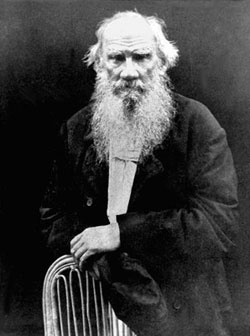
From what I’ve read, Leo Tolstoy (above, right) wrote I Cannot Be Silent! in 1908. Maybe this is the book to which Buffa is referring. I’ve never even heard of it. (But that’s why reading is such a hoot: I always learn something.)

Here’s the greatest moral authority in Russia, in that era, raging against technology and the fact that human beings embrace it with fervor. A hundred years ago. Just after Borden embraced change and condensed milk.

The morality of our adapting to tech has been debated and derided ad nauseam, whether it’s the medieval Church banning crossbows or middle-American communities banning pagers in their schools. Technology only changes morality if we let it. If we can cope with steam locomotives and telegraphs, if we can live through the era of portable TVs, we’ll get through the iPods and Blackberrys, too.


Adaptations shouldn’t condense our sense of the moral and the ethical, though. Right, Ken Lay?

Quotes from Trial by Fire, © DW Buffa, 2005. Tolstoy photo from www.biblioforum.de.

Wednesday, May 24, 2006

Condensing Time

Last month (April 21), I blogged about the 24/7 lifestyle that technology has conferred on us. Roberta Lewis called from New Hampshire this AM, where she was visiting one of her clients. She had a quick job for me, had already hand-written a rough and wanted to fax it to me. I told her I didn’t have a fax machine. “Old technology,” I said, sidestepping the fact that I’ve intended to get one but haven’t. (I partially credit the fax machine with the downfall of the Soviet Union, BTW.)

It’s not old technology – but we keep moving faster and faster.

We also keep forgetting that the increasing velocity of life is old news. Thanks to a fine article in this morning’s Houston Chronicle, by Food Editor Peggy Grodinsky, I was reminded again.

She’s written about condensed milk and its inventor, Gail Borden. A great read with a lot of history to it. Borden (above, right) was one of those Promethean 19th Century gents who relished the advance of technology and calculated its effect on the daily lives of millions. In a ‘graph in the middle of her long article, Grodinsky quotes from a biography of Borden:

The world is changing in the direction of condensing…Time was when people…would spend hours at a meal. Napolelon never took over 20 minutes…I am through in 15.

Grodinsky’s article is one more reminder that there’s little that's new under the sun. That our lives are constantly accelerating. It didn’t start with the computer, the fax machine or the telephone. It’s been going on for 200-plus years: what the Industrial Revolution really means. It’s as well to say that technology condenses time the same way that Borden condensed milk.

It’s hard to be politically correct and blame McDonald’s for our fast food addiction when it’s been growing for a couple of centuries.


Photo from Gail Borden Public Library District, Elgin, IL. All rights reserved.

Monday, May 22, 2006

Fizzy Room

Two people watch Abraham Lincoln give his brief address at Gettysburg. One thought it was the poorest, weakest thing he had ever heard. The other (Edward Everett) wrote the President, “I should be glad if I could flatter myself that I came as near to the central idea of the occasion in two hours, as you did in two minutes.” Different people, different impressions.

So I can only report my impressions of the AMA Healthcare Special Interest Group’s “Service Line Marketing” event at the Texas Medical Center last week. No historic two-minute address here, but helpful insights and conclusions.

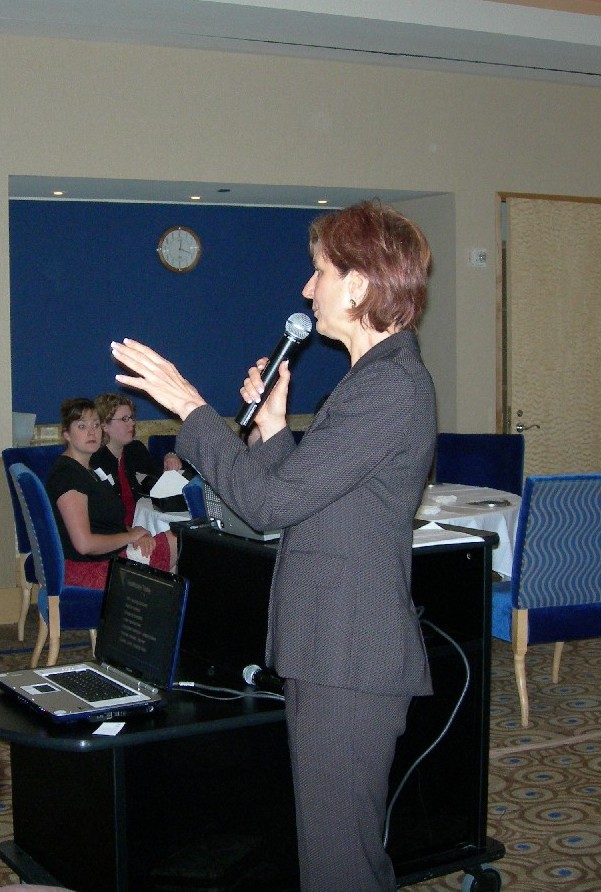
The photos don’t show it, but our two speakers played to a packed house. Gail McFaddin, RHD Memorial Medical Center’s Director of Business Development (top) and Andrea Patton of Iris Advertising (bottom) came from Dallas last Tuesday AM to present a comparison of service line marketing efforts from two Tenet hospitals, Houston Northwest Medical Center and RHD itself.


A crowd gives a room energy. So the Trevisio meeting room was fizzy and the speakers responded to it. They gave an honest presentation: two hospital promotions, two results…and little to show for them.

When you go to an event like this, you expect to hear success. That’s what every speaker wants to present, every client wants to show off. But Gail and Andrea stepped up and gave us the sadder facts of their case. Both promotions were based around an effort to reach men over 50 with a hospital-directed message about colorectal cancer – and they offered a free self-test kit as an incentive.

They went through the right steps: matching prospects at risk to the demographics of the hospitals’ respective service areas; creating a mixed-media campaign of postcard mailer and small ads; assembling a fulfillment package complete with a free EZ Detect Kit and a way to return the self-test results to the hospitals; and tracking the results.

The media were similar in both cities, with about the same amount of money spent on each promotion. But the Dallas campaign focused primarily on community prospects, while the Houston program split its fire among three targets: community, hospital employees, and patients in the hospital database.

In the end, Houston did better. Northwest Medical Center was able to measure its ROI: the promotion turned $14.60 in net revenue for every dollar spent on the promotion.

RHD was in the negative numbers – 52 cents in net revenue for each dollar spent…not so good. The speakers pointed to what they felt they’d done right – and what they’d do differently. But the presentation suggested that this colorectal cancer promotion didn’t play to the definition of service line marketing: a completely packaged approach to deploying and fielding a very specific service.

A service line reinforces branding – it firmly supports what your hospital or clinic is known for (or wants to be known for). It can increase volume, profitability and reimbursement. It can help maintain and even increase market share. It can improve customer service.

It’s easy to be on the outside looking in. But my takeaways from last Tuesday were two. They’ll both be familiar to you. First, the basic service line marketing idea is only sell one thing at a time. Second, sell the living daylights out of it.

Number one is hard enough…it’s tough to get any organization to focus, focus, focus. Yet we recognize immediately the cancer treatment focal point of University of Texas MD Anderson Cancer Center, and the pediatric specialization of Texas Childrens Hospital. Even in a general-services hospital, you can strongly promote a particular specialty, as Spring Branch did a few years ago with its wound care clinic.

Number two is harder. Put enough throw-weight behind a promotion – in dollars and dedication – to make certain that it penetrates your marketplace. Northwest Medical Center’s apparent success is pleasant to contemplate but the actual dollars involved were very low. The time the promotions spent attacking their markets was quite limited. Building a brand is challenging enough. Too little time and money spend on a promotion will result in failure.

So what do you give two marketing professionals who stand in front of their peers and present a case that didn’t win?

One hell of a round of applause for taking the rougher road. Thanks to Gail and Andrea for a fine learning experience.

Thanks to Karen Orso for the photographs.

Friday, May 19, 2006

Why Lawyers

Look: this wheel has come off. For every one of us creative and marketing people who’ve rassled with client lawyers over the wording of brochure sentences, or what can’t be shown in an ad, there’s a lesson here.

It’s a cheerless one. In the “The M-BlawG” section of the April 15 number of the AMA’s Marketing News, I noted that Reebok, the athletic shoe manufacturer, is recalling 300,000 lead-based charm bracelets after a four-year-old swallowed the charm. And died of complications from lead poisoning. You can read the whole story here.

Here’s where a knowledgeable, experienced lawyer comes in – not after a tragedy like this happens, but before it happens. According to the story in Marketing News:

Health officials indicated that the bracelet was 99% lead; a second bracelet was 68% lead. The safety limit in jewelry in the United States is 0.006%. The promotional item, which Reebok says was made in China, was engraved with the Canton, Mass.-based company’s logo and was given as a free gift with the purchase of children’s shoes since May 2004.

This isn’t a problem of copyright law – it’s a consumer safety issue. And someone at Reebok, somewhere, never thought to ask about the lead content of the charm bracelet. The US government identified the toxicity of lead more than 30 years ago. The US voluntary toy safety standard, ASTM F-963-03, limits soluble lead in toys (that is, lead that may migrate from the toy and be ingested by a child) to no more than 90 parts-per-million (ppm). But under federal law, the US Consumer Product Safety Commission (CPSC) enforces a limit for total lead content of 600 ppm – that’s the 0.006% number in the quote above.

That’s why we need to think of all the ramifications of our activities (I wonder if I would have thought of it?) …and why we need our clients’ lawyers. In my own experience, the very best client lawyers – and I have worked with lots of them –do three things:
  • Refrain from imposing their subjective opinions on your creative expressions
  • Advise you of the relative risks involved in specific cases, like product comparisons – and let you make the decisions
  • Inform you when you absolutely cannot say, picture, or do something that is, de jure, illegal.

In the Reebok case, the promotional item was illegal. Its composition was against the law in May 2004; it’s against the law now. True: hindsight is 20/20. Also true: a conscientious lawyer keeps you from making a deadly error before you make it. Before the wheels come off your promotion or your marketing activity.

I am sorry for the child that died from swallowing the charm, and sorry for his parents. Sorry for Reebok, whom I’m certain meant no harm. But this is one of those cases where I’m really sorry that an attorney familiar with CPSC law didn’t blow the whistle. That’s “why lawyers.”

Wednesday, May 17, 2006

Man Law

After chatting about Mitchum’s new advertising campaign (see the post, April 24th), I’ve gotten some feedback about how blatant and even exploitive the campaign’s TV commercials are – maybe you’ve seen these clumsy items yourself.

Thanks to a note from Susan Reeves, watch how Miller Lite handles the same line of attack: a series of commercials called “Man Law” which you can see here. Neat ideas, handled in a self-mocking manner that’s got some genuine appeal. (I also protest that Burt Reynolds still looks like he hasn’t aged a day in the past 15 years. Unlikely he’s a Mitchum Man, since he turned 70 this year and is way outside Mitchum’s demographic.)

I don’t drink the stuff…but Miller’s advertising: always a good call.

Monday, May 15, 2006

Craft Beer

It is the sin of the world that there are just two brewpubs left in Houston (that I know about). ‘Cause this week, May 15-21, has been elected American Craft Beer Week by The Brewers Association: “A time for all legal-drinking-age Americans to explore and celebrate the flavorful beers produced by our small, traditional and independent brewers.”

In a city of four million-plus people, two’s hardly enough. So if you should happen to be in the West U area, stop by
Two Rows Restaurant & Brewery. Mucking about Bay Area Boulevard, way down south? Try BJ's Restaurant & Brewery.

The good news, of course, is that we still have St. Arnold’s, whose brews are available on tap or in bottles all over town. (Its rainbow-painted Bentley was in the Art Car Parade on Saturday.) Plus plenty of places where you can get a pull and a pint of all kinds of craft beers.

I’ve been seeing outdoor media around the city introducing Heineken Premium Light Beer – whatever next? If you are one of those people that drink “Lite” beer under the persistent delusion that these are real, treat yourself to the healthy effect of a craft-brewed ale or lager somewhere in the Bayou City this week.

Banging the barrel for my current favorites, purchase a few sample bottles from Stone Brewery, available at Spec’s. Its Arrogant Bastard and IPA are particularly tasty and filled with good things – you will enjoy them. (Actually, just reading the Arrogant Bastard back label will give you the courage to go on with your life…or the nerve.)

If you see me out this week in any of the pubs, I’ll stand you a pint.

Sunday, May 14, 2006

Barbara's Escape

Most of you know by now that Barbara Nytes-Baron has left the building, work-wise. My spousal unit sent this e-mail to a number of friends and relations:

Well I certainly hope this includes everyone I need to inform. If you think I’ve missed someone please feel free to inform them that you heard from me that I am no longer at the Northwest Branch (of the Harris County, TX, library system).

I will have to say that my arthritic hip is no longer sore and believe it or not there are actually fewer frown lines! All in all a good decision. I’ll be loafing for a few months – doing all of the things that I couldn’t or didn’t get around to when I was working. Then I’ll regroup and move on.

Our daughter, Rachel Baron, exhibited mysterious foresight last weekend, before Barbara resigned the library. She gave her mom a Saint Barbara votive candle (with the traditional red wax, from the Reed Candle Company, San Antonio, TX). Curious parallel: in the Middle Ages, Barbara, one of the most popular saints, was kept imprisoned in a tower to “protect” her from the world.

Now Barbara has escaped from her tower. It’s kinda nice having her around during my workdays.
Happy Mother’s Day, Barbara, and much love. I couldn’t be happier for you.

Saturday, May 13, 2006

Connie’s Joke

Fred Chung came to America and realized his dream. After just a few years, he had opened his own restaurant in a little shopping area in town. His place was popular, he made friends with the other retailers up and down the street, and he prospered. So he decided it was time to wed, and he sent to China for a bride in the traditional way.

A marriage was arranged. A lovely and traditional young woman arrived from Szechuan Province to be his wife and helpmeet. His happiness was complete.

Several years after he married, a long-time customer told him a shocking thing: his wife was having an affair with Chaim Goldstein, who owned the tailor and dry cleaning shop just three doors down the street.

Impossible! He couldn’t believe it. He wouldn’t believe it. He swore that he wouldn’t bring it up. But as soon as he arrived home that evening and saw her, he burst out: “Are you having an affair with Chaim Goldstein the Tailor?”

His wife looked him straight in the eye and said, “What are you, meshugee? What momzer told you that?”


Courtesy of Connie Flemming, Stonehenge Productions. Yiddish-impaired? Check here. A bi gezunt!

Thursday, May 11, 2006

Cahill Blogs

I haven’t spoken to Jim Cahill in a decade. Less than an hour after I posted my recollection about Emerson’s DeltaV process management brand (below), I got a great note from Jim. Today, he is Director of Marketing Communications for the Process Systems and Solutions business unit of Emerson Process Management.

Here’s what’s important to you: Jim started a blog about Emerson technology and solutions. Most of this story is his:

I believe there is a lot of knowledge that is trapped in e-mail inboxes of our experts, and this blog is the first step for us to make this expertise more visible and easier for people to find via search engines like Google.

Jim and Emerson are practicing what I’ve been preaching about the appropriate use of blogging for marketing. So here is the rest of Jim’s tale:

We started the weblog because we believed this would be the best way to showcase the expertise we have here at Emerson. My belief is that marketing “expertise” is very different from marketing products. It requires a more conversational tone; much like how you might assess the capabilities and competence of a roofer after a hailstorm (we’ve had quite a few of these recently!).

Blogs are a great medium for this. They also provide a means for two-way dialog with comments. Among our primary competitors we are the first to be blogging (much like DeltaV was the first of the new breed of digital automation systems).

Emerson Process Experts has been around for a little over two months. It has been discovered by a few of the trade press editors (Gary Mintchell, Walt Boyes) who also blog, and have pointed posts over my way. I've been actively promoting the blog to our global sales force and installed base customers for our systems and solutions customers, and subscribers to our EasyDeltaV.com email list. We definitely want to reach process manufacturing professionals, particularly automation engineers and their management.

We are up to around 7000 visitors a month (excluding internal and global Emerson folks). RSS subscriptions are much smaller – in the order around a 100.

Jim and his team have been working to promote the adoption of RSS with an RSS Starter Kit. He discusses some of the issues he thinks are holding RSS adoption back here. The famous PR blogger Steve Rubel even mentioned Emerson’s RSS Starter Kit in one of his posts.

Newsletters have their place in your marketing mix today. But they are awkward to produce – even “Emerson Process Experts” is labor-intensive. They are also a bit old-fashioned, especially if they reflect badly on a position you’ve taken as a “technology” company (whatever your industry).

Think about your external and internal audiences. Determine whether your audiences have access to computers and the Internet. If they don’t, stick with the printed newsletter.

But as Jim Cahill demonstrates, a righteous blog has the potential of replacing your newsletter and reaching out to customers, prospects and employees in ways you never imagined.

Read the blog. Be the blog.

Thanks and a tip of the Hatlo hat to Jim Cahill for all the details.

Tuesday, May 09, 2006

It’s Alive!

Ten years back, Honeywell was the market leader in process control systems. Today the leader is Emerson Process Management, thanks to its DeltaV control system.

I was pretty danged pleased to see Emerson at the Offshore Technology Conference (Booth 2775). Because I created the DeltaV brand name for what was then Fisher-Rosemount back at the end of ’95. I used a version of SEMANTIK*, my brand-creation methodology.

F-R has since been totally absorbed by Emerson. But DeltaV has gone on to fame and fortune. Readers of
Control Magazine voted the DeltaV system the industry's #1 process automation system for a fifth consecutive year.

This Emerson business unit was a client of The Edmondson Group in Austin. I worked with Roger Edmondson to create this “way cool” brand for the entire new system. Gayle Smith, Roger’s Chief Designer then and now, created the logo you see here – much the same over the past decade. So forgive a prideful moment.


What’s even cooler is that Emerson is, to this day, using much the same description of the brand that I invented for the system at the beginning of ’96:

The name DeltaV is derived from the engineering equation for acceleration: dv/dt, the change in velocity over the change in time. The DeltaV system makes planning, engineering, installing, commissioning, training, operating, and maintaining your process EASY, which accelerates your success in improving your plant performance.

Going into the original creative process, Todd Brace and Jim Cahill told us that the new system, whose working name was “Hawk,” was going to revolutionize the process control business. Thanks to Emerson’s technology and selling power – and a great brand name – they were absolutely right.

Oh yeah...the commercial. I almost forgot. Want to learn more about creating brands that last for decades? E-mail me and I’ll send you a copy of the SEMANTIK presentation.


*A Richard Laurence Baron trademark. All rights reserved. Logo courtesy of Emerson.

Monday, May 08, 2006

Something Fishy

One of the gifts we received for our 29th wedding anniversary was a visit from Rachel Baron (daughter) and Alison Bond (friend), all the way from New York City.

The previous weekend, they had been to the “historic” Shad Festival in Lambertville, NJ. This two-day get-together has been held annually since 1981 to herald the return of spawning shad up the Delaware River. This quote is part of the “romance” of the shad:

The abundance of shad in spring reminds us again how fortunate we are to have in our midst the largest free flowing river in the East, one that has eagerly responded to conservation and clean up efforts. Nowhere is this thanks better expressed than at the annual Shad Festival at Lambertville, where the tiny city’s commercial links with shad span more than a century. The Lewis family of Lambertville, whose island fishery dates to 1888, and who hold the only remaining commercial license to catch shad with nets, have been key participants since the festival’s inception 24 years ago.

So before Rachel and Alison visited Houston, they reveled in the Shad Festival and the area surrounding Lambertville. The accompanying photos are proof of their visit. (Rachel was at a loss to explain how she can to be inside something resembling a concrete outhouse. She swears she couldn’t remember – the shad stole her mind.) She does note, however, that in the entire Shad Festival complex, you could only get actual shad in two booths. The people were abundant but the shad were not.

Friday, May 05, 2006

Silver Winner

Want to know what wins great big creative awards in India? Flea Global, headed by one of my colleagues in India, Sunil Shibad, won a Silver Award for this commercial at Goa Fest.

“Car Park” was entered in a two-day awards festival, 28-29 April, in Goa. The Advertising Agencies Association of India (AAAI), the collective body of the country’s leading advertising agencies, hosted the event…similar to the Cannes Film Festival.


The AAAI expected more than 3,000 entries from members as well as non-members. All the creative work entered for the show was on display and the TV spots that were submitted were fully screened. Goa Fest was big enough to make the Times of India.

You have to watch it for yourself – I won’t give it away. But to win an award in a contest this size is a wonder. It’s worth a click. Sunil and director/producer Vivek Kamat handled the project for McCann Erickson. Way to go!

Monday, May 01, 2006

Atypical Premium

Advertising that breaks pattern is going to stand out.

In some industries, there’s a common pattern in most ads. In the consulting segment, you’ll see ads that feature a carefully balanced group of people, standing or sitting seriously around a big conference table. Young people having fun, fun, fun: that’s either cell phones or MP3 players…sometimes both.

It’s called “the rig in the sunset” in the upstream oil and gas sector: a big, beautiful four-color photograph of a drilling rig or production platform at sunrise or sunset. A little (or a lot of) copy underneath it. The company logo is usually stashed at the bottom. Everybody has done it at one time or another. But the ads you remember are the ones that don’t have that assembly-line look.

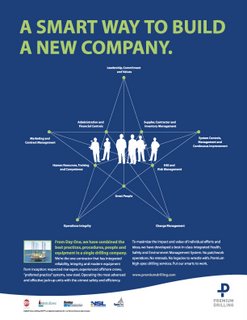
For a brand new company, Premium Drilling, we broke the mold. That’s me and Prism Design. We looked at existing advertising for drilling companies and presented our client with several more-or-less utterly different options. I credit Premium Drilling with selecting the differentest of the lot.

This new company got itself a running start, with every new jack-up rig a-building in Singapore already booked. Its two ads were specifically designed to run as a pair, with an initial appearance in that epitome of an oilfield annual, the Mobile Rig Register.

So the headline play is purposeful and highlights a company that decided how it wanted to operate from its inception: not only new but smart with it.

Much more important is the ads’ design. Here’s a very graphic approach to telling two stories in a unified format. Against its Premium Blue background, “Smart Way” uses a star-configured constellation of bullet points to emphasize the building blocks of the new company’s organizing principles, architected against silhouettes of some of its employees.

“New Way” organizes different bullet points – about the rigs’ technical features – as contributing factors, with a silhouette of one drill rig as its center. The designer integrates headlines, visuals, copy, even participating organizations, into cohesive wholes which deliver a different look to a market niche that has way too many photos of drill rigs as its main ad visuals.

My appreciation to Premium Drilling for allowing us to work with it on its advertising. And to my long-time colleagues at Prism, my thanks for letting me help create these atypical and vivid corporate ads.

For the record: Susan Reeves, Creative Director; Terry Teutsch, Designer/Art Director; Richard Laurence Baron, Copywriter.

Friday, April 28, 2006

Creative Process

Creativity is one thing. The process of creation, the experience, is something else.

OTC starts this Monday. When this 37th Offshore Technology Conference opens, more than 50,000 visitors will be going to Reliant Center for the world’s largest oilfield exhibition. If you are one of them, stop by the Mustang Engineering booth (#1305). Say hello to some outstanding people. And see a new video presentation called “The MUSTANG Experience” for yourself.

To say I helped create this 12-minute video is true. To say that it encompassed one of my most rewarding processes of creation is also true and a sizeable understatement.

No “creative” can take seven weeks of planning, videotaping and editing for granted. The team effort that has brought this video to the screen in an efficient, timely way is virtually unique in my worklife (which covers quite a few years).

Most of the credit goes to the Mustangers themselves: Allison Miller, Brian Hadley, Carmen Loera, Christine Beck, David Williams, Dee Medina, Dena Lee, Heather Broeder, Mark Payton, Mike Weatherwax, Paul Post, Richard Livingston, Sharon Paul and Tina Kutach – and these are just the Mustang participants whose names I can recall. At least a dozen more deserve mentions as well.

In Locke Bryan Productions, we had a way-better-than-just-good production house. Director-Producer Mike Patterson and his crew (on location and at the studio) accomplished a superlative job. They’ve delivered a story that fits Mustang Engineering to a T. Editing, music, graphics...this group’s calmness, consideration and talent contributed massively to my “MUSTANG Experience.”

I won’t tell you what’s in this 12-minute show.

I will tell you that the visual above is a title slide that doesn’t really reflect the thoughtfulness and the real-life feelings of the Mustangers on-screen. You’ll have to see it for yourself. Or ask me to show you my copy when OTC is over.

Thank you, everyone, for a great experience. See you at Reliant Center.

Thursday, April 27, 2006

Coffee Dog

When you’re driving to and from Austin on State Highway 71 (the one that runs up to the PDRA* from I-10 west of Columbus), do you miss Starbucks? I do. It’s a poorly disguised fact that I get nervous when I’m more than three miles from a Starbucks or some other high-quality java-source.

I use the term “miss” here in two ways. One is the sense of lacking something – like the boldest, heaviest battery-acid jamoke I can put in my travel mug.

The other is, like, maybe there is a Starbucks between West Katy and the eastern edge of Austin, but I haven’t noticed/found/run across one.

Now there’s an answer: Coffee Dog. I found it yesterday on my way up to Austin for a meeting. But you have to look sharp or you’ll miss it like I almost did. Its official address: 1421 Highway 71 West, Suite 100, Bastrop 78602 if you want to Mapquest it. Seven miles west of Bastrop, in the American Business Park strip center. Telephone: 512.303.2244.

Guy Roush has opened a very nice café here. The joe’s terrific and even if you like yours in one of Starbucks’ infinite variations, the lovely Coffee Dog people can deliver it. Along with assorted pastries. A nice place to sit down. And WiFi. Out there on the far west edge of Bastrop.

No website yet, but when they get one up, I’ll let you know. Meanwhile, keep an eye peeled on the north side of the road for the American Business Park (see the photo) and give it a try.

Coffee Dog got me those last 25 miles to Austin, for sure.

PS: The nice people even gave me a nifty Coffee DogTM “Frequent Slurper Card.” The 10th cup be free, oh yes.


*People’s Democratic Republic of Austin. Photograph courtesy of LoopNet.

Tuesday, April 25, 2006

Scott’s Winter

Working for ConocoPhillips in Anchorage, Scott McKinley has sent his fourth Life-in-Alaska report. Read along with the proprietor of McKinley Friends & Family B&B. “Book now,” says he. “Summer ’06 lodging is 70% full.”

Locals say there are two seasons to Alaska: winter and tourist. Anchorage is experiencing the last moments of the transition period; a time we call the “Spring Breakup.”
Spring Breakup is when the weather finally starts hovering consistently above the freezing mark. The roads become wet with melting snow, ice chunks (the size of SUVs) along the coast begin to shrink, and five months of frozen dog poop begins to thaw. It is a time of distinctive visual and olfactory “enlivenment”. It’s also a signal that the tourists will soon be arriving.

While most tourists opt for the relative certainty of summertime weather conditions, these fair-weather travelers have missed out on some uniquely Alaskan wintertime events.

Iditarod: a sled dog race from Anchorage to Nome, “a race over 1,150 miles of the most extreme and beautiful terrain known to man, across mountain ranges, frozen rivers, dense forests, desolate tundra and windswept coastline.” Imagine you, twelve of your favorite dogs, and a sled full of survival gear and dog food in the remote environs of Alaska for nine full days of mushing (the winning time) or even thirty-four days (the record for the slowest finish). Participation in the Iditarod may not be within the boundaries of most people’s imagination, but it was a joy to watch hundreds of dogs excitedly awaiting their sleds’ turn at the Iditarod starting line with guests from California, Texas and Colorado.

The modernized version of the Iditarod is a 2,000 mile snowmobile race. Called
Iron Dog, it is billed as the longest, toughest snowmobile race in the world. Imagine the same nasty temperatures as the Iditarod (as cold as -60°), then just add a wind-chill factor for speeds up to 100 miles per hour. Bryan Bonner was the brave Texan to come up and view the start of the Iron Dog from the middle of a frozen lake.

One thing we noticed: drivers of the snowmobiles were putting duct tape on their face. Evidently the helmets, balaclavas, and goggles weren’t effective at protecting the area around the eyes from the cold temperatures. Solution? Duct tape. Not recommended for everyday use, but riders report the tape also helps with unwanted facial hair.

The
Arctic Man is a downhill ski race and a snowmobile race, all in one. The skier begins at a summit elevation of 5,800 feet and drops 1,700 feet (in less than two miles) to the bottom of a narrow canyon where he meets up with his snowmobile partner. The skier grabs the (in-motion) snowmobile tow rope and gets pulled 2-1/4 miles uphill at speeds exceeding 90 mph. The skier and the snowmobiler separate as they top the second mountain, where the skier drops another 1,200 feet to the finish line. The winning time? 4 minutes, 4 seconds. Amazingly, no deaths have been reported.

To add to the uniqueness, a town actually “appears” in the middle of Alaska for this week-long event. Somebody snowplows a field and 12,000 people in RV’s show up for the fun. I missed this spectator sport this year…so if anybody wants to RV-camp next winter in the middle of nowhere, Alaska..?

Most tourists come during a three-month window to view the beauty of Alaska. The locals are glad to share the roads and trails, but we’re also glad to have the State mostly to ourselves for the other nine months. That’s when the true Alaskan spirit, the embracing of this Last Frontier, fully emerges.

Icebox that it is, Scott loves the place. Given that he also reports mountain winds blowing out a car window and falling through the ice, I know he will enjoy the arrival of summer – and that you’ll enjoy reading about his adventures.

Monday, April 24, 2006

Mitchum Man

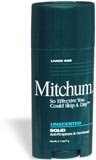
What you don’t see on this photo of a Mitchum antiperspirant container is ongoing evidence of the deodorant’s year-old advertising campaign. I only noticed these labels on my deodorant tubes yesterday…I swear.

One tube cap bears a label that says, “IF YOU ONLY SHAVE WHEN YOU HAVE TO, YOU’RE A MITCHUM MAN.”

Another tube cap label notes, “IF IT’S 96° BUT YOU SMELL LIKE 76°, YOU’RE A MITCHUM MAN.” What does that mean? Do any of the advertising people who put this together live in Texas?

It appears I missed an entire revolution in deodorant advertising – another one.

In an April, 2005, New York Times Advertising article, Nat Ives wrote about the new Mitchum ad campaign – which will tell you in a heartbeat that I’m not in the advertising agency’s key market demographic:

The goal was to introduce Mitchum to young men without alienating the older men who already buy it, said Kathy Delaney, managing partner and executive creative director at the flagship New York office of Deutsch, creator of the campaign.

Another coaster reads, “If you can see the inner beauty of the girl dancing on the bar, you’re a Mitchum man.” The men being aimed at, Ms. Delaney said, might think, ‘I don't go to topless bars and watch girls there any more, but that’s pretty funny and I remember when I did.’”

Maximesque marketing has proved effective on men in general and young men in particular, but it will lose strength if it does not recognize the target's particular circumstance, said Robin Wood, vice president for antiperspirant, deodorant and fragrance marketing at
Revlon, which sells Mitchum.

“These guys are guys who are entering or have entered into a completely different lifestyle,” Mr. Wood said. “They are advancing in their careers, are new fathers, have a great deal of demands. The thing they are really missing is time for themselves, which we call guy time.”

The campaign uses commercials during shows like “Fear Factor” on NBC and “Two and a Half Men” on CBS, ads in magazines like Sports Illustrated and The Week, matchbooks to accompany the coasters in bars, ads on Web sites like
www.moviefone.com and www.match.com, billboards across the country and posters in places like supermarkets and restrooms. Many of the ads point consumers to a new site, www.mitchumman.com.

(You have got to see this site – especially the “Mitchum Man-O-Log!”)

The messages are tailored to suit the venues, Mr. Wood said, noting that Maxim magazine will also run Mitchum ads. Maxim readers may receive the more risqué of the ads, like one that shows a close-up of a woman’s breasts with the text, “If they look real enough to you, you’re a Mitchum man.”

The campaign is the last for Mitchum from Deutsch, part of the
Interpublic Group of Companies. Deutsch resigned the Mitchum account last month after Revlon shifted other assignments, with far higher ad spending, from Deutsch to other agencies. Revlon spent $2.5 million to advertise Mitchum in major media in 2002, but no significant sums in 2003 or 2004, according to estimates by TNS Media Intelligence.

I don’t know which agency is doing the campaign now, but if the stickers on my Mitchum tubes are any indication, Revlon ought to get somebody new, and right quick, too.

Meantime, I’m going back to the Mitchum Man-O-Log and (with tears of laughter rolling down my cheeks) take a closer look at the Talking Buck’s Head and the Galvanized Roofing Nails. Apparently, they’d be crucial to my lifestyle if I was 30 – again.

Friday, April 21, 2006

Computing Accessory

Stone tools, the crudest type of flaked and battered stones, showed up…oh…2.5 million years ago. For humanity, the genie was out of the bottle; technology moved pretty quickly after that.

Weaving cloth: 25,000 BCE. Indoor bathrooms just 23,000 years later. The Chinese invent gunpowder, a popular number, around 1040 CE (that’s AD depending on your dating convention). Printing: 1440. The flying-shuttle loom: 1733. We’re really flying now.

Samuel F B Morse patents the practical – and successful – electric telegraph in 1837 (the world’s first Internet and the birth mother of the “telegrapher”). The vacuum tube: 1907. Then a short leap to color TV in 1940. The first electric computer: 1943, using the above-mentioned vacuum tubes. Simultaneously, the first propeller-head appears. The first transistor in 1948, which leads 10 years later to the first fully transistorized computer. By 1975, there’s a personal computer on the market – but Apple Computer is founded the following year.


A quarter of a century later, the second Internet has arrived, the world is almost completely wired and we can’t live without our communications infrastructure.

Now, according to Jeanne Sahadi, CNNMoney.com senior writer, one of the newest “in-vogue jobs” is Director of Mobile Computing:

Thanks to the BlackBerry, Treo, laptop and cell phone, every job can be turned into a 24/7 message fest. So integral are these devices to work life now that when the maker of the BlackBerry was facing a potential shut down of its services this year, you would have thought the business world was bracing for a loss of electricity. Upgrading all those portable lifelines to the office and keeping them in good working order has now become a full-time job with a big title.

A couple of a million years in the blink of an eye – and we’re hip-deep in people whose special expertise is keeping other people (who have to use the technology) intercommunicating and interconnected.

My hat’s off to them all. I cherish them and applaud their efforts to keep me in the marcom business. I enjoy working with my advanced technology clients – and my deepest thanks to them.

But tell me: every once in a while, don’t you have the urge to take up the crudest type of flaked and battered stone and bring it down on your server with deadly force?

Perhaps RIM (BlackBerry developer and manufacturer), Apple (iPOD creator) and other manufacturers should supply just such a stone tool to each and every newly minted Director of Mobile Computing. It’ll help keep them humble in the face of what we have wrought. Won’t it?


Have a great weekend.

Thanks and a tip of the Hatlo Hat to Rob Schoenbeck for the Sahadi article. Wikipedia Commons Image: en:Image:Acheuleanhandaxes.jpg.

Tuesday, April 18, 2006

The Commons

Look at this building. This is “The Commons.” Actually, the John P. McGovern Texas Medical Center Commons at the Texas Medical Center (or TMC if you’re into acronyms).

Unless you work in the TMC, or been to The Commons, you probably don’t have a clue how to get there. Let me tell you: it ain’t easy. The Commons is on the TMC campus…and you can’t see it from any of the main streets.

Here is how you get to it. If you can’t figure it out from the “Take Three Simple Steps to Our Door” arrangement, plug The Commons’ address into Mapquest: 6550 Bertner, Houston, TX 77030.

Why point this out?


I want to make certain you find your way to the Service Line Marketing for Hospitals and Group Practices presentation. It’s the American Marketing Association Healthcare Special Interest Group event on May 16, 2006.

Just under a month from now. At the Trevísio restaurant in The Commons. That building in the picture right up there. That’s why I’m showing you what it looks like. Print a hard copy. Tape it to your computer. (Stop with the whining…I know it’s hard to get in and out of TMC.)

Gail M McFaddin, Director of Business Development of RHD Memorial Medical Center in Dallas, is one of the speakers. Gail has developed and executed on business strategy for three healthcare start-ups and has consulted with some of the largest integrated delivery systems in the country. She is a national and international speaker on healthcare topics of interest and was the CIGNA liaison to the Clinton White House on rural healthcare in America. She’s going to present a pointed case history about Service Line Marketing.

You ought to hear it. Here is the link to online registration for the Healthcare SIG event on Tuesday, May 16. At The Commons. Parking inside the building (when you find it).


Come on down. Really. It’ll be worth the trip.

Saturday, April 15, 2006

Friday, April 14, 2006

Shocking Direct


What’s old is news again – especially in direct mail.

The much lauded Halloween Mask Mailers created by illustrator Chris Lockwood and Richard Laurence Baron (me) are hot items again, since Martha Justice, President of The Premier Company, was written up in the Houston Business Journal last week. The
article by Thora Qaddumi talked about a number of creative direct mail formats, which Premier uses and in some cases pioneered.

One of these outstanding ShapeUpTM mask mailers appears above. There’s a ghoul and Frankenstein’s bride too. I had a hard time picking which one to show you hear – not because they aren’t terrific every one; but because they’re largish files. In fact, though you can easily see why Chris is such a superb illustrator, you probably can’t read my equally expert copy.

So e-mail me and I will send you a full set of jpegs…or ask Martha to send you an actual printed set of all four.

Thanks to Chris’s inventiveness, these die-cut mailers are all about capturing the recipients’ attention. Nobody who got the Mask Mailers has forgotten them. Some are still taped to people’s filing cabinets or pinned to managers’ walls all over this part of the world. Martha wanted to take advantage of the fact that the USPS now allows odd shapes to be mailed. Martha let us run with the concept that Halloween masks would be arresting, provocative…and really cool. I even invented the “ShapeUp” brand name for them.

Each mailer’s copy highlighted a specific area of Premier capability. I tuned the headlines to Chris’s amazing Illustrations.

The timing is perfect: what Chris and I created for Premier illustrates the precise point I made in Monday’s post about b-o-o-o-r-r-ing credit card mail packages (see below). The Masks are what creativity can do for direct mail. Anyone who discounts creativity as a driver is making a mistake – or do you want to bore your mail recipients to death?

Yes: one banker told me that a 2% response rate to the bank’s direct mail packages made the boring approach difficult to ignore – for the bank. As I said, the numbers are on their side (‘cause 2% of, say, a million pieces is a pretty big number).

Yes: Martha points out that although self-mailers are cheaper to produce, they practically never out-pull envelope-enclosed letter mailings. Golly, what if you combined the horsepower of (say) Lockwood-Baron creativity with your key message? What if you got the recipient to really pay attention to your offer?

I invite someone of you to find out – and measure the results. They could shock the boring right out of your prospects.


Thanks and a tip of the Hatlo hat to Chris Lockwood for the jpg files, and to The Premier Company for printing and mailing the mask series.

Thursday, April 13, 2006

Opening Night

Today is my birthday. I’m celebrating by telling my sister to break a leg, because she opens tonight in A Fine & Private Place at the York Theatre Company in NYC.

Evalyn Baron is a great actor – started when she was 12. The Broadway portion of her career has encompassed Big River and Les Misérables among many, many others. She was Tony-nominated for her role in Quilters.

So after some years as the assistant creative director for Barter Theatre in Virginia and returning to New York to teach, her opening tonight is a wonderful opportunity to be where she’s supposed to be: legitimate theatre.

Don’t know much about the play. Peter S. Beagle wrote the original novel. Then it was turned into a musical by Erik Haagensen (book and lyrics) and Richard Isen (music). According to the theatre’s newsletter:

The show tells the story of Jonathan Rebeck, a recluse who lives in a Bronx cemetery courtesy of his feathered friend, a wise (and wisecracking) Raven who flies in stolen fast food in exchange for companionship. Rebeck…helps newly arrived ghosts…accept death. Once these ghosts no longer remember what it is to be alive, they vanish.

Ev’s not a ghost – she’s a widow who continually visits the tomb of her husband. I think she represents the pull of life. The director, Gabriel Barre, says he hopes the revived musical will make audiences “not want to waste a moment of this opportunity we call life.”

Evalyn has a history with this musical. She was in the original cast – you can hear her on the album. You can read all about her adventures with rehearsals and her fellow actors on her blog.

Break a leg, Sis. Your opening is finest kind birthday gift.