While Barbara finishes up a "final" shopping list, I have canvassed the neighbors on our block. Some are leaving, or have left already. Half us of - six or seven families - are staying, and will watch the neighborhood carefully. Our biggest challenge is policing the area for UFO materials. Some evacuees haven’t been as careful as others. We have a very stable neighborhood, and most of us know one another. Cellular service, or the lack of it, is the most-remarked failure so far.
This afternoon, after putting our own planters, water bottles, and deck chairs away, I’ll round up a couple of guys and try to stuff trash cans, etc., in safer places. Across Kempwood, there’s a yet-undeveloped pasture whose owner keeps longhorn cattle. So finding the information below, on www.juliantrubin.com, is appropriate for this entry. Simply replace the word “tornado” with the word “hurricane.”
Everybody knows about the Fujita Scale which measures the power of tornadoes. But nobody really knows what all those types of twisters do to COWS. So here is the MOOJITA Scale...
M0 Tornado - Cows in an open field are spun around parallel to the wind flow and become mildly annoyed.
M1 Tornado - Cows are tipped over and can't get up.
M2 Tornado - Cows begin rolling with the wind.
M3 Tornado - Cows tumble and bounce.
M4 Tornado - Cows are airborne.
M5 Tornado – STEAK!
Saturday evening may be Steak Night in Spring Branch. Good luck to those driving out. Good luck to those staying behind.
Thursday, September 22, 2005


We're Staying
Good morning. We're staying, and will continue our preparations for the coming storm. This will include pickup and storage for everything in the front and back yards – no UFOs. Then I'll visit the neighbors - see who's staying and who's not. While electricity and cellular services continue, I'll keep posting. Thank you for your e-notes of caution and care.
I am also participating in an experiment by the Houston Chronicle in "citizen journalism." Go to http://blogs.chron.com/stormwatchers/, the newspaper's blog site, to follow what's happening. More anon.
I am also participating in an experiment by the Houston Chronicle in "citizen journalism." Go to http://blogs.chron.com/stormwatchers/, the newspaper's blog site, to follow what's happening. More anon.
Wednesday, September 21, 2005
Rita's Coming
…And she’s got a 165-mph chip on her shoulder. Some of my out-of-town readers don’t actually realize what’s in store for us down here, even in the aftermath of Hurricane Katrina and its considerable news coverage. Evacuees are not taking any chances...they are getting away before this turns ugly.
I was at the HEB supermarket on the corner of Gessner and Kempwood early this morning, about 8AM. It was already crowded, but everyone was polite and patient. HEB has a distribution center about a mile north, on Clay Road. So stockers were refilling the shelves as quickly as possible. Bottled water, tuna, and diapers were top o' the pops this AM.
Now that the storm has been upclassed to 5, more and more people will leave the area. The Interstate highways to the west and north are bumper-to-bumper, and the Sam Houston Tollway (a portion of which I can see out my back window) is abnormally congested.
Barbara and I will discuss Rita’s impending arrival this evening, and plan from there. My normally reliable cell phone is hobbled by Cingular's circuits being busy right now. It's a bit of a mess - but it's an early mess.
More on this later – I’ll try to keep you up to date on our whereabouts…we may decide to depart early for Minnesota. Be safe: Rita doesn’t look like she’s worth the wait.
I was at the HEB supermarket on the corner of Gessner and Kempwood early this morning, about 8AM. It was already crowded, but everyone was polite and patient. HEB has a distribution center about a mile north, on Clay Road. So stockers were refilling the shelves as quickly as possible. Bottled water, tuna, and diapers were top o' the pops this AM.
Now that the storm has been upclassed to 5, more and more people will leave the area. The Interstate highways to the west and north are bumper-to-bumper, and the Sam Houston Tollway (a portion of which I can see out my back window) is abnormally congested.
Barbara and I will discuss Rita’s impending arrival this evening, and plan from there. My normally reliable cell phone is hobbled by Cingular's circuits being busy right now. It's a bit of a mess - but it's an early mess.
More on this later – I’ll try to keep you up to date on our whereabouts…we may decide to depart early for Minnesota. Be safe: Rita doesn’t look like she’s worth the wait.
Tuesday, September 20, 2005
Type Brands
Next to my computer sits a bottle of champagne. The real stuff: Champagne S. Coquillette à Chouilly, from grower Stephane Coquillette in the Marne. It’s not a brand you’ll find stateside. It came as a house gift from Philippe and Christiane Holtzweiler of Freiburg, Germany, when Philippe visited us this past spring.
This is different way to look at brand types – as opposed, say, to manufacturer brands and own-label brands. Think of a type brand as a product descriptor that has become so familiar that it lives and breathes on its own. The European Union strongly believes “Champagne” is a geographic indicator that should be used only for wines made in the region of that name. The same is true of names like “Sherry” and “Port.” (“Escalator” is the reverse – an actual brand name that became a generic term. “Band-Aid” narrowly escaped this fate.)
The US believes champagne, sherry, and port are “semi-generics.” It’s important to the concept of type brand, because it’s taken the EU and the US more than 20 years to approve a wine-trade agreement. (This is reported in last Thursday’s Wall Street Journal, page A18, reported by Sarah Nassauer.)
Technical details aside, some European winemakers accuse various US sparkling-wine makers of purposely misleading consumers. That is, American wineries put “Champagne” on their labels when the wines are actually made in California or Texas or Washington State. Real champagne should come from…Champagne.
It’s pretty serious stuff. According to Ms. Nassauer, 43% of Europe’s wine exports came to the US last year. That’s a lot of money. Think about it another way. Would the Disney Company willing have used DisneyTerre instead of “Disneyland Paris?”
Most US brand names and descriptors never leave the country. The American consumer and industrial markets are so hugeous, there’s often no need to consider the impact and meaning of terms in other parts of the world. But what happens when type brands are involved? Doesn’t the term “Washington State Apples” have a brand value when the fruit is exported to Japan? What happens when Japanese apple-growers (orchardists?) use such a term to describe their apples, in order to capture that indication-of-origin caché? Would you buy “Swiss-like Chocolate?” How much “Italian sausage” do you buy that’s actually made in Italy? When you purchase “Virginia ham,” is it really from Virginia? How about “Canadian bacon?”
Many of these terms entered American usage years, even centuries ago. My Oxford English Dictionary credits Champagne as “the name of a province in Eastern France” and notes its first use with a capital “C” in 1664. Encarta notes that the “process of making sparkling wine has been copied by wine-makers in many other parts of the world. These producers may put the words méthode traditionnelle on bottles to indicate that the champagne method has been used, but they may not use the words champagne or méthode champenoise.” (I’m using Champagne as an example – not a political exercise.)
When you go to the liquor store to pick up a little something for your anniversary, do you ask for “sparkling wine” or “champagne?” I thought so.
Producers and manufacturers have a right to protect their brands and descriptors, especially when such descriptors gain wide acceptance. Overcoming consumer habit, on the other hand, may make a brand program much more expensive and time-consuming. Ask Coca-Cola.
This seemingly obscure US-EU settlement has some impact on the branding work I do. I’ll consider it further as Barbara and I are drinking the 1998 Champagne S. Coquillette à Chouilly. Cheers!
This is different way to look at brand types – as opposed, say, to manufacturer brands and own-label brands. Think of a type brand as a product descriptor that has become so familiar that it lives and breathes on its own. The European Union strongly believes “Champagne” is a geographic indicator that should be used only for wines made in the region of that name. The same is true of names like “Sherry” and “Port.” (“Escalator” is the reverse – an actual brand name that became a generic term. “Band-Aid” narrowly escaped this fate.)
The US believes champagne, sherry, and port are “semi-generics.” It’s important to the concept of type brand, because it’s taken the EU and the US more than 20 years to approve a wine-trade agreement. (This is reported in last Thursday’s Wall Street Journal, page A18, reported by Sarah Nassauer.)
Technical details aside, some European winemakers accuse various US sparkling-wine makers of purposely misleading consumers. That is, American wineries put “Champagne” on their labels when the wines are actually made in California or Texas or Washington State. Real champagne should come from…Champagne.
It’s pretty serious stuff. According to Ms. Nassauer, 43% of Europe’s wine exports came to the US last year. That’s a lot of money. Think about it another way. Would the Disney Company willing have used DisneyTerre instead of “Disneyland Paris?”
Most US brand names and descriptors never leave the country. The American consumer and industrial markets are so hugeous, there’s often no need to consider the impact and meaning of terms in other parts of the world. But what happens when type brands are involved? Doesn’t the term “Washington State Apples” have a brand value when the fruit is exported to Japan? What happens when Japanese apple-growers (orchardists?) use such a term to describe their apples, in order to capture that indication-of-origin caché? Would you buy “Swiss-like Chocolate?” How much “Italian sausage” do you buy that’s actually made in Italy? When you purchase “Virginia ham,” is it really from Virginia? How about “Canadian bacon?”
Many of these terms entered American usage years, even centuries ago. My Oxford English Dictionary credits Champagne as “the name of a province in Eastern France” and notes its first use with a capital “C” in 1664. Encarta notes that the “process of making sparkling wine has been copied by wine-makers in many other parts of the world. These producers may put the words méthode traditionnelle on bottles to indicate that the champagne method has been used, but they may not use the words champagne or méthode champenoise.” (I’m using Champagne as an example – not a political exercise.)
When you go to the liquor store to pick up a little something for your anniversary, do you ask for “sparkling wine” or “champagne?” I thought so.
Producers and manufacturers have a right to protect their brands and descriptors, especially when such descriptors gain wide acceptance. Overcoming consumer habit, on the other hand, may make a brand program much more expensive and time-consuming. Ask Coca-Cola.
This seemingly obscure US-EU settlement has some impact on the branding work I do. I’ll consider it further as Barbara and I are drinking the 1998 Champagne S. Coquillette à Chouilly. Cheers!
Monday, September 19, 2005
Pirate Talk
Avast, ye swabs! What do the following three jokes sent in by Rachel Baron have in common?
1. What is a pirate’s favorite cheese? [A: Jarlsburg].
2. Which is a pirate’s favorite body of water? [A: The Arctic Ocean].
3. Where do pirates travel in the States? [A: They just love ole Arkansas].
Now, say the answers again – out loud – keeping in mind that today is National Talk Like a Pirate Day! Arrrh! Yer right, mateys, it’s talk like a pirate or walk the plank.
Whether or not you’re a fan of Treasure Island (and my all-time favorite plot device, the Black Spot), go to www.talklikeapirateday.com. Don’t ‘ee dare stop to pick up that buried treasure.
You’ll find the whole story there. But the plain fact is that National Talk Like a Pirate Day was invented by John Baur and Mark Summers just over 10 years ago: “…And that really should be all you need to know about the origins of Talk Like a Pirate Day. We're guys. Not men, with responsibility and suits and power ties. We're guys, with all that that implies.”
Robert Louis Stevenson enthusiasts know this. Members of The Gun Room, the Aubrey-Maturin über-group site, know this. Even fans of “Pirates of the Caribbean” know this. Just with the basics (I’ve pirated these from their web site), like:
Ahoy! - "Hello!"
Avast! - Stop and give attention. It can be used in a sense of surprise, "Whoa! Get a load of that!" which today makes it more of a "Check it out" or "No way!" or "Get off!"
Aye! - "Why yes, I agree most heartily with everything you just said or did."
Aye aye! - "I'll get right on that, sir, as soon as my break is over."
Arrr! - This one is often confused with arrrgh, which is of course the sound you make when you sit on a belaying pin. "Arrr!" can mean, variously, "yes," "I agree," "I'm happy," "I'm enjoying this beer," "My team is going to win it all," "I saw that television show, it sucked!" and "That was a clever remark you or I just made." And those are just a few of the myriad possibilities of Arrr!
Now ye know it too. Start early – talk like a pirate, ye lubbers, else it’s the Black Spot fer ye. Or a one-way trip to the Arrrtic.
1. What is a pirate’s favorite cheese? [A: Jarlsburg].
2. Which is a pirate’s favorite body of water? [A: The Arctic Ocean].
3. Where do pirates travel in the States? [A: They just love ole Arkansas].
Now, say the answers again – out loud – keeping in mind that today is National Talk Like a Pirate Day! Arrrh! Yer right, mateys, it’s talk like a pirate or walk the plank.
Whether or not you’re a fan of Treasure Island (and my all-time favorite plot device, the Black Spot), go to www.talklikeapirateday.com. Don’t ‘ee dare stop to pick up that buried treasure.
You’ll find the whole story there. But the plain fact is that National Talk Like a Pirate Day was invented by John Baur and Mark Summers just over 10 years ago: “…And that really should be all you need to know about the origins of Talk Like a Pirate Day. We're guys. Not men, with responsibility and suits and power ties. We're guys, with all that that implies.”
Robert Louis Stevenson enthusiasts know this. Members of The Gun Room, the Aubrey-Maturin über-group site, know this. Even fans of “Pirates of the Caribbean” know this. Just with the basics (I’ve pirated these from their web site), like:
Ahoy! - "Hello!"
Avast! - Stop and give attention. It can be used in a sense of surprise, "Whoa! Get a load of that!" which today makes it more of a "Check it out" or "No way!" or "Get off!"
Aye! - "Why yes, I agree most heartily with everything you just said or did."
Aye aye! - "I'll get right on that, sir, as soon as my break is over."
Arrr! - This one is often confused with arrrgh, which is of course the sound you make when you sit on a belaying pin. "Arrr!" can mean, variously, "yes," "I agree," "I'm happy," "I'm enjoying this beer," "My team is going to win it all," "I saw that television show, it sucked!" and "That was a clever remark you or I just made." And those are just a few of the myriad possibilities of Arrr!
Now ye know it too. Start early – talk like a pirate, ye lubbers, else it’s the Black Spot fer ye. Or a one-way trip to the Arrrtic.
Saturday, September 17, 2005
Yellow Journalism
Attention, media friends: Now that Viet Hoang is publishing Yellow magazine, an old term takes on a whole new meaning.
At the end of the 19th Century, Americans got their news from newspapers – they were pretty much the only news sources. Major newspapers like Joseph Pulitzer’s New York World and William Randolph Hearst’s San Francisco Examiner and later the New York Morning Journal changed their newspapers to attract more readers (the “circulation wars”). Sensational stories and scandalous news coverage were ordered up; garish drawings and comic strips were added. Editors actively demanded and printed irresponsible and flamboyant news reporting. After Pulitzer began publishing color comic sections that included a strip entitled "The Yellow Kid" in early 1896, this type of paper was labeled yellow journalism.
A funny thing happened on the way to the 21st Century: the complexion of America changed.
Today (by 2004 figures, www.infoplease.com), Asians and Asian-Americans make up 4.2% of our population, more than 12 million of us. Additional studies show that this part of our population is one of the best educated and the most affluent in our history.
Yellow, which Hoang began publishing last spring, appeals to this part of Houston’s kaleidoscopic population. It’s up-to-the-moment, vivid, and beautifully produced. These days, it’s referred to as a niche publication, and it’s one of the best designed new magazines in the Houston area.
It focuses on fashion, lifestyle, art, and entertainment, and the Asian-American people who are involved in these areas. The only “yellow kids” that appear in its pages are artists, fashion models, doctors, politicians, and restaurateurs – talented, young, and trendy.
It’s already attracting major advertisers, who recognize the significant buying power that Asian-Americans represent. The September number is available now, and if you haven’t seen it, you should pick up a copy or go to www.yellowmags.com. It’ll change the way you think about population segments and give you a creative media opportunity to take to your retail and commercial clients.
Do it today. There’s no better sound that that of a stereotype being smashed.
At the end of the 19th Century, Americans got their news from newspapers – they were pretty much the only news sources. Major newspapers like Joseph Pulitzer’s New York World and William Randolph Hearst’s San Francisco Examiner and later the New York Morning Journal changed their newspapers to attract more readers (the “circulation wars”). Sensational stories and scandalous news coverage were ordered up; garish drawings and comic strips were added. Editors actively demanded and printed irresponsible and flamboyant news reporting. After Pulitzer began publishing color comic sections that included a strip entitled "The Yellow Kid" in early 1896, this type of paper was labeled yellow journalism.
A funny thing happened on the way to the 21st Century: the complexion of America changed.
Today (by 2004 figures, www.infoplease.com), Asians and Asian-Americans make up 4.2% of our population, more than 12 million of us. Additional studies show that this part of our population is one of the best educated and the most affluent in our history.
Yellow, which Hoang began publishing last spring, appeals to this part of Houston’s kaleidoscopic population. It’s up-to-the-moment, vivid, and beautifully produced. These days, it’s referred to as a niche publication, and it’s one of the best designed new magazines in the Houston area.
It focuses on fashion, lifestyle, art, and entertainment, and the Asian-American people who are involved in these areas. The only “yellow kids” that appear in its pages are artists, fashion models, doctors, politicians, and restaurateurs – talented, young, and trendy.
It’s already attracting major advertisers, who recognize the significant buying power that Asian-Americans represent. The September number is available now, and if you haven’t seen it, you should pick up a copy or go to www.yellowmags.com. It’ll change the way you think about population segments and give you a creative media opportunity to take to your retail and commercial clients.
Do it today. There’s no better sound that that of a stereotype being smashed.
Friday, September 16, 2005
Disaster Reporting
Thanks to Rob Schoenbeck of The Cartel in San Antonio for sending this article. It fits with other posts about communicating in a disaster. Reportage is communication, for sure.
It’s a long piece (yes, you have to read to the end) from today’s London Times, bylined by Gerard Baker. All copyrights apply.
Space, food, medicine, protection:
it's better here in Barbara's hall of plenty
BARBARA BUSH. Don’t you just love her? Last week she put her elegant heel right into what her husband used to call deep doo-doo when she told a television interviewer that evacuees from Hurricane Katrina who had been housed in the Houston Astrodome were really very happy with their lot.
“What I’m hearing is that many of them want to stay in Texas,” the former First Lady said. “The hospitality has been so overwhelming. And so many of the people in the arena here, you know, were underprivileged anyway, so this is working very well for them.”
Not since Louis XVI’s missus puzzled about the dietary choices of indigent Parisians has there been such an appalling display of aristocratic ignorance. How dare she? How could she? Even the White House winced.
But in the disgust that greeted her remarks in Highgate and the Upper West Side no one stopped to consider the possibility that Mrs Bush was, in fact, dead right.
Anyone who has visited the most deprived parts of America’s cities, rather than merely empathised with them from afar, would have no difficulty whatsoever with the proposition that the inhabitants would prefer an air-conditioned sports stadium with all the food they can eat, the country’s best medical attention and the benign security of National Guard protection to the hunger, sickness and lawlessness in which many of them live.
Large parts of Detroit, Philadelphia, Chicago or Los Angeles already look, on their best days, as though they have been hit by natural disasters. I’m not at all surprised to hear that the fortunate who made it to Houston are eager to start new lives there, rather than return to the crime-infested housing projects of New Orleans.
But Mrs Bush touched on a larger truth, almost wholly obscured in the rush to judgment. Most of the attention has focused on how the Government failed in responding to the disaster. I have done it myself. Grand conclusions have been drawn about the (flawed) nature of American society. I’ve done a bit of that too. But little has been said about what the response of ordinary Americans — not mayors or governors or presidents — tells us about the strengths of that same American society.
Another lucky group of New Orleans evacuees has been housed not far from where I live in Washington at the DC Armoury, the local headquarters of the National Guard. This week, along with the truckloads of food, water and clothes, came something that will, in the longer term, be of even greater assistance, a group of eager employers looking for workers.
Forty-two local businesses participated in a job fair for the new homeless at the Armoury on Tuesday; more wanted to take part but couldn’t because there was limited space. Twenty of the 150 or so evacuees were hired on the spot. An official at the District of Columbia government involved in organising the event said that more were expected to be offered jobs in the next few days. The exercise was such a success that employers are demanding another one. If there’s anyone left still to hire it will take place in the next couple of weeks.
The story is being replicated across the country. The victims of Katrina are getting new opportunities. Some of it comes from an immense outpouring of compassion by Americans in the form of hundreds of millions of dollars in charitable contributions and unquantifiable help in housing families and schooling children. Some of it comes from the unsentimental compassion of the free market: the unerring capacity of the capitalist system to match those who have something with those who need it, whether it be labour, capital, goods or services.
Both tell us far more about the way this country works, the strengths of its values and people, than the bureaucratic bungling in Baton Rouge and Washington.
Of course you will almost certainly not have read or seen much about this, especially outside the US. The world has indicted America once again on charges of ineptitude and racism and has moved on to more important matters such as Britney Spears’s baby. For a variety of reasons this good news about the response of ordinary Americans is of little interest to the media. First, no self-respecting reporter wants to waste his time with insights into the better angels of human nature. No one ever won a Pulitzer or a Bafta recounting banal tales of man’s humanity to man.
Secondly, it really doesn’t fit too well into the stereotype that entrances most of the world these days. Anything that doesn’t show Americans as stupid, selfish, warmongering, religious bigots, half of them living in pampered luxury in garish purpose-built Italianate mansions, the other half downtrodden in the ghetto by Halliburton stock-owning fat-cats, isn’t going to make it to the front pages or the Ten O’Clock News.
But the main reason I think these recovery efforts by millions of people attract insufficient attention is that most people have become conditioned to thinking solely in terms of government’s responsibility. Of course, the bulk of the recovery effort must be paid from public funds as President Bush announced yesterday but most Europeans and — despite decades of a so-called conservative revolution — a large number of Americans, can’t think beyond the government.
Something bad happens: it’s government’s fault for not preventing it. It’s government’s responsibility for cleaning up the mess. And if the mess gets bigger, that’s government’s fault too.
The irony is that New Orleans is one of those cities where government-dependency had reached such levels that a kind of economic and social anomie had set in. For many of its victims the escape depicted by Barbara Bush is just what they needed.
It’s a long piece (yes, you have to read to the end) from today’s London Times, bylined by Gerard Baker. All copyrights apply.
Space, food, medicine, protection:
it's better here in Barbara's hall of plenty
BARBARA BUSH. Don’t you just love her? Last week she put her elegant heel right into what her husband used to call deep doo-doo when she told a television interviewer that evacuees from Hurricane Katrina who had been housed in the Houston Astrodome were really very happy with their lot.
“What I’m hearing is that many of them want to stay in Texas,” the former First Lady said. “The hospitality has been so overwhelming. And so many of the people in the arena here, you know, were underprivileged anyway, so this is working very well for them.”
Not since Louis XVI’s missus puzzled about the dietary choices of indigent Parisians has there been such an appalling display of aristocratic ignorance. How dare she? How could she? Even the White House winced.
But in the disgust that greeted her remarks in Highgate and the Upper West Side no one stopped to consider the possibility that Mrs Bush was, in fact, dead right.
Anyone who has visited the most deprived parts of America’s cities, rather than merely empathised with them from afar, would have no difficulty whatsoever with the proposition that the inhabitants would prefer an air-conditioned sports stadium with all the food they can eat, the country’s best medical attention and the benign security of National Guard protection to the hunger, sickness and lawlessness in which many of them live.
Large parts of Detroit, Philadelphia, Chicago or Los Angeles already look, on their best days, as though they have been hit by natural disasters. I’m not at all surprised to hear that the fortunate who made it to Houston are eager to start new lives there, rather than return to the crime-infested housing projects of New Orleans.
But Mrs Bush touched on a larger truth, almost wholly obscured in the rush to judgment. Most of the attention has focused on how the Government failed in responding to the disaster. I have done it myself. Grand conclusions have been drawn about the (flawed) nature of American society. I’ve done a bit of that too. But little has been said about what the response of ordinary Americans — not mayors or governors or presidents — tells us about the strengths of that same American society.
Another lucky group of New Orleans evacuees has been housed not far from where I live in Washington at the DC Armoury, the local headquarters of the National Guard. This week, along with the truckloads of food, water and clothes, came something that will, in the longer term, be of even greater assistance, a group of eager employers looking for workers.
Forty-two local businesses participated in a job fair for the new homeless at the Armoury on Tuesday; more wanted to take part but couldn’t because there was limited space. Twenty of the 150 or so evacuees were hired on the spot. An official at the District of Columbia government involved in organising the event said that more were expected to be offered jobs in the next few days. The exercise was such a success that employers are demanding another one. If there’s anyone left still to hire it will take place in the next couple of weeks.
The story is being replicated across the country. The victims of Katrina are getting new opportunities. Some of it comes from an immense outpouring of compassion by Americans in the form of hundreds of millions of dollars in charitable contributions and unquantifiable help in housing families and schooling children. Some of it comes from the unsentimental compassion of the free market: the unerring capacity of the capitalist system to match those who have something with those who need it, whether it be labour, capital, goods or services.
Both tell us far more about the way this country works, the strengths of its values and people, than the bureaucratic bungling in Baton Rouge and Washington.
Of course you will almost certainly not have read or seen much about this, especially outside the US. The world has indicted America once again on charges of ineptitude and racism and has moved on to more important matters such as Britney Spears’s baby. For a variety of reasons this good news about the response of ordinary Americans is of little interest to the media. First, no self-respecting reporter wants to waste his time with insights into the better angels of human nature. No one ever won a Pulitzer or a Bafta recounting banal tales of man’s humanity to man.
Secondly, it really doesn’t fit too well into the stereotype that entrances most of the world these days. Anything that doesn’t show Americans as stupid, selfish, warmongering, religious bigots, half of them living in pampered luxury in garish purpose-built Italianate mansions, the other half downtrodden in the ghetto by Halliburton stock-owning fat-cats, isn’t going to make it to the front pages or the Ten O’Clock News.
But the main reason I think these recovery efforts by millions of people attract insufficient attention is that most people have become conditioned to thinking solely in terms of government’s responsibility. Of course, the bulk of the recovery effort must be paid from public funds as President Bush announced yesterday but most Europeans and — despite decades of a so-called conservative revolution — a large number of Americans, can’t think beyond the government.
Something bad happens: it’s government’s fault for not preventing it. It’s government’s responsibility for cleaning up the mess. And if the mess gets bigger, that’s government’s fault too.
The irony is that New Orleans is one of those cities where government-dependency had reached such levels that a kind of economic and social anomie had set in. For many of its victims the escape depicted by Barbara Bush is just what they needed.
In response to the huge flood that drowned the Gulf Coast in 1927, President Calvin Coolidge sent his secretary of Commerce, Herbert Hoover, to head the mainly private-sector reconstruction effort. As quoted in yesterday's Wall Street Journal, Hoover said, "I suppose I could have called in the whole of the Army. But what was the use? All I had to do was call in Main Street itself."
Thanks, Mr. Baker, for writing about what Main Street really means to America. Thanks, Rob, for passing it along.
Wednesday, September 14, 2005
Ware Marriage
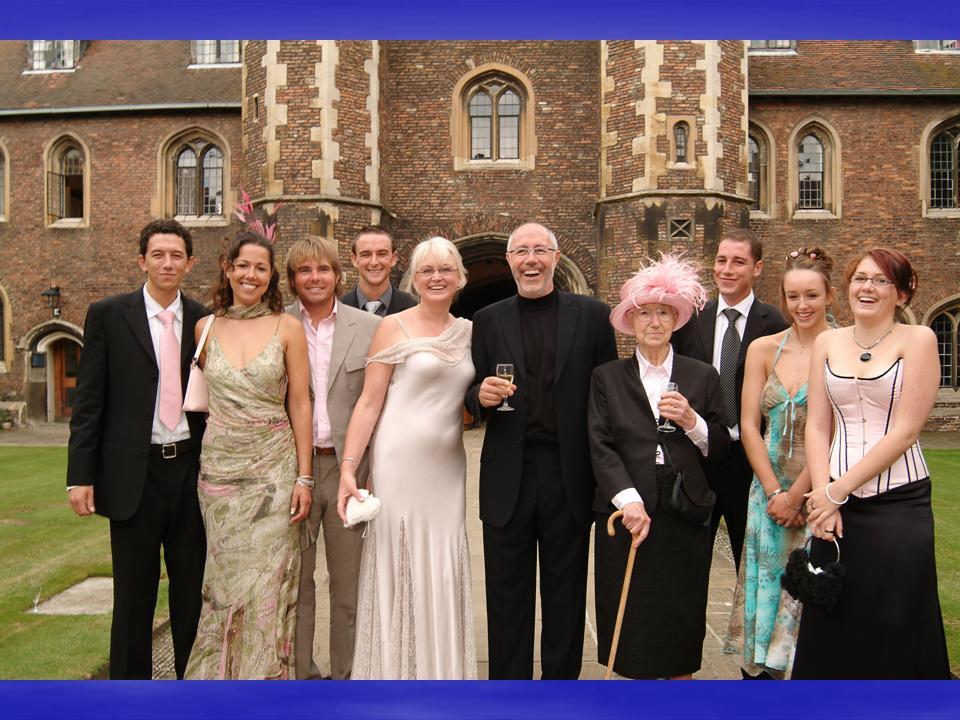 Not a warning...a celebration! I hadn’t gotten recent news from Robert Ware, former principal of Ware Anthony Rust (WAR), the fine British ad agency and Dialogue International’s UK member.
I wrote him yesterday and he answered with a surprise: “Di and I have got married after 18 years together – a wonderful occasion at the Old Hall at Queens’ College in Cambridge.”
I’d better give you his picture’s caption before this post gets too lengthy.
PHOTO: The Ware family is a truly modern unit as it comes in the shape of a 'blended/extended' group. The picture, L2R shows Barney Ware, Kirsty Ware, Damian Drury (KW's partner), Tim Hall (son of my first wife with second husband, stepbrother of B, K &T, and brother of Emily), Diane Ware, Robert Ware, Winifred Ware (mother of RW and going strong at 94!), Toby Ware, Emily Hall (see Tim Hall), Hannah Ware (daughter of R&D).
Whew! I’m crazy fond of Winifred’s hat. That’s Old Hall in back, I guess…looks old. Diane (née Spencer) looks phenomenal.
There are many more photos, which I’ll summarize this way. Some 80 guests attended, including Graham and Jo Rust from Prague. Graham is Robert’s former partner who left WAR years ago to start an ad agency in The Czech Republic – another staunch Dialogue member to this day.
The wedding site, as mentioned above, was Queens’ Old Hall, very recently refurbished so that, according to Robert, the colors looked as new (so that's only about 500 years ago). “Quite staggering,” says the groom, “and a tremendous privilege to be able to party in such a majestic hall.”
His final quote: “And the only pagan thing about the occasion was the amount of 'liquid refreshment’ that was cheerfully consumed. This probably fuelled some of the interesting and irreverent comments to be found in the 'Wedding Book’ – a beautifully made Florentine leather-bound volume – that everyone was asked to add their bon mot within. Great fun was had by all.”
Robert has, over the years, been a terrific colleague as well as a long-distance friend. I have enjoyed Robert’s great spirits (and Diane’s and Hanna’s) on more than one occasion, not only at Dialogue Managers’ Meetings but at the Wares’ home. (We’ll leave that part of the story gracefully cloaked.) The company and the hospitality have always been heart-warming.
In addition to raising up a very excellent marcom agency just across the Cam and the Water Meadow from Cambridge’s great colleges, then leaving WAR to be carried on in the hands of an superb crew, he’s got himself officially hitched up. I’m sure that, at the very instant of matrimony, Robert said to his new bride, “Now, Diane Spencer, be Ware!”
Robert and Di, congratulations from the Republican part of Texas. I’m uncertain if the realm of British advertising will survive while you improve your golf handicap, but I wish both of you the very, very best of life.
Tuesday, September 13, 2005
Advertising Sweat
When cellular circuits are busy and the people you have to reach can’t reach a computer, voice and Internet vectors may not be enough – just what’s happened in the wake of Hurricane Katrina.
Despite the stories you hear about the impending demise of print and other older media forms, there are times when you have to use every weapon in the inventory. When getting the word out is critical, companies turn to…advertising.
There are several kinds of communications. First, recent appearances of ads and broadcast announcements drive home the point that corporations are doing everything in their power to get information in front of their employees and employee families. In the Houston Chronicle alone, there has been a stream large-space advertising from a host of companies – Northrop Grumman and BP, to name just two – offering every kind of assistance: benefits information, housing options, contact phone numbers, paycheck pickup locations.
The advertising is supplemented by highly visible corporate home-page links to relief and assistance pages for employees and families.
Second, companies like Visa and Pfizer have been messaging in ethical ways about disaster-related topics: information about credit card fraud monitoring or emergency supplies of medicines. (See last Sunday’s post about “Disaster Marketing.”) There are more of these ads, more from these companies, at a time when information can make a major difference in how people get through this trauma.
I know some of the corporate communications professionals who have working hard, long hours to get these messages in place and in front of their people. You might say they’re just doing their jobs…but isn’t this exactly the time when you want them to do those jobs with care, passion, and a lot of sweat?
I do.
Despite the stories you hear about the impending demise of print and other older media forms, there are times when you have to use every weapon in the inventory. When getting the word out is critical, companies turn to…advertising.
There are several kinds of communications. First, recent appearances of ads and broadcast announcements drive home the point that corporations are doing everything in their power to get information in front of their employees and employee families. In the Houston Chronicle alone, there has been a stream large-space advertising from a host of companies – Northrop Grumman and BP, to name just two – offering every kind of assistance: benefits information, housing options, contact phone numbers, paycheck pickup locations.
The advertising is supplemented by highly visible corporate home-page links to relief and assistance pages for employees and families.
Second, companies like Visa and Pfizer have been messaging in ethical ways about disaster-related topics: information about credit card fraud monitoring or emergency supplies of medicines. (See last Sunday’s post about “Disaster Marketing.”) There are more of these ads, more from these companies, at a time when information can make a major difference in how people get through this trauma.
I know some of the corporate communications professionals who have working hard, long hours to get these messages in place and in front of their people. You might say they’re just doing their jobs…but isn’t this exactly the time when you want them to do those jobs with care, passion, and a lot of sweat?
I do.
Monday, September 12, 2005
The TEN
When I mentioned the Ten Commandments briefly in yesterday’s post, I got a darn good offer from Susan Kirkland. She wrote, “I just happen to have the TEN (on stone, no less) in PDF format if you’d like to post the download to your site.”
Some of you have now realized that I haven’t completely figured out how to do some of this photo-posting, so I make you an offer in return (and presume that Susan won’t mind). Drop me a note – not anonymous, please, I’ll need an address. I’ll send you the PDF she sent to me. You’ll like it.
Answering the next question, though, may be tougher. Which TEN will you be getting? Although I’ve been in and out of the Pentateuch for years – and there’s a giveaway – the fact is there are somewhat different versions for Protestantism, Catholicism, and Judaism. To help you with the answer, compare Susan’s PDF with www.positiveatheism.org/crt/whichcom.pdf. Think of it as an exercise in proofreading.
Some of you have now realized that I haven’t completely figured out how to do some of this photo-posting, so I make you an offer in return (and presume that Susan won’t mind). Drop me a note – not anonymous, please, I’ll need an address. I’ll send you the PDF she sent to me. You’ll like it.
Answering the next question, though, may be tougher. Which TEN will you be getting? Although I’ve been in and out of the Pentateuch for years – and there’s a giveaway – the fact is there are somewhat different versions for Protestantism, Catholicism, and Judaism. To help you with the answer, compare Susan’s PDF with www.positiveatheism.org/crt/whichcom.pdf. Think of it as an exercise in proofreading.
Sunday, September 11, 2005
Disaster Marketing, Hurricane Katrina and Mount Vesuvius.
This is about the ethics of marketing and selling after a disaster. It’s a bit of a ramble, I’m afraid…starting as it does in AD 79.
Until Vesuvius blew its top on 24 August, 79, citizens and vacationers in Pompeii didn’t know that mountain four miles away was a volcano. It had been inactive for, say, 1,500 years. Romans had built themselves quite a resort city along the Bay of Naples. Most people didn’t evacuate – they stayed in their homes, temples, and baths thinking that the buildings would protect them. Almost all of them were trapped and died from fire, asphyxiation, or outright burial under yards (not inches) of ash and pumice.
The Roman Empire never rebuilt Pompeii and the other cities that were destroyed by volcanic eruption.
There’s one surviving account by Pliny the Younger. His uncle, Pliny the Elder, was a Roman official in command of the fleet at Misenum, at the top of the Bay of Naples. The elder Roman took his vessels toward Pompeii, attempting to rescue the citizens; he died on the beach. The younger Pliny wrote, “You could hear the shrieks of women, the wailing of infants, and the shouting of men; some were calling their parents, others their children or their wives, trying to recognize them by their voices.” (Read his letters at www.eyewitnesstohistory.com).
People acted like people – mostly good, some bad, and some who saw a chance to take advantage of the survivors and people in the surrounding areas. Novels and movies have the occasional scene of ship owners overcharging desperate evacuees. Read history, and you’ll see this bad behavior repeated after just about every natural and man-made disaster in the record book. Gen-u-wine souvenirs from the recent battlefield at Gettysburg? The ‘I Survived Andrew’ tee-shirts, coffee mugs, pillows? The guy who tells you your roof is totaled, takes your money to repair it, and is never seen again?
After Hurricane Katrina, I see all the good again: the real outpouring of supplies and funding from all over the world, selfless volunteers, businesses who genuinely put themselves and their employees at the service of consumers and businesspeople who have to continue their lives, who need to keep their businesses going. Company after company has been searching out employees and their families who have been devastated by the hurricane, offering relief in massive, well-managed doses.
I’m also seeing the Web sites set up to illegitimately capture credit card numbers from potential charitable donors. A very few businesses are soliciting work from companies under the guise of ‘helping.’
There’s likely a set of ethical guidelines for businesses in these situations. Maybe a blog reader will send it along for posting. (I’d personally start with the Ten Commandments.)
For charitable giving, you can’t do better than checking with the Better Business Bureau (www.bbbhou.org)
Meantime, I think you ought to ask yourself (as a businessperson in this situation), “Am I doing other people, other businesses, real good here? Or am I taking advantage?” You have to answer these questions for yourself, or consult with someone in the clergy. Ethics are not situational – they’re full-time.
At a minimum, I suggest the Golden Rule – and I hope I can always practice what I preach. The next volcano could go off right underneath West Houston.
Until Vesuvius blew its top on 24 August, 79, citizens and vacationers in Pompeii didn’t know that mountain four miles away was a volcano. It had been inactive for, say, 1,500 years. Romans had built themselves quite a resort city along the Bay of Naples. Most people didn’t evacuate – they stayed in their homes, temples, and baths thinking that the buildings would protect them. Almost all of them were trapped and died from fire, asphyxiation, or outright burial under yards (not inches) of ash and pumice.
The Roman Empire never rebuilt Pompeii and the other cities that were destroyed by volcanic eruption.
There’s one surviving account by Pliny the Younger. His uncle, Pliny the Elder, was a Roman official in command of the fleet at Misenum, at the top of the Bay of Naples. The elder Roman took his vessels toward Pompeii, attempting to rescue the citizens; he died on the beach. The younger Pliny wrote, “You could hear the shrieks of women, the wailing of infants, and the shouting of men; some were calling their parents, others their children or their wives, trying to recognize them by their voices.” (Read his letters at www.eyewitnesstohistory.com).
People acted like people – mostly good, some bad, and some who saw a chance to take advantage of the survivors and people in the surrounding areas. Novels and movies have the occasional scene of ship owners overcharging desperate evacuees. Read history, and you’ll see this bad behavior repeated after just about every natural and man-made disaster in the record book. Gen-u-wine souvenirs from the recent battlefield at Gettysburg? The ‘I Survived Andrew’ tee-shirts, coffee mugs, pillows? The guy who tells you your roof is totaled, takes your money to repair it, and is never seen again?
After Hurricane Katrina, I see all the good again: the real outpouring of supplies and funding from all over the world, selfless volunteers, businesses who genuinely put themselves and their employees at the service of consumers and businesspeople who have to continue their lives, who need to keep their businesses going. Company after company has been searching out employees and their families who have been devastated by the hurricane, offering relief in massive, well-managed doses.
I’m also seeing the Web sites set up to illegitimately capture credit card numbers from potential charitable donors. A very few businesses are soliciting work from companies under the guise of ‘helping.’
There’s likely a set of ethical guidelines for businesses in these situations. Maybe a blog reader will send it along for posting. (I’d personally start with the Ten Commandments.)
For charitable giving, you can’t do better than checking with the Better Business Bureau (www.bbbhou.org)
Meantime, I think you ought to ask yourself (as a businessperson in this situation), “Am I doing other people, other businesses, real good here? Or am I taking advantage?” You have to answer these questions for yourself, or consult with someone in the clergy. Ethics are not situational – they’re full-time.
At a minimum, I suggest the Golden Rule – and I hope I can always practice what I preach. The next volcano could go off right underneath West Houston.
Saturday, September 10, 2005
Saturday Joke
Went a-Googling for a joke, and found this at www.grouchyoldcripple.com, who posted it some time back from Ralph Gizzip (and which naturally I have changed for the worse).
An American tourist in London decides to skip his tour group and explore the city on his own. He wanders about, seeing the sights and occasionally stopping at a ‘quaint pub’ to soak up the local culture, chat up the lads, and have a pint or three.
After a bit, he finds himself in a very upmarket neighborhood...big, stately residences. No pubs, no shops, no restaurants, and worst of all...NO PUBLIC TOILETS.
He really, really has to go, what with the lagers and the bitters. He finds a narrow side street, with high walls surrounding the adjacent buildings, and decides to use the wall to solve his problem. As he is unzipping, he is tapped on the shoulder by a London Bobby, who says, "Beg pardon, sir, you simply cannot do that here, you know."
"I'm very sorry, officer," replies the American, "but I really, really HAVE TO GO, and I just can't find a public restroom."
"Ah, yes," said the Bobby. "Just follow me.” He leads the American to an alley, past some dustbins, then along a wall to a gate, which he opens. "In there," points the Bobby. "Whizz away, anywhere you choose."
The American enters and finds himself in the most beautiful garden he has ever seen. Manicured lawns, statuary, fountains, sculptured hedges, and huge beds of gorgeous flowers, all in perfect bloom.
Since he has the Bobby's blessing, he unzips his trousers, unburdens himself – and is vastly relieved. As he comes back through the gate, he says to the policeman, "That was really decent of you...is that 'British Hospitality?'"
"No, sir," replies the Bobby, with a satisfied smile on his face. “That is the French Embassy."
An American tourist in London decides to skip his tour group and explore the city on his own. He wanders about, seeing the sights and occasionally stopping at a ‘quaint pub’ to soak up the local culture, chat up the lads, and have a pint or three.
After a bit, he finds himself in a very upmarket neighborhood...big, stately residences. No pubs, no shops, no restaurants, and worst of all...NO PUBLIC TOILETS.
He really, really has to go, what with the lagers and the bitters. He finds a narrow side street, with high walls surrounding the adjacent buildings, and decides to use the wall to solve his problem. As he is unzipping, he is tapped on the shoulder by a London Bobby, who says, "Beg pardon, sir, you simply cannot do that here, you know."
"I'm very sorry, officer," replies the American, "but I really, really HAVE TO GO, and I just can't find a public restroom."
"Ah, yes," said the Bobby. "Just follow me.” He leads the American to an alley, past some dustbins, then along a wall to a gate, which he opens. "In there," points the Bobby. "Whizz away, anywhere you choose."
The American enters and finds himself in the most beautiful garden he has ever seen. Manicured lawns, statuary, fountains, sculptured hedges, and huge beds of gorgeous flowers, all in perfect bloom.
Since he has the Bobby's blessing, he unzips his trousers, unburdens himself – and is vastly relieved. As he comes back through the gate, he says to the policeman, "That was really decent of you...is that 'British Hospitality?'"
"No, sir," replies the Bobby, with a satisfied smile on his face. “That is the French Embassy."
Friday, September 09, 2005
Search Rewarded
You won’t get a more rewarding story today than this e-mail from Zephyr Salvo Studios' Brian Bearden (www.zsalvo.com).
I thought I would share this miracle that happened when I was volunteering at Reliant Hall on Thursday.
I volunteered on Thursday to help the victims of Hurricane Katrina. I went down there thinking that I was going to help write resumes for people searching for jobs. Instead, I ended up running the communication center for people searching for missing relatives. I spent the day helping people search national databases for their lost relatives and making sure they were listed as survivors.
A women named Sharon Webb sat down and had me search for her 13-year old son, Trayshawn. We had no luck, so I entered her name and her son's name in the national databases. This women's story stayed with me. She had been looking for her son since they were separated at the New Orleans Convention Center. The story she told was unbelievable.
In the early afternoon, I flagged down a CNN crew and told them Sharon's story. I used the PA system in Reliant Hall to call Sharon. Sharon came and gave her story to CNN. Since there was a chance that her story would go nationwide, I gave my personal cell phone number as her contact.
CNN did run her story. I had no idea the number of calls I would receive or what kind of calls, so I put all of my cell calls to voicemail.
At 3.30PM, I received a voice mail. The voicemail was from a women in Arkansas. I called the number back and it was Sharon's sister-in-law. She was at a FEMA-sponsored hotel and had seen the CNN broadcast. She knew where Sharon's son was and the story does not end...The sister-in-law was missing her two children. After paging Sharon for the second time, I used my phone to put them together. Sharon had her sister-in-law's two children with her in Reliant Hall.
Miracles do happen. Do your part to help the people affected by Hurricane Katrina.
P. S. If you know of someone who is missing and would like to use the national databases to find them, visit http://news.yahoo.com/katrinahelp. It lists most of the resources that are available.
I thought I would share this miracle that happened when I was volunteering at Reliant Hall on Thursday.
I volunteered on Thursday to help the victims of Hurricane Katrina. I went down there thinking that I was going to help write resumes for people searching for jobs. Instead, I ended up running the communication center for people searching for missing relatives. I spent the day helping people search national databases for their lost relatives and making sure they were listed as survivors.
A women named Sharon Webb sat down and had me search for her 13-year old son, Trayshawn. We had no luck, so I entered her name and her son's name in the national databases. This women's story stayed with me. She had been looking for her son since they were separated at the New Orleans Convention Center. The story she told was unbelievable.
In the early afternoon, I flagged down a CNN crew and told them Sharon's story. I used the PA system in Reliant Hall to call Sharon. Sharon came and gave her story to CNN. Since there was a chance that her story would go nationwide, I gave my personal cell phone number as her contact.
CNN did run her story. I had no idea the number of calls I would receive or what kind of calls, so I put all of my cell calls to voicemail.
At 3.30PM, I received a voice mail. The voicemail was from a women in Arkansas. I called the number back and it was Sharon's sister-in-law. She was at a FEMA-sponsored hotel and had seen the CNN broadcast. She knew where Sharon's son was and the story does not end...The sister-in-law was missing her two children. After paging Sharon for the second time, I used my phone to put them together. Sharon had her sister-in-law's two children with her in Reliant Hall.
Miracles do happen. Do your part to help the people affected by Hurricane Katrina.
P. S. If you know of someone who is missing and would like to use the national databases to find them, visit http://news.yahoo.com/katrinahelp. It lists most of the resources that are available.
Thursday, September 08, 2005
Synagogic Champ
September 15th is the beginning of Rosh Hashanah, the first of the Jewish High Holidays. Leigh Lerner, the Rabbi who will be officiating at his own synagogue in Montreal, Canada, sent me a newspaper clipping: the announcement of another synagogue’s High Holiday Services for the upcoming new Jewish year, 5766. He is comparing the name of this shul to “that lake” in Massachusetts, the one with 49 characters in the name – see www.websterlakeassociation.com.
The synagogue is Congregation Chevra Shaas Adath Jeshurim Hadrath Kodesh Shevet Achim Chaverim Kol Yisrael d’Beth Abraham. It’s 79 characters long – eat your heart out, Lake Webster.
Rabbi Lerner’s translation: “Congregation Talmud Study Group Congregation of Jeshurun Beauty of Holiness Dwelling Together All Israel Are Friends of the House of Abraham.” Very nice. (Alternatives welcome.)
The synagogue is at 5855 Lavoie Avenue in Montreal. If you’re going to be in the city and want to celebrate the Holy Days here, call (514) 739-2448. When you leave the synagogue, you should greet your fellow worshippers, “May you be inscribed in the Book of Life.”
The synagogue is Congregation Chevra Shaas Adath Jeshurim Hadrath Kodesh Shevet Achim Chaverim Kol Yisrael d’Beth Abraham. It’s 79 characters long – eat your heart out, Lake Webster.
Rabbi Lerner’s translation: “Congregation Talmud Study Group Congregation of Jeshurun Beauty of Holiness Dwelling Together All Israel Are Friends of the House of Abraham.” Very nice. (Alternatives welcome.)
The synagogue is at 5855 Lavoie Avenue in Montreal. If you’re going to be in the city and want to celebrate the Holy Days here, call (514) 739-2448. When you leave the synagogue, you should greet your fellow worshippers, “May you be inscribed in the Book of Life.”
Wednesday, September 07, 2005
Blog Misdirection?
Quite a bit of buzzing about blog marketing these days, including some comments from Greg Jarboe, president and cofounder of SEO-PR in an AMA e-zine article. He says marketers should become the authoritative voice on a subject and speak to blog readers, who are not ‘the average person.’
According to Jarboe, 57% of blog readers are men, and most are under age 30, higher-income and well-educated. As broadband users and Internet veterans, blog readers are sophisticated consumers, and knowing how to speak to this audience could give marketers a ‘wonderful competitive advantage.’
That 57% bothers me. Jarboe has aimed blog marketers at men. Yet his statistic means that the other 43% of blog readers are women. There’s no attribution of the 57% in the AMA article (or I missed it). It could be off by 2% or 5% depending on the survey. Then maybe blog readership is a 50-50 split. Marketers who aim their blogs only at men are missing half their potential audience, depending on the product or service.
A long time ago, in an agency far, far away, I worked the Tonka Toy account. The conventional wisdom, supported by research, was that 50% of the buyers of “non-riding wheeled transportation toys” – those great big wonderful dump trucks – were women, the mothers of the children who’d get the toys.
Several of us argued strenuously that Tonka was missing the other half of the market: fathers who’d really enjoy how the metal toys were made, the engineering involved, and so on. Did no good. Every Christmas season, Tonka advertising went into home-makers’ magazines.
In a reverse play, Jarboe’s statistic-based statement infers that women don’t do blogs. Given the number of blogs I’ve looked at, the inference is less than accurate. So always question “a” statistic. It’s good for your mental health – and maybe for your advertising program, too.
According to Jarboe, 57% of blog readers are men, and most are under age 30, higher-income and well-educated. As broadband users and Internet veterans, blog readers are sophisticated consumers, and knowing how to speak to this audience could give marketers a ‘wonderful competitive advantage.’
That 57% bothers me. Jarboe has aimed blog marketers at men. Yet his statistic means that the other 43% of blog readers are women. There’s no attribution of the 57% in the AMA article (or I missed it). It could be off by 2% or 5% depending on the survey. Then maybe blog readership is a 50-50 split. Marketers who aim their blogs only at men are missing half their potential audience, depending on the product or service.
A long time ago, in an agency far, far away, I worked the Tonka Toy account. The conventional wisdom, supported by research, was that 50% of the buyers of “non-riding wheeled transportation toys” – those great big wonderful dump trucks – were women, the mothers of the children who’d get the toys.
Several of us argued strenuously that Tonka was missing the other half of the market: fathers who’d really enjoy how the metal toys were made, the engineering involved, and so on. Did no good. Every Christmas season, Tonka advertising went into home-makers’ magazines.
In a reverse play, Jarboe’s statistic-based statement infers that women don’t do blogs. Given the number of blogs I’ve looked at, the inference is less than accurate. So always question “a” statistic. It’s good for your mental health – and maybe for your advertising program, too.
Tuesday, September 06, 2005
Missed Trend
While running an errand in the mall, I passed a bookstore and noticed a display of books about sudoku. According to the starbursts on the book covers and at the top of the rack, this is the “hot new puzzle craze.” The books are filled with grids, with a few numbers in some of the spaces. To solve each puzzle, you’re supposed to fill in the blanks with the digits 1 through 9 in such a way that each digit appears in each column, row, and 3x3 box only once. Uhuh.
Sudoku is Japanese for "number place," described as “…a fever that is now spreading to the United States, as readers of the New York Post and Los Angeles Times can readily attest.” Apparently, it started in Japan in ’86, and went global within the past year or so. You need numbers, but no math is involved, which is a huge relief for me, known far and wide as math-impaired. (I’ve spent years perfecting this clever bit of misdirection: once someone knows that you can do statistics or budgets – well, they want you to do statistics and budgets. There are lots more fun things to do.)
Same with sudoku. Puzzles in general are not my cup of tea. I’d rather read a biography about the inventor of the pencil or listen to Wagner.
Still, I feel bad enough when I can’t identify more than 30% of the people whose pictures fill People magazine. Now it’s worse. I’ve missed another major trend.
Popular culture is a fairly important part of my work as a freelance ad-guy. So I’m going to start dropping it into conversations with clients. “What about we try something with sudoku?” I’ll mutter.
“How do we get the prospect to try your hydrogen blistering inhibitors? Why, sudoku of course!” If I march the idea by enough clients, someone’s bound to go for it. It’s just a matter of numbers.
Sudoku is Japanese for "number place," described as “…a fever that is now spreading to the United States, as readers of the New York Post and Los Angeles Times can readily attest.” Apparently, it started in Japan in ’86, and went global within the past year or so. You need numbers, but no math is involved, which is a huge relief for me, known far and wide as math-impaired. (I’ve spent years perfecting this clever bit of misdirection: once someone knows that you can do statistics or budgets – well, they want you to do statistics and budgets. There are lots more fun things to do.)
Same with sudoku. Puzzles in general are not my cup of tea. I’d rather read a biography about the inventor of the pencil or listen to Wagner.
Still, I feel bad enough when I can’t identify more than 30% of the people whose pictures fill People magazine. Now it’s worse. I’ve missed another major trend.
Popular culture is a fairly important part of my work as a freelance ad-guy. So I’m going to start dropping it into conversations with clients. “What about we try something with sudoku?” I’ll mutter.
“How do we get the prospect to try your hydrogen blistering inhibitors? Why, sudoku of course!” If I march the idea by enough clients, someone’s bound to go for it. It’s just a matter of numbers.
Monday, September 05, 2005
Black Russian
Long before Barbara became a Baron, she was a baker. She used to bake more frequently than she does now, and I can’t recall one of her breads or cakes I haven’t enjoyed far more than I should have. (I’ll reserve the story of “The Queen’s Buhkda” for another time.)
One specialty she hadn’t made in many years was her Russian Black Bread – she still has the recipe clipped from some home-maker’s magazine decades in the past. I must have been whining about it, because she baked two loaves yesterday.
It’s a marvelous bread, chewy and flavored with coffee, molasses, and chocolate. It’s a very long recipe, and an even longer process; this is no “quick bread,” not a “machine bread.”
This is hard-labor bread and I'm going to share it with you because it’s wonderful – think of it as Barbara’s Labor Day gift to you. Ingredients:
4 cups rye flour
3 cups all-purpose flour
1 teaspoon sugar
2 teaspoons salt
2 cups whole-bran cereal
2 teaspoons instant coffee (not freeze-dried)
2 teaspoons onion powder
½ teaspoon fennel seed, crushed
2 packages active dry yeast
¼ cup vinegar
¼ cup dark molasses
1 square (1 ounce) unsweetened chocolate
¼ cup butter
1 teaspoon cornstarch.
That’s the easy stuff. Here’s the process.
Combine flours. In large bowl of electric mixer, stir together thoroughly 2-1/3 cups water and next 8 ingredients. Combine 2-1/2 cups water and next 4 ingredients in saucepan. Put over low heat until very warm (120-130º F; butter and chocolate need not melt). Gradually add to dry ingredients and beat at medium speed of electric mixer, scraping bowl occasionally, 2 minutes. Add ½ cup flour mixture, or enough to make a thick batter.
Beat at high speed, scraping bowl occasionally, 2 minutes. Stir in enough flour mixture to make a soft dough. Turn out onto a lightly floured board. Cover and let rest 15 minutes (you, too), then knead 15 minutes, until smooth and elastic (dough may be sticky.) Put in greased bowl, turning to grease top.
Cover and let rise in warm place 1 hour, or until doubled in bulk. Punch down and turn out onto lightly floured board. Divide in half and shape each half into a ball about 5” in diameter. Put each bal in a greased 8” round layer-cake pan. Cover and let rise in a warm place free from drafts 1 hour, or until doubled in bulk.
Bake in pre-heated 350º F oven 45 minutes, or until done. Blend cornstarch and ½ cup cold water in small saucepan and put over medium heat, stirring until mixture boils, then cook, stirring, 1 minute. When bread is baked, brush cornstarch mixture on top of loaves. Put bread back in oven and bake 2 minutes, or until glaze is set. Cool on wire rack.
“A man may work from sun to sun, but a woman’s work is never done” – especially when she’s baking this Russian Black Bread. Thank you, Barbara, for the wonderful treat. Too bad the kids aren’t at home any longer. Too, too bad.
One specialty she hadn’t made in many years was her Russian Black Bread – she still has the recipe clipped from some home-maker’s magazine decades in the past. I must have been whining about it, because she baked two loaves yesterday.
It’s a marvelous bread, chewy and flavored with coffee, molasses, and chocolate. It’s a very long recipe, and an even longer process; this is no “quick bread,” not a “machine bread.”
This is hard-labor bread and I'm going to share it with you because it’s wonderful – think of it as Barbara’s Labor Day gift to you. Ingredients:
4 cups rye flour
3 cups all-purpose flour
1 teaspoon sugar
2 teaspoons salt
2 cups whole-bran cereal
2 teaspoons instant coffee (not freeze-dried)
2 teaspoons onion powder
½ teaspoon fennel seed, crushed
2 packages active dry yeast
¼ cup vinegar
¼ cup dark molasses
1 square (1 ounce) unsweetened chocolate
¼ cup butter
1 teaspoon cornstarch.
That’s the easy stuff. Here’s the process.
Combine flours. In large bowl of electric mixer, stir together thoroughly 2-1/3 cups water and next 8 ingredients. Combine 2-1/2 cups water and next 4 ingredients in saucepan. Put over low heat until very warm (120-130º F; butter and chocolate need not melt). Gradually add to dry ingredients and beat at medium speed of electric mixer, scraping bowl occasionally, 2 minutes. Add ½ cup flour mixture, or enough to make a thick batter.
Beat at high speed, scraping bowl occasionally, 2 minutes. Stir in enough flour mixture to make a soft dough. Turn out onto a lightly floured board. Cover and let rest 15 minutes (you, too), then knead 15 minutes, until smooth and elastic (dough may be sticky.) Put in greased bowl, turning to grease top.
Cover and let rise in warm place 1 hour, or until doubled in bulk. Punch down and turn out onto lightly floured board. Divide in half and shape each half into a ball about 5” in diameter. Put each bal in a greased 8” round layer-cake pan. Cover and let rise in a warm place free from drafts 1 hour, or until doubled in bulk.
Bake in pre-heated 350º F oven 45 minutes, or until done. Blend cornstarch and ½ cup cold water in small saucepan and put over medium heat, stirring until mixture boils, then cook, stirring, 1 minute. When bread is baked, brush cornstarch mixture on top of loaves. Put bread back in oven and bake 2 minutes, or until glaze is set. Cool on wire rack.
“A man may work from sun to sun, but a woman’s work is never done” – especially when she’s baking this Russian Black Bread. Thank you, Barbara, for the wonderful treat. Too bad the kids aren’t at home any longer. Too, too bad.
Sunday, September 04, 2005
Baron Class
I worked on an article about Print Management solutions for Image Source magazine, for the Pennsylvania-based agency that handles one of the largest copier cartridge remanufacturers in the US (which itself is based in Arizona). The agency’s CEO, Fred Shamlian, sent these compliments:
“A class act, to go with your name. Thank you for your fair and good-spirited solution to our first assignment together. On another note, it took me a good deal of time to do a stage of the writing – a tribute to your effort: Imagine learning a whole new industry as step one of a writing assignment. Many thanks, and best wishes.”
From my side, I appreciated the chance to work with such a conscientious team of people, from Philadelphia to Phoenix. I also had the opportunity to speak with copier-dealer CEOs in four states. If you look at the right-hand column of the blog, you’d note that my chief objective in this freelance life is amiability. Congeniality goes with collegiality.
A few hundred years back, Sir Francis Bacon said, "Choose the life that is most useful, and habit will make it the most agreeable." As a business model, I have to say that it beats the alternatives. Thanks back at you, Fred.
“A class act, to go with your name. Thank you for your fair and good-spirited solution to our first assignment together. On another note, it took me a good deal of time to do a stage of the writing – a tribute to your effort: Imagine learning a whole new industry as step one of a writing assignment. Many thanks, and best wishes.”
From my side, I appreciated the chance to work with such a conscientious team of people, from Philadelphia to Phoenix. I also had the opportunity to speak with copier-dealer CEOs in four states. If you look at the right-hand column of the blog, you’d note that my chief objective in this freelance life is amiability. Congeniality goes with collegiality.
A few hundred years back, Sir Francis Bacon said, "Choose the life that is most useful, and habit will make it the most agreeable." As a business model, I have to say that it beats the alternatives. Thanks back at you, Fred.
Saturday, September 03, 2005
Gooney Word
I ran across the word goon in some thriller yesterday. Despite its age, goon hasn’t disappeared from our language or been co-opted for some politically correct cause.
In a way, I grew up with the word: Bob Fusillo introduced me to “The Goon Show” when I was his student at University. How can you not love a professor who had (in the mid-60s) reel-to-reel tapes of a startling British radio show that started at the beginning of the 50s. The first real alternative humor show starred Peter Sellers, Harry Secombe, and Spike Milligan as The Goons, with musical interludes. (Click www.thegoonshow.co.uk for a look at the hilarious past.)
It would be nice to believe that goon comes from the obsolete word gony or gooney, words for “simpleton” and “booby” that pop up as far back at the 1580s. Gooney is also a sailor’s word for the albatross…which came down to us as the slag term for the C47 aircraft, the “gooney bird.” My edition of the OED is elderly, and goon itself does not appear.
Somewhere along the way, goon changed itself from a simpleton to a thug. Think Popeye. Encarta credits the word’s transformation to “Alice the Goon,” the Sea Hag's hulking bodyguard from cartoonist EC Segar. Alice loomed over others, speaking a language of squiggled lines as she carried out the Sea Hag's evil bidding. Her first appearance was in 1933-34's Plunder Island, a 32-week-long Sunday page continuity. (Click www.netherworld.com.)
So by the time that Hyman Goldman’s edition of Dictionary of American Underworld Lingo is published in 1950, a goon is “A hired practitioner of the art of assault and mayhem, retained by unethical strike-beating agencies, unions, and management; a member of a private company police force.”
His example (page 84): “Take a couple of them goons, wreck every truck pulling out, and give the drivers a workout (beating).”
Your assignment today is to Google goon. See what you find – and if you download some clips from “The Goon Show,” you might even laugh out loud. Which meaning, after all, explains the title of the show?
In a way, I grew up with the word: Bob Fusillo introduced me to “The Goon Show” when I was his student at University. How can you not love a professor who had (in the mid-60s) reel-to-reel tapes of a startling British radio show that started at the beginning of the 50s. The first real alternative humor show starred Peter Sellers, Harry Secombe, and Spike Milligan as The Goons, with musical interludes. (Click www.thegoonshow.co.uk for a look at the hilarious past.)
It would be nice to believe that goon comes from the obsolete word gony or gooney, words for “simpleton” and “booby” that pop up as far back at the 1580s. Gooney is also a sailor’s word for the albatross…which came down to us as the slag term for the C47 aircraft, the “gooney bird.” My edition of the OED is elderly, and goon itself does not appear.
Somewhere along the way, goon changed itself from a simpleton to a thug. Think Popeye. Encarta credits the word’s transformation to “Alice the Goon,” the Sea Hag's hulking bodyguard from cartoonist EC Segar. Alice loomed over others, speaking a language of squiggled lines as she carried out the Sea Hag's evil bidding. Her first appearance was in 1933-34's Plunder Island, a 32-week-long Sunday page continuity. (Click www.netherworld.com.)
So by the time that Hyman Goldman’s edition of Dictionary of American Underworld Lingo is published in 1950, a goon is “A hired practitioner of the art of assault and mayhem, retained by unethical strike-beating agencies, unions, and management; a member of a private company police force.”
His example (page 84): “Take a couple of them goons, wreck every truck pulling out, and give the drivers a workout (beating).”
Your assignment today is to Google goon. See what you find – and if you download some clips from “The Goon Show,” you might even laugh out loud. Which meaning, after all, explains the title of the show?
Friday, September 02, 2005
Hurricane Help
This came to me through the After Hours Network – some of you have already seen it. But my thanks to Cynthia Cannizzaro and Jon King for letting me post it here. Mistakes are mine, not theirs - send corrections as needed.
I had a request from an oil company to find places w/ short- term leases for office spaces and homes for people who will live here in Houston for the next few months until they can return to Louisiana, Mississippi, and Alabama.
It occurred to me that others may need this service so I have lined up office space, apartments, and houses that are willing to work with us, as well as rental furniture. If you know of anyone with this need or a company please have them call me. This is one way I can help! Please forward this e-mail to others so we can get these people and companies somewhat settled.
What I have noticed about my family is there is much stress in not having a place to "hang their hat" and feel somewhat settled. Thanks, Cynthia (713-446-7330).
Many people in our business are coming forward with offers of help. Many churches and charities need your assistance, so they can help others from areas devastated by the hurricane. Share your money and your time – your hands may be as critical as your dollars. To volunteer time or relief supplies, click www.houstonredcross.org.
I had a request from an oil company to find places w/ short- term leases for office spaces and homes for people who will live here in Houston for the next few months until they can return to Louisiana, Mississippi, and Alabama.
It occurred to me that others may need this service so I have lined up office space, apartments, and houses that are willing to work with us, as well as rental furniture. If you know of anyone with this need or a company please have them call me. This is one way I can help! Please forward this e-mail to others so we can get these people and companies somewhat settled.
What I have noticed about my family is there is much stress in not having a place to "hang their hat" and feel somewhat settled. Thanks, Cynthia (713-446-7330).
Many people in our business are coming forward with offers of help. Many churches and charities need your assistance, so they can help others from areas devastated by the hurricane. Share your money and your time – your hands may be as critical as your dollars. To volunteer time or relief supplies, click www.houstonredcross.org.
Thursday, September 01, 2005
Star Status
When Steve Collier left Houston to become the Senior Designer at Gallery Player in Seattle, I feared we’d never hear from him again. I underestimated him big time. News, jokes, gumbo-related cooking advice, and updates on the Gallery Player offering have been streaming out of Washington State. According to his e-mails, it’s easy to find good food up there, but it ain’t Cajun.
All this has been supplemented by his occasional return visits to the city, when we engage in consumption of mass quantities. He has done a superlative job of making “gone but not forgotten” come true. (I also owe him an apology: he offered a beta test for the new Gallery Player product. My old computer wasn’t up to the task – or maybe it was my antique computer-mindedness.)
Steve has been exceptionally productive under his Collier Studio identity. Now, his spectacular artwork has been picked for representation by Corbis: he’s become a star in his own right, and about damn time.
It’s simply outstanding stuff that deserves wider use. Go to www.pro.corbis.com and plug “Rights Representation” into its search engine, you’ll find one of his illustrations, of Edward G Robinson, on the display page. Better yet, type “Collier Studio” into the Corbis search space and you can see the panoply of his available work and styles.
Come home again soon.
All this has been supplemented by his occasional return visits to the city, when we engage in consumption of mass quantities. He has done a superlative job of making “gone but not forgotten” come true. (I also owe him an apology: he offered a beta test for the new Gallery Player product. My old computer wasn’t up to the task – or maybe it was my antique computer-mindedness.)
Steve has been exceptionally productive under his Collier Studio identity. Now, his spectacular artwork has been picked for representation by Corbis: he’s become a star in his own right, and about damn time.
It’s simply outstanding stuff that deserves wider use. Go to www.pro.corbis.com and plug “Rights Representation” into its search engine, you’ll find one of his illustrations, of Edward G Robinson, on the display page. Better yet, type “Collier Studio” into the Corbis search space and you can see the panoply of his available work and styles.
Come home again soon.
Wednesday, August 31, 2005
Armstrong Guilty?
Rob Schoenbeck, current COO at The Cartel Group in San Antonio, just sent this along. It would be a crime not to post it.
BANNED SUBSTANCES FOUND IN ARMSTRONG'S HOTEL by Michelle Faul (Associated Press Wednesday, August 30, 2005; 11:00 PM Paris.)
Lance Armstrong's record setting seventh Tour de France victory, along with his entire Tour de France legacy, may be tarnished by what could turn out to be one of the greatest sports scandals of all time.
Armstrong is being quizzed by French police after three banned substances were found in his South France hotel room while on vacation after winning the 2005 Tour de France.
The three substances found were toothpaste, deodorant, and soap, which have been banned by French authorities for over 75 years. Armstrong's girlfriend and American rocker Sheryl Crowe is quoted as saying, "We use them every day in America, so we naturally thought they'd be OK throughout Europe."
BANNED SUBSTANCES FOUND IN ARMSTRONG'S HOTEL by Michelle Faul (Associated Press Wednesday, August 30, 2005; 11:00 PM Paris.)
Lance Armstrong's record setting seventh Tour de France victory, along with his entire Tour de France legacy, may be tarnished by what could turn out to be one of the greatest sports scandals of all time.
Armstrong is being quizzed by French police after three banned substances were found in his South France hotel room while on vacation after winning the 2005 Tour de France.
The three substances found were toothpaste, deodorant, and soap, which have been banned by French authorities for over 75 years. Armstrong's girlfriend and American rocker Sheryl Crowe is quoted as saying, "We use them every day in America, so we naturally thought they'd be OK throughout Europe."
Tuesday, August 30, 2005
Hey, Dude...
Where's my blog format? Those of you that have been reading Signalwriter for a while may have noted that the "About Me" material used to appear directly to the right of the daily posting(s).
Now...it's dropped all the way down to the lower right-hand end of the blog. This is [a] annoying, because I would hope that more people will read about what I do; and [b] confusing, because I don't know how to fix it.
When I've republished the format using this set of templates, the same problem re-occurs. when I select a completely different format, the problem appears to fix itself...except that I don't like the other formats as well as this one.
So to start with, if any other Blogspotters can help fix this, please post a reply. Otherwise, I'll try a different (if less formal) format for a while. Meantime, I'll keep posting for your information-focused pleasure.
Now...it's dropped all the way down to the lower right-hand end of the blog. This is [a] annoying, because I would hope that more people will read about what I do; and [b] confusing, because I don't know how to fix it.
When I've republished the format using this set of templates, the same problem re-occurs. when I select a completely different format, the problem appears to fix itself...except that I don't like the other formats as well as this one.
So to start with, if any other Blogspotters can help fix this, please post a reply. Otherwise, I'll try a different (if less formal) format for a while. Meantime, I'll keep posting for your information-focused pleasure.
Monday, August 29, 2005
PR Day
Okay, what does the wife of a public relations expert do when she has insomnia?She rolls over and says, "Tell me again, darling, just what is it that you do for a living?"
BusinessWire’s Melanie Brenneman is giving you the chance to come up with something more…exciting: The Houston Chapter of the Public Relations Society of America (PRSA) is throwing its annual professional development conference in a couple of weeks – September 14, in fact, at the Hyatt Regency Downtown. Called "Breaking New Ground: PR Tools for Changing Times," you can hear a great lineup of speakers, panelists and, yes, even media professionals. The day will focus on the most up-to-date PR tools available. (Check out www.prsahouston.org).
The headliner is one of today's experts on public relations management, James Arnold, APR, Fellow PRSA and founder of Arnold Consulting Group, Inc. He will host the exclusive Masters' Breakfast for senior-level practitioners (15+ years' experience) at 7:30AM and a keynote afternoon session. If you attend the Masters' Breakfast, you’ll have the opportunity for informal, one-on-one discussion about today's sharpest PR issues and strategy.
PR Day's luncheon will be "Proving PR Value" – a panel discussion moderated by Tony Wyllie, VP Communications for the Houston Texans. Other panelists for the luncheon include:
BusinessWire’s Melanie Brenneman is giving you the chance to come up with something more…exciting: The Houston Chapter of the Public Relations Society of America (PRSA) is throwing its annual professional development conference in a couple of weeks – September 14, in fact, at the Hyatt Regency Downtown. Called "Breaking New Ground: PR Tools for Changing Times," you can hear a great lineup of speakers, panelists and, yes, even media professionals. The day will focus on the most up-to-date PR tools available. (Check out www.prsahouston.org).
The headliner is one of today's experts on public relations management, James Arnold, APR, Fellow PRSA and founder of Arnold Consulting Group, Inc. He will host the exclusive Masters' Breakfast for senior-level practitioners (15+ years' experience) at 7:30AM and a keynote afternoon session. If you attend the Masters' Breakfast, you’ll have the opportunity for informal, one-on-one discussion about today's sharpest PR issues and strategy.
PR Day's luncheon will be "Proving PR Value" – a panel discussion moderated by Tony Wyllie, VP Communications for the Houston Texans. Other panelists for the luncheon include:
- Christine McGee, APR, VP Marketing, Weatherford International Ltd.
- Graham Painter, SVP Communications, Sterling Bank
- Steve Stuyck, VP Public Affairs, The University of Texas MD Anderson Cancer Center
- John E. "Ned" Walker, SVP Worldwide Corporate Communications, Continental Airlines.
Sunday, August 28, 2005
Budapest Dialogue
Many of you know that I have stayed involved in Dialogue International, the European-based network of 20 or so independent advertising agencies (see www.dialogue-international.com).
I just got the word that the Fall Managers’ Meeting is coming up, featuring a wonderful autumn weekend in Budapest. The actual meeting dates are Wednesday through Friday 5-7 October. The hosts are GreenLight, the Hungarian member agency, and its Managing Director, Peter Sari: www.greenlight.hu.
Well, it’s a great city with an unusual National Museum: a place that lets you see all the faces of Hungary – and there have been many. The attendees are going to be staying at the Corinthia Grand Hotel Royal, a phenomenal hotel. This opened after our last visit to the city. Renovated behind a glorious Austro-Hungarian Empire façade, the Grand Hotel Royal won “Best Hotel Architecture In Europe” in 2004.
Barbara and I stayed at its sister, the Corinthia Aquincum, a thoroughly modern hotel on the west side of the Danube, in Obuda. I remember spending a whole afternoon exploring the partly excavated ruins of a Roman town of the same name: Aquincum - 1800-year-old public baths with central heating, houses, and (formerly) covered markets.
I just got the word that the Fall Managers’ Meeting is coming up, featuring a wonderful autumn weekend in Budapest. The actual meeting dates are Wednesday through Friday 5-7 October. The hosts are GreenLight, the Hungarian member agency, and its Managing Director, Peter Sari: www.greenlight.hu.
Well, it’s a great city with an unusual National Museum: a place that lets you see all the faces of Hungary – and there have been many. The attendees are going to be staying at the Corinthia Grand Hotel Royal, a phenomenal hotel. This opened after our last visit to the city. Renovated behind a glorious Austro-Hungarian Empire façade, the Grand Hotel Royal won “Best Hotel Architecture In Europe” in 2004.
Barbara and I stayed at its sister, the Corinthia Aquincum, a thoroughly modern hotel on the west side of the Danube, in Obuda. I remember spending a whole afternoon exploring the partly excavated ruins of a Roman town of the same name: Aquincum - 1800-year-old public baths with central heating, houses, and (formerly) covered markets.
I remember the Great Synagogue on Dohany Street, a magnificent Byzantine-Moorish house of worship, with its small Holocaust museum in the basement, one of the saddest places I have ever been.
I remember the happiest ending too, 40 of us spending Friday night after the last meeting, eating, drinking, and dancing to wild music at a hunting-styled restaurant overlooking the city.
Dialogue meetings are always valuable. For years, agencies from all over Europe (and the US) have met and discussed everything from new-business techniques to best practices. Most important: the relationships that have been built over the years and continue to grow. I still count these people among my best friends.
I wish we were going – but we have a prior commitment, a wedding in Minnesota. Can’t get out it. So I hope that several of the attendees will drop Signalwriter a few ‘graphs about the meeting when it happens a month from now.
Saturday, August 27, 2005
ArtWalk Tonight
Elisabeth and Steve Lanier just opened their art-and-craft space on Post Office Street in Galveston (www.designworks2.com). So here’s what’s going on with this evening’s Galveston ArtWalk and the Laniers’ new exhibit.
The Galveston Arts Center's doing its arts-centric evening of gallery-hopping again in Galveston’s historic downtown district. The date’s today, August 27th, from 6 to 9-ish PM. Brochures listing this ArtWalk’s venues, are available at the Galveston Arts Center, 2127 Strand. Get in your car/truck/SUV and go. More important, see DesignWorks’ “Waxing Abstract: Recent Encaustic Paintings” which also opens tonight.
But first Elisabeth had to explain encaustic painting to me – and thank you very much. Encaustic, from the Greek word meaning “to burn in,” is an age-old painting technique in which pigment is suspended in melted beeswax. Beginning with layers upon layers of wax, these intensely-colored pigments are brushed, sculpted, daubed, coaxed into form by melting, pouring and brushing. The artist may choose to alter the surface with additional layering, etching, burning and reapplying of the pigmented wax. The surface thus created becomes a lambent pool of multi-layered textures from thick impastos of brilliant colors to translucent washes of shimmering hues. DesignWorks in Galveston is featuring two encaustic artists.
Words from Elisabeth (catch me using a word like “metaphysically” in public):
Paintings by Eleanor Schimmel are very much about the seductive quality of color and surface. In this series, variously entitled “Compositions,” she explores planes of light, and the fracturing of those planes, inspired by the angled roof of a Pennsylvania barn as viewed from the window of her studio. Surprisingly, her light-dappled compositions take on a tropical quality while reminding the viewer of the Impressionists’ efforts to capture the elusive qualities of light. More metaphysically, these compositions reflect her preoccupation with the negotiations and compromises we all face in the minutiae of our daily lives.
Works by Larry Spaid are subtly textured, minimal studies in oil and wax medium on canvas. He is interested in creating formal and technical compositions that are, in turn, objects as well as fields of illusion. These pieces are based on a recent study and travel sabbatical in Vietnam and Cambodia, where Spaid had previously served in the Vietnam War. While there, he researched traditional farm building techniques, crafts, utilitarian devices and objects of ritual, all of which inform this present body of work. Although seemingly similar, both artists work in wax using geometry as metaphor. The works are actually striking in their contrast.
It’s a new gallery and new people, people.
Go south. See Elisabeth and Steve – and the exhibit. “Waxing Abstract: Recent Encaustic Paintings” at DesignWorks, 2119A Post Office Street in Galveston’s art and entertainment district. Gallery hours are Monday, 11AM to 6PM; Tuesday and Wednesday, by appointment; Thursday, Friday and Saturday, 11 to 7; and Sunday, 1 to 6PM.
The Galveston Arts Center's doing its arts-centric evening of gallery-hopping again in Galveston’s historic downtown district. The date’s today, August 27th, from 6 to 9-ish PM. Brochures listing this ArtWalk’s venues, are available at the Galveston Arts Center, 2127 Strand. Get in your car/truck/SUV and go. More important, see DesignWorks’ “Waxing Abstract: Recent Encaustic Paintings” which also opens tonight.
But first Elisabeth had to explain encaustic painting to me – and thank you very much. Encaustic, from the Greek word meaning “to burn in,” is an age-old painting technique in which pigment is suspended in melted beeswax. Beginning with layers upon layers of wax, these intensely-colored pigments are brushed, sculpted, daubed, coaxed into form by melting, pouring and brushing. The artist may choose to alter the surface with additional layering, etching, burning and reapplying of the pigmented wax. The surface thus created becomes a lambent pool of multi-layered textures from thick impastos of brilliant colors to translucent washes of shimmering hues. DesignWorks in Galveston is featuring two encaustic artists.
Words from Elisabeth (catch me using a word like “metaphysically” in public):
Paintings by Eleanor Schimmel are very much about the seductive quality of color and surface. In this series, variously entitled “Compositions,” she explores planes of light, and the fracturing of those planes, inspired by the angled roof of a Pennsylvania barn as viewed from the window of her studio. Surprisingly, her light-dappled compositions take on a tropical quality while reminding the viewer of the Impressionists’ efforts to capture the elusive qualities of light. More metaphysically, these compositions reflect her preoccupation with the negotiations and compromises we all face in the minutiae of our daily lives.
Works by Larry Spaid are subtly textured, minimal studies in oil and wax medium on canvas. He is interested in creating formal and technical compositions that are, in turn, objects as well as fields of illusion. These pieces are based on a recent study and travel sabbatical in Vietnam and Cambodia, where Spaid had previously served in the Vietnam War. While there, he researched traditional farm building techniques, crafts, utilitarian devices and objects of ritual, all of which inform this present body of work. Although seemingly similar, both artists work in wax using geometry as metaphor. The works are actually striking in their contrast.
It’s a new gallery and new people, people.
Go south. See Elisabeth and Steve – and the exhibit. “Waxing Abstract: Recent Encaustic Paintings” at DesignWorks, 2119A Post Office Street in Galveston’s art and entertainment district. Gallery hours are Monday, 11AM to 6PM; Tuesday and Wednesday, by appointment; Thursday, Friday and Saturday, 11 to 7; and Sunday, 1 to 6PM.
Friday, August 26, 2005
First Client
Mary Jo Martin has landed her inaugural client in her new corporate existence as Knowledge-Based Marketing. Congratulations. It’s always exciting – a definite milestone – to get the very first client. Herewith, a celebratory limerick:
There was a smart woman in Houston
Whose new-business effort lacked boostin’.
She found yesterday,
In delight and dismay,
That a spanking new client came roostin’.
Okay…it’s awful. But it’s Friday. (And you can forget about rhymes with “Martin” – don’t go there – and “Knowledge-Based Marketing.” Perhaps readers of this blog would be willing to try their hands?)
Well done, MJ, you Goddess of Databases. May this be the first wavelet in a flood of clients. PS: Consider buying Susan Kirkland's new book - see below.
There was a smart woman in Houston
Whose new-business effort lacked boostin’.
She found yesterday,
In delight and dismay,
That a spanking new client came roostin’.
Okay…it’s awful. But it’s Friday. (And you can forget about rhymes with “Martin” – don’t go there – and “Knowledge-Based Marketing.” Perhaps readers of this blog would be willing to try their hands?)
Well done, MJ, you Goddess of Databases. May this be the first wavelet in a flood of clients. PS: Consider buying Susan Kirkland's new book - see below.
Thursday, August 25, 2005
Housewives’ Hit
Don't diss the power of pop culture. I recently participated in creating a direct mail campaign that turned ABC’s “Desperate Housewives” into “Desperate Households.”
Like most advertising trends, everybody’s doing it. Stuart Elliott wrote in his New York Times column yesterday that advertisers and agencies seeking endorsers for campaigns are making belles of the ball of the actresses appearing on the hit ABC series "Desperate Housewives," which is to return for a second season on Sept. 25. Almost every cast member is in an ad, some for more than one marketer, in a rush reminiscent of the ardor to use the actors from other popular shows like "Friends" and "Sex and the City."
(Forgive the absence of attribution quotes – there are too many of them; click http://www.nytimes.com to read the whole column – you can register for free access.)
Read the article, and you’ll see that other advertisers are doing related takes on the idea. This ain’t new, Magoo. How many of you had a client who absolutely had to have something related to “The Force be with you” in a sales program or campaign? For those of you that are old enough, “Patton” was a big, big hit on the sales meeting circuit, with the CEO appearing in uniform like George C. Scott in the movie – on top of a platform to boot.
A neat parody appears in the movie “Dave,” when Kevin Kline, playing a common man who happens to look like the President of the United States, makes a ‘celebrity appearance’ at a car dealership, riding into camera on the back of a pig.
It’s okay. That’s what pop culture is for. Give the pop icon a fresh spin, and it helps make connections that would (as Elliott point out in his column) take too much time to explain otherwise. More important, pop culture is a powerful force that can magnify the reach and impact of creative messages.
Use this power only for good. Or outright laughter.
Like most advertising trends, everybody’s doing it. Stuart Elliott wrote in his New York Times column yesterday that advertisers and agencies seeking endorsers for campaigns are making belles of the ball of the actresses appearing on the hit ABC series "Desperate Housewives," which is to return for a second season on Sept. 25. Almost every cast member is in an ad, some for more than one marketer, in a rush reminiscent of the ardor to use the actors from other popular shows like "Friends" and "Sex and the City."
(Forgive the absence of attribution quotes – there are too many of them; click http://www.nytimes.com to read the whole column – you can register for free access.)
Read the article, and you’ll see that other advertisers are doing related takes on the idea. This ain’t new, Magoo. How many of you had a client who absolutely had to have something related to “The Force be with you” in a sales program or campaign? For those of you that are old enough, “Patton” was a big, big hit on the sales meeting circuit, with the CEO appearing in uniform like George C. Scott in the movie – on top of a platform to boot.
A neat parody appears in the movie “Dave,” when Kevin Kline, playing a common man who happens to look like the President of the United States, makes a ‘celebrity appearance’ at a car dealership, riding into camera on the back of a pig.
It’s okay. That’s what pop culture is for. Give the pop icon a fresh spin, and it helps make connections that would (as Elliott point out in his column) take too much time to explain otherwise. More important, pop culture is a powerful force that can magnify the reach and impact of creative messages.
Use this power only for good. Or outright laughter.
Wednesday, August 24, 2005
Venezuela Bound
A crude tanker had left the Port of Houston far behind on its regular run to Maracaibo. The Captain was on the bridge with his new First Officer when, deep in the Gulf of Mexico, the vessel passed a tiny island.
The First Officer can see a bearded man on the small island who is shouting and desperately waving his hands. "Who is it?" he asks the Captain.
The tanker’s captain replies, "I've no idea. Every time when we pass, he goes nuts."
The First Officer can see a bearded man on the small island who is shouting and desperately waving his hands. "Who is it?" he asks the Captain.
The tanker’s captain replies, "I've no idea. Every time when we pass, he goes nuts."
Tuesday, August 23, 2005
Port Response
I got this response about yesterday’s post from H. Thomas Kornegay, PE, PPM, Executive Director, Port of Houston Authority. (He uses PHA – and there are several more acronyms explained below.)
“The front page of Monday's edition of The Wall Street Journal featured an article on a port project in Savannah, Georgia, accompanied by a chart sourced from the AAPA that lists the busiest US ports in terms of container TEUs.”
The AAPA is the American Association of Port Authorities. TEU is twenty-foot equivalent units, container-wise, loaded and empty.
“In 2004, the Port of Houston Authority handled approximately 1.4 million TEUs. This was a high amount and yet another record for PHA; however, it was not high enough to place the PHA in the Top 10 of busy ports based strictly on containers.
“Houston's port – including all public PHA facilities and all private facilities – remains sixth largest in the world and ranks first in the US in foreign tonnage and second in total tonnage based on the combined total of all cargoes, not just containers. Cargoes handled at Houston's diverse port facilities include liquid bulk (e.g. petroleum and chemicals), breakbulk, project cargo, steel, automobiles, grains, and more.”
The Port of Houston is 53 miles long. Most of us don’t even notice it unless we’re visiting a client in Pasadena or some other part of the Houston Ship Channel. I’d like to see PHA get even more positive press, so consider this my bit for the Port.
“The front page of Monday's edition of The Wall Street Journal featured an article on a port project in Savannah, Georgia, accompanied by a chart sourced from the AAPA that lists the busiest US ports in terms of container TEUs.”
The AAPA is the American Association of Port Authorities. TEU is twenty-foot equivalent units, container-wise, loaded and empty.
“In 2004, the Port of Houston Authority handled approximately 1.4 million TEUs. This was a high amount and yet another record for PHA; however, it was not high enough to place the PHA in the Top 10 of busy ports based strictly on containers.
“Houston's port – including all public PHA facilities and all private facilities – remains sixth largest in the world and ranks first in the US in foreign tonnage and second in total tonnage based on the combined total of all cargoes, not just containers. Cargoes handled at Houston's diverse port facilities include liquid bulk (e.g. petroleum and chemicals), breakbulk, project cargo, steel, automobiles, grains, and more.”
The Port of Houston is 53 miles long. Most of us don’t even notice it unless we’re visiting a client in Pasadena or some other part of the Houston Ship Channel. I’d like to see PHA get even more positive press, so consider this my bit for the Port.
Monday, August 22, 2005
POHA Blues
An article in The Wall Street Journal this morning can’t have made some Houston ad and PR people very happy. The Page 1 article, “Ship Shape: How Savannah Brought New Life To Its Aging Port,” lists the Top 10 busiest North American ports. Houston isn’t on the list. The story’s bylined by Daniel Machalaba.
As many of you local blog-readers know, The Port of Houston Authority (POHA) has put a lot of work into expanding and improving its facilities the past few years. As part of the process, POHA has fueled an aggressive advertising and public relations campaign, with the help and support of a changing cast of communications agencies here.
WSJ – and Houston – may have been snookered by statistics. The article’s Top 10 List is built on the total number of containers landed:
--Los Angeles (at #1, with 7.32 milllion containers)
--Long Beach, CA
--New York/New Jersey
--Oakland, CA
--Charleston, SC
--Hampton Roads, VA
--Tacoma, WA
--Seattle
--Vancouver
--Savannah, GA (#10, with 1.66 million containers).
POHA’s Web site (www.poha.com) lists 1.44 million containers in 2004, but that adds up to just 13.96 million tons, out of a grand total of 200 million short tons in the Year 4. According to POHA’s site, this kind of tonnage has made the Port “1st in the US in foreign tonnage for nine consecutive years, 2nd in US in total tonnage for 14 consecutive years, 6th largest in the world.”
Read Savannah’s site. You’ll discover that its grand-total 2004 tonnage was just 18.3 million tons overall…putting the Georgia Port Authority rather farther down a real Top 10 list. (See the press release, 7/26/05, www.gaports.com.)
As closely as I could read the WSJ, no mention of total tonnages appears in the story. So Savannah gets the press (although the story’s not completely rosy), while Houston gets left out again.
There’s no telling when even someone as conscientious as a WSJ reporter will bite on a good story about a scrappy little port doing better. Today's lesson: For what you’re advocating, keep fighting the good fight. Help the real numbers speak as positively as possible.
PS: Will someone please send Mr. Machalaba a letter?
Sunday, August 21, 2005
Slogan Power
I have shamelessly stolen the following from www.biz-community.com, the Web site of the South African ad community. (I did this for you.)
A mother had three virgin daughters. They were all getting married within a short time period. Because Mom was a bit worried about how their sex life would get started, she made them all promise to send a postcard from the honeymoon with a few words on how marital sex felt.
The first girl sent a card from Hawaii two days after the wedding. The card said nothing but: "Nescafe!” Mom was puzzled at first, but then went to her kitchen and got out the Nescafe jar. It said: "Good till the last drop.” Mom blushed, but was pleased for her daughter.
The second girl sent the card from Vermont a week after the wedding, and the card read: "Rothmans.” Mom now knew to go straight to her husband's cigarettes, and she read from the pack: "Extra Long. King Size." She was again slightly embarrassed but still happy for her daughter.
The third girl left for her honeymoon in Cape Town. Mom waited for a week, nothing. Another week went by and still nothing. Then after a whole month, a card finally arrived. Written on it with shaky handwriting were the words "South African Airways.”
Mom took out her latest YOU magazine, flipped through the pages fearing the worst, and finally found the ad for SAA. The ad said: "Ten times a day, seven days a week, both ways."
Mom fainted!
A mother had three virgin daughters. They were all getting married within a short time period. Because Mom was a bit worried about how their sex life would get started, she made them all promise to send a postcard from the honeymoon with a few words on how marital sex felt.
The first girl sent a card from Hawaii two days after the wedding. The card said nothing but: "Nescafe!” Mom was puzzled at first, but then went to her kitchen and got out the Nescafe jar. It said: "Good till the last drop.” Mom blushed, but was pleased for her daughter.
The second girl sent the card from Vermont a week after the wedding, and the card read: "Rothmans.” Mom now knew to go straight to her husband's cigarettes, and she read from the pack: "Extra Long. King Size." She was again slightly embarrassed but still happy for her daughter.
The third girl left for her honeymoon in Cape Town. Mom waited for a week, nothing. Another week went by and still nothing. Then after a whole month, a card finally arrived. Written on it with shaky handwriting were the words "South African Airways.”
Mom took out her latest YOU magazine, flipped through the pages fearing the worst, and finally found the ad for SAA. The ad said: "Ten times a day, seven days a week, both ways."
Mom fainted!
Saturday, August 20, 2005
TxDOT Mystery
Barbara received her Registration Renewal Receipt from the Texas Department of Transportation. This time, the computer-generated receipt has two stickers attached.
One is the more-or-less standard window sticker, the one that (in this state) lets you and the policefolk know when your registration expires – in this case, 8 and 06, August of next year. It has several application instructions such as PRESS THUMB THROUGH RED AREA and REMOVE WINDOW STICKER FROM BACK. It also has a handy diagram to help instruction-challenged people like me know exactly where to place the sticker on the windshield. Thank you, TxDOT.
What has this got to do with communications? Well, that would lead us to the second sticker on the receipt. This is a smaller, 1-inch x 2-inch sticker that has a number and the word VOID in great big letters. The only instruction: PEEL STICKER FROM CORNERS.
Neither Barbara nor I have ever seen one these before. There are no other instructions or indications about where to place this sticker. There’s nothing else about it on the receipt; there’s nothing on the TxDOT Web site. Nothing. TxDOT doesn’t give anything away and Barbara would probably balk at wearing it on her forehead.
I have a suspicion this is supposed to go on the license plate. But…maybe not. TxDOT could have a completely different use in mind. They just aren’t communicating it. If any reader of this blog can give us a hint – or even actual instruction, I’d appreciate it.
Signalwriter’s instruction: ENJOY YOUR SATURDAY.
One is the more-or-less standard window sticker, the one that (in this state) lets you and the policefolk know when your registration expires – in this case, 8 and 06, August of next year. It has several application instructions such as PRESS THUMB THROUGH RED AREA and REMOVE WINDOW STICKER FROM BACK. It also has a handy diagram to help instruction-challenged people like me know exactly where to place the sticker on the windshield. Thank you, TxDOT.
What has this got to do with communications? Well, that would lead us to the second sticker on the receipt. This is a smaller, 1-inch x 2-inch sticker that has a number and the word VOID in great big letters. The only instruction: PEEL STICKER FROM CORNERS.
Neither Barbara nor I have ever seen one these before. There are no other instructions or indications about where to place this sticker. There’s nothing else about it on the receipt; there’s nothing on the TxDOT Web site. Nothing. TxDOT doesn’t give anything away and Barbara would probably balk at wearing it on her forehead.
I have a suspicion this is supposed to go on the license plate. But…maybe not. TxDOT could have a completely different use in mind. They just aren’t communicating it. If any reader of this blog can give us a hint – or even actual instruction, I’d appreciate it.
Signalwriter’s instruction: ENJOY YOUR SATURDAY.
Friday, August 19, 2005
Aesthetic Jobs
Designer/author Susan Kirkland sent the following:
“Promoting a book is a new experience for me. Being a bit of a hermit (and enjoying it greatly), the thought of casting a line into the public arena feels like a poke in the eye; but you gotta do what you gotta do.
“Some time ago, in an effort to give back to the next generation of designers, I started spending time at design forums, encouraging the little whippersnappers to pursue their dreams. I got bored answering the same questions and decided to put what I knew in a book. I'm not a writer, though after years of correcting the horrid grammar that came out of the executive suite, I've had plenty of practice. Now that the book is out (Start & Run a Creative Business, see August 13 post, and http://www.sdkirkland.com/book.html), I find myself wandering back to the forums, perhaps more to keep my finger on the pulse of things (I watch MTV too).
“The eternal argument Mac vs. PC has resurfaced. In an effort to bring more to the table than statistics, the right/left brain argument and the fact that prices have leveled to comparable, I surfed the wave of information to find something new. What I found was a very interesting commencement address delivered by Steve Jobs to the class of 2005 at Stanford University. Seems he dropped out of college and decided to audit courses until he found direction, or in his words ‘what he loved to do.’"
Jobs said, ‘Throughout the campus every poster, every label on every drawer, was beautifully hand calligraphed. Because I had dropped out and didn't have to take the normal classes, I decided to take a calligraphy class to learn how to do this. I learned about serif and san serif typefaces, about varying the amount of space between different letter combinations, about what makes great typography great.’
‘None of this had even a hope of any practical application in my life. But ten years later, when we were designing the first Macintosh computer, it all came back to me. And we designed it all into the Mac. It was the first computer with beautiful typography. If I had never dropped in on that single course in college, the Mac would have never had multiple typefaces or proportionally spaced fonts. And since Windows just copied the Mac, it’s likely that no personal computer would have them. If I had never dropped out, I would have never dropped in on this calligraphy class, and personal computers might not have the wonderful typography that they do. Of course it was impossible to connect the dots looking forward when I was in college. But it was very, very clear looking backwards ten years later.’
Susan continues, “What started out to be a wild contest of facts and figures, to weigh the scales one way or another, finally came down to pure aesthetics. Things have calmed considerably at the forums because nobody in design can argue against beautiful typography. So it isn't price, wysiwyg, GUI, or screen resolution. Just fabulous characters.”
There is a value to aesthetics. It’s not simply what designers like Susan believe. It’s what moves people – often unconsciously – to make choices about the world around them. This goes for a designer’s audience, an engineer’s audience, and your audience too. Read Jobs’s full commencement address at: http://news-service.stanford.edu/news/2005/june15/jobs-061505.html
“Promoting a book is a new experience for me. Being a bit of a hermit (and enjoying it greatly), the thought of casting a line into the public arena feels like a poke in the eye; but you gotta do what you gotta do.
“Some time ago, in an effort to give back to the next generation of designers, I started spending time at design forums, encouraging the little whippersnappers to pursue their dreams. I got bored answering the same questions and decided to put what I knew in a book. I'm not a writer, though after years of correcting the horrid grammar that came out of the executive suite, I've had plenty of practice. Now that the book is out (Start & Run a Creative Business, see August 13 post, and http://www.sdkirkland.com/book.html), I find myself wandering back to the forums, perhaps more to keep my finger on the pulse of things (I watch MTV too).
“The eternal argument Mac vs. PC has resurfaced. In an effort to bring more to the table than statistics, the right/left brain argument and the fact that prices have leveled to comparable, I surfed the wave of information to find something new. What I found was a very interesting commencement address delivered by Steve Jobs to the class of 2005 at Stanford University. Seems he dropped out of college and decided to audit courses until he found direction, or in his words ‘what he loved to do.’"
Jobs said, ‘Throughout the campus every poster, every label on every drawer, was beautifully hand calligraphed. Because I had dropped out and didn't have to take the normal classes, I decided to take a calligraphy class to learn how to do this. I learned about serif and san serif typefaces, about varying the amount of space between different letter combinations, about what makes great typography great.’
‘None of this had even a hope of any practical application in my life. But ten years later, when we were designing the first Macintosh computer, it all came back to me. And we designed it all into the Mac. It was the first computer with beautiful typography. If I had never dropped in on that single course in college, the Mac would have never had multiple typefaces or proportionally spaced fonts. And since Windows just copied the Mac, it’s likely that no personal computer would have them. If I had never dropped out, I would have never dropped in on this calligraphy class, and personal computers might not have the wonderful typography that they do. Of course it was impossible to connect the dots looking forward when I was in college. But it was very, very clear looking backwards ten years later.’
Susan continues, “What started out to be a wild contest of facts and figures, to weigh the scales one way or another, finally came down to pure aesthetics. Things have calmed considerably at the forums because nobody in design can argue against beautiful typography. So it isn't price, wysiwyg, GUI, or screen resolution. Just fabulous characters.”
There is a value to aesthetics. It’s not simply what designers like Susan believe. It’s what moves people – often unconsciously – to make choices about the world around them. This goes for a designer’s audience, an engineer’s audience, and your audience too. Read Jobs’s full commencement address at: http://news-service.stanford.edu/news/2005/june15/jobs-061505.html
Thursday, August 18, 2005
Reaching Editors
If you had gotten out of bed early this morning, you’d have gone to the Business Wire Breakfast Seminar: Judi Swartz’s (now annual) “Meet the Media” event. Judi is Regional Manager for Business Wire. I can’t recommend a better way to hear the straight dope about getting business-related stories into key media in this town.
To prove it, 140 PR and corporate relations professionals showed up at the JW Marriott before 7.30AM. We heard from Loren Steffy, business columnist for the Houston Chronicle; Thaddeus Herrick from the Wall Street Journal; KUHF business reporter Ed Mayberry; and Special Sections Editor Thora Qaddumi of the Houston Business Journal. Lots of questions and answers afterwards…and intense scribbling of tips, editors’ names, and e-mail addresses.
Judi and her gang are not only conscientious businesspeople, but terrific hosts. And although Business Wire hosts a number of seminars each summer, this one tops the chart with a bullet.
You should be on the Business Wire list if you’re in Houston. You might drop Judi a note at judi.swartz@businesswire.com and beg to be invited. Meantime, my thanks to Judi, Melanie, Melissa, and Sam – great job!
To prove it, 140 PR and corporate relations professionals showed up at the JW Marriott before 7.30AM. We heard from Loren Steffy, business columnist for the Houston Chronicle; Thaddeus Herrick from the Wall Street Journal; KUHF business reporter Ed Mayberry; and Special Sections Editor Thora Qaddumi of the Houston Business Journal. Lots of questions and answers afterwards…and intense scribbling of tips, editors’ names, and e-mail addresses.
Judi and her gang are not only conscientious businesspeople, but terrific hosts. And although Business Wire hosts a number of seminars each summer, this one tops the chart with a bullet.
You should be on the Business Wire list if you’re in Houston. You might drop Judi a note at judi.swartz@businesswire.com and beg to be invited. Meantime, my thanks to Judi, Melanie, Melissa, and Sam – great job!
Wednesday, August 17, 2005
Jerk-O-Meter Research
Pay attention. This is real: a device that measures how bored you are by a telephone conversation. A couple of guys at MIT are testing software that will analyze speech patterns and, when downloaded to your cell phone or Voice-over-IP, will rate your conversational partner on how closely he or she is listening to you.
For the paranoid, it’s one more electronic nail in the privacy coffin. An Atlanta telecoms analyst, Jeff Kagan, is quoted as saying, “It sounds pretty cool. But if somebody was using it against me, I’d say, ‘How dare they!’” (What’s that old line about paranoia?)
For marketers, researchers, and ad people, the Jerk-O-Meter offers another tool for creating and getting messages to people more effectively. Nevertheless, I’m reminded of those scenes in the Tom Cruise movie, “The Minority Report,” in which interactive billboards scan people’s eyeballs and then start sales-pitching them by name.
You can read the whole AP article if you just Google “Jerk-O-Meter” – that’s easy, it shows up on several sites, including Wired magazine’s. I’ll ask my research-engaged friends to review the article and send me feedback for posting. Meantime, don’t let your mind wander next time you’re on the phone with your insurance agent.
For the paranoid, it’s one more electronic nail in the privacy coffin. An Atlanta telecoms analyst, Jeff Kagan, is quoted as saying, “It sounds pretty cool. But if somebody was using it against me, I’d say, ‘How dare they!’” (What’s that old line about paranoia?)
For marketers, researchers, and ad people, the Jerk-O-Meter offers another tool for creating and getting messages to people more effectively. Nevertheless, I’m reminded of those scenes in the Tom Cruise movie, “The Minority Report,” in which interactive billboards scan people’s eyeballs and then start sales-pitching them by name.
You can read the whole AP article if you just Google “Jerk-O-Meter” – that’s easy, it shows up on several sites, including Wired magazine’s. I’ll ask my research-engaged friends to review the article and send me feedback for posting. Meantime, don’t let your mind wander next time you’re on the phone with your insurance agent.
Tuesday, August 16, 2005
Hotel Ads
I stay in touch with my colleagues from Dialogue International, the European-based agency network – I spent two years as the association’s Chairman. I had a nice note from one of my colleagues, Elena Gurovna a few days ago. She’s the principal of Generator, a lovely agency in Saint Petersburg (Russia, not Florida). Here’s what Elena e-mailed:
“I have a question to you. We have a new client - new hotel Kempinski Mojka 22 – a very nice medium size deluxe hotel in early 19th century building in the centre of Saint-Petersburg. They are now launching – there was no official launch, though it is already open, they try to prepare so far all necessary corporate and PR staff including ads in press. I was going to ask you if you are interested to create headlines and copy for the series of ads for the international press.” (See the hotel: http://www.kempinski.com/en/hotel/index.htm.)
A chance to do ads for a hotel in Russia doesn’t come by every day. So I said Da. Elena sent me further details:
“They started renovation of the hotel in 2004. They position it as deluxe, although it is 4-star. Managed by Kempinski, the GM is an Irish guy.
“The building is overlooking State Hermitage – one of the biggest world art collection museums. The building was designed in 1840s by architect Von Witte; one of the bars in the Hotel bears his name. There are two conference rooms (Neva and Fontanka, named after Saint-Petersburg rivers) and five restaurants – Beau Rivage, Bellevue (top floor), Tea Room, Von Witte (bar), 1853 wine cellar.
“I have a question to you. We have a new client - new hotel Kempinski Mojka 22 – a very nice medium size deluxe hotel in early 19th century building in the centre of Saint-Petersburg. They are now launching – there was no official launch, though it is already open, they try to prepare so far all necessary corporate and PR staff including ads in press. I was going to ask you if you are interested to create headlines and copy for the series of ads for the international press.” (See the hotel: http://www.kempinski.com/en/hotel/index.htm.)
A chance to do ads for a hotel in Russia doesn’t come by every day. So I said Da. Elena sent me further details:
“They started renovation of the hotel in 2004. They position it as deluxe, although it is 4-star. Managed by Kempinski, the GM is an Irish guy.
“The building is overlooking State Hermitage – one of the biggest world art collection museums. The building was designed in 1840s by architect Von Witte; one of the bars in the Hotel bears his name. There are two conference rooms (Neva and Fontanka, named after Saint-Petersburg rivers) and five restaurants – Beau Rivage, Bellevue (top floor), Tea Room, Von Witte (bar), 1853 wine cellar.
“The first time I met the GM and vice -director a year ago, the hotel was under construction and they didn't have office there yet. Then I visited them in the hotel. Mr. GM decorated his office with gorgeous antique clock - he bought it during the auction in Stockholm. Yesterday, when I was delivering first volumes of menus, I saw Tea Room cafe (the one still under construction) filled with oil paintings in huge gilded frames - I was told those were copies from the 18th-19th century European paintings - impressive decoration for a modern hotel.
“Mr. GM had comment about a 19th-century woman on Tea Room menu, that the menu looks 'sexist.' But me and Vice Director, a young woman, commented that in 19th century this would be a place for women only, so it has more historical context than male-female.”
Elena's real objective has been to associate the new hotel with the city itself.
Soon as I figure out how to upload images to this blog, I'll show you the ad - or let me know and I'll send you a pdf. Meantime, according to Elena, I done good: the first headline of the series is NEW HOTEL MEETS CLASSICAL CITY: LOVE AT FIRST SIGHT.
Elena sent, “The headlines are extremely good and bring us to very high professional level – it is easy to do art direction if you have slogans like this.”
I appreciate the work, Elena – and thanks for the opportunity to make you look good in front of your client.
Monday, August 15, 2005
22 Again
Good Monday. Searching for the Fountain of Youth? Want to recapture the heady days when you’d just started in the business of marketing communications? Erin Bettison has joined Wood Group, so I asked her to draft a few notes about getting into marcom. Here’s what she wrote, fresh from her keyboard:
“Classification: intern. E-mail signature: corporate communications intern. That is what I have been for the better part of the year 2005. I never thought I would be an intern (aren’t they just in law and doctor’s offices?), and as of Monday, August 15, I might never be an intern again.
“In order to graduate from college, I HAD to do an internship. It was required, mandatory, credit hours, nada diploma without it. So I secured an internship at probably any male’s (and many of the fairer sex’s as well) dream place: a Budweiser distributing company. I was a marketing intern, but mostly, I was a paper cutter.
“I did my share of sitting in on marketing meetings, onsite marketing, and merchandising. I even got to help plan the annual company convention. But, for a good two-thirds of my internship, I was in the print shop, standing over a paper cutter or laminator. Such is life and I did indeed learn about all of Budweiser’s products and how they market their beverages to various gender, ethnic, age, etc. segments.
“Then I graduated. Now I would get a job. No more internships, right? I had completed one, and the first experience was not an unpleasant one. I was so scared that I would now waste away my summer searching for that unreachable, but ‘it has to be out there,’ ideal job. Little did I know that an internship would lead me to that position.
“At first I turned down the second internship that was offered. It was only offered as an internship with no opportunity for a continuing position, and my travel arrangements were unreasonable for just a ten-week internship. Fate wasn’t ignoring this naïve, new graduate, however. I received a call that the internship offer had changed. It would now hold the opportunity for a full-time job to follow. I jumped.
“Enter a whole new world: the oil industry. I thought, ‘I can’t write about oil wells and natural gas! I can’t organize events around an industry I don’t even understand!’
“But I did, and I still am. It was rough at first, and the bumps continue to be firmly ironed out. If those ten weeks had served as just an internship I would have been so much more confident if I had to search for another job following it. I have written, edited, designed layouts, had international correspondences, booked flights and hotel rooms, ordered food (of course!), and so much more.
“The internship is over now. I have said goodbye to my mentor and shed my old e-mail signature. My title now reads ‘Corporate Communications Coordinator.’ I never thought I would be 22 years old, out of college, already at a job, and actually using the degree I worked four years to earn. From Budweiser’s golden brew, to the ‘black gold’ of oil, I made it, with two internships behind me.”
The rest will be history. Join me in wishing Erin good luck!
“Classification: intern. E-mail signature: corporate communications intern. That is what I have been for the better part of the year 2005. I never thought I would be an intern (aren’t they just in law and doctor’s offices?), and as of Monday, August 15, I might never be an intern again.
“In order to graduate from college, I HAD to do an internship. It was required, mandatory, credit hours, nada diploma without it. So I secured an internship at probably any male’s (and many of the fairer sex’s as well) dream place: a Budweiser distributing company. I was a marketing intern, but mostly, I was a paper cutter.
“I did my share of sitting in on marketing meetings, onsite marketing, and merchandising. I even got to help plan the annual company convention. But, for a good two-thirds of my internship, I was in the print shop, standing over a paper cutter or laminator. Such is life and I did indeed learn about all of Budweiser’s products and how they market their beverages to various gender, ethnic, age, etc. segments.
“Then I graduated. Now I would get a job. No more internships, right? I had completed one, and the first experience was not an unpleasant one. I was so scared that I would now waste away my summer searching for that unreachable, but ‘it has to be out there,’ ideal job. Little did I know that an internship would lead me to that position.
“At first I turned down the second internship that was offered. It was only offered as an internship with no opportunity for a continuing position, and my travel arrangements were unreasonable for just a ten-week internship. Fate wasn’t ignoring this naïve, new graduate, however. I received a call that the internship offer had changed. It would now hold the opportunity for a full-time job to follow. I jumped.
“Enter a whole new world: the oil industry. I thought, ‘I can’t write about oil wells and natural gas! I can’t organize events around an industry I don’t even understand!’
“But I did, and I still am. It was rough at first, and the bumps continue to be firmly ironed out. If those ten weeks had served as just an internship I would have been so much more confident if I had to search for another job following it. I have written, edited, designed layouts, had international correspondences, booked flights and hotel rooms, ordered food (of course!), and so much more.
“The internship is over now. I have said goodbye to my mentor and shed my old e-mail signature. My title now reads ‘Corporate Communications Coordinator.’ I never thought I would be 22 years old, out of college, already at a job, and actually using the degree I worked four years to earn. From Budweiser’s golden brew, to the ‘black gold’ of oil, I made it, with two internships behind me.”
The rest will be history. Join me in wishing Erin good luck!
Sunday, August 14, 2005
Dorothy Parker
Catherine Noyes, one of the principals of CatalystMoon Public Relations in Houston, wrote back, “Scanned your blog...perhaps some wise words from Dorothy Parker:
Love to have a Martini,
Two at the most.
Three I'm under the table,
Four I'm under the host.”
Have a great Sunday – thanks for reading.
Love to have a Martini,
Two at the most.
Three I'm under the table,
Four I'm under the host.”
Have a great Sunday – thanks for reading.
Saturday, August 13, 2005
Get Booking
There’s still time left for a good summer read – especially if you’re in marketing communications.
A colleague and friend, Susan Kirkland, has published Start & Run a Creative Services Business. It’s a complete how-to manual for all of us that are trying to make a living in the ad biz (which I hope you’ll accept as shorthand for marketing communications, public relations, and all the other areas of creative services). It’s 174 pages of well-grounded advice, tips, and stories, and the stories are familiar to all of us who have spent years in this business.
Susan has developed (and written very well about) strategies and tactics from beginning to end, from “Getting Started” to “Sage Advice from a Veteran.” I was particularly honored to be asked to contribute a blurb prior to publication, so I admit that you’ll see my name on the back cover. More important, every word I wrote there is absolutely true in terms of the content of Susan’s book.
You should read this book if you’re a freelancer because it will help you make certain you’re covering all the bases – even if you’ve been freelancing for years. You ought to read this book if you’re a corporate communications manager or an agency creative director to remind yourself that the true path to a good business relationship runs in both directions.
Start & Run a Creative Services Business, Self-Counsel Press, 2005, is available online from Barnes & Noble and Amazon. Or you can visit Susan’s Web site at www.sdkirkland.com and get acquainted with her capabilities. You still have time to get hold of it and give it a good look before Labor Day.
A colleague and friend, Susan Kirkland, has published Start & Run a Creative Services Business. It’s a complete how-to manual for all of us that are trying to make a living in the ad biz (which I hope you’ll accept as shorthand for marketing communications, public relations, and all the other areas of creative services). It’s 174 pages of well-grounded advice, tips, and stories, and the stories are familiar to all of us who have spent years in this business.
Susan has developed (and written very well about) strategies and tactics from beginning to end, from “Getting Started” to “Sage Advice from a Veteran.” I was particularly honored to be asked to contribute a blurb prior to publication, so I admit that you’ll see my name on the back cover. More important, every word I wrote there is absolutely true in terms of the content of Susan’s book.
You should read this book if you’re a freelancer because it will help you make certain you’re covering all the bases – even if you’ve been freelancing for years. You ought to read this book if you’re a corporate communications manager or an agency creative director to remind yourself that the true path to a good business relationship runs in both directions.
Start & Run a Creative Services Business, Self-Counsel Press, 2005, is available online from Barnes & Noble and Amazon. Or you can visit Susan’s Web site at www.sdkirkland.com and get acquainted with her capabilities. You still have time to get hold of it and give it a good look before Labor Day.
Thursday, August 11, 2005
Bad Pitch?
After a bad presentation…when my life has flashed in front of my eyes…I think of this: An airline pilot wrote that on one particular flight he had hammered his ship into the runway really hard.
The airline had a policy which required the first officer to stand at the door while the passengers exited, smile, and give them a "Thanks for flying XYZ airline." He said that in light of his bad landing, he had a hard time looking the passengers in the eye, thinking that someone would have a smart comment.
Finally everyone had gotten off except for this little old lady walking with a cane. She said, "Sonny, mind if I ask you a question?" "Why no, Ma'am," said the pilot, "What is it?"
The little old lady said, "Did we land or were we shot down?"
The airline had a policy which required the first officer to stand at the door while the passengers exited, smile, and give them a "Thanks for flying XYZ airline." He said that in light of his bad landing, he had a hard time looking the passengers in the eye, thinking that someone would have a smart comment.
Finally everyone had gotten off except for this little old lady walking with a cane. She said, "Sonny, mind if I ask you a question?" "Why no, Ma'am," said the pilot, "What is it?"
The little old lady said, "Did we land or were we shot down?"
Wednesday, August 10, 2005
Manual Marketing
When does an instruction manual or a user’s manual serve as a marketing tool? The right answer is…always. A recent project focused my attention on this, and I appreciate the chance to share it with you.
An instruction manual first explains various components of a product or system to its users. (For convenience, let’s just call it a “product,” even if it’s software or lawn fertilizer.) It instructs operators, supervisors, and managers in how to operate or use the product. It helps them remember the various steps needed for successful operation.
You’d think the instruction manual should then be viewed as technical communications rather marketing communications, right? Consider the following: the first goal of an instruction manual is to clearly instruct. I agree.
Wait, though. There’s major brand value to be gained by an effective, useful manual. A very good user’s manual will be recognized by its users – customers - as a useful, even valuable asset of the product. So there’s an element of marketing to it. The how-to manual also “welcomes” users to the working environment of the product and its maker.
Michael Lewis of Australia’s Brandle Technical Communications has contributed an important distinction in the area of user manuals. He wrote, “Technical communication is often taken to be synonymous with technical writing. But this common view misses the fact that writing is a solitary act, while communication is an interactive process.
“Technical communication is not the creation of documentary or textual resources, such as specifications: it is the creation of documentary or textual instruments, such as user manuals.” (I have added the italics here - a user manual is an instrument, not just a resource.)
A descriptive text covers what the product is. An explanatory text details how the product works. But a tutorial text explains how to use the product. Combining this with Lewis’s conjecture, a tutorial is almost completely instrumental. That is, it’s a “how-to” manual.
Most of us are tool-using animals. We instinctively recognize when a how-to manual is good, and when it's bad. (This presumes I read the manual first, of course.) The best how-to manuals involve the reader through an empathic connection between reader and material, tuning the material from ordinary or even clumsy text into interactive instrument.
The reader of a how-to manual is mainly searching for a solution to an immediate and usually personal problem: “How do I use this product to successfully accomplish X task?”
There’s more to it than that. A how-to manual is tutorial, interactively leading the reader by the hand from a problem (I need information to make the product work properly) to the solution (I know what I need to do to use the product successfully).
The text should be written from the point of view of the reader’s need, and therefore from the reader’s point of view. At the same time, it has to focus on the functions and facilities provided by the product. When I’m writing a how-to manual, I want to make certain to deliver content-centered matter in a reader-centered manner.
When I’m successful at this, users will recognize that this is a “good manual.” The good manual becomes another facet of a good brand – and the company behind it. I have sent the right signal and you’ve gained a marketing tool.
Neat, huh? Feel free to comment. Just post a reply.
An instruction manual first explains various components of a product or system to its users. (For convenience, let’s just call it a “product,” even if it’s software or lawn fertilizer.) It instructs operators, supervisors, and managers in how to operate or use the product. It helps them remember the various steps needed for successful operation.
You’d think the instruction manual should then be viewed as technical communications rather marketing communications, right? Consider the following: the first goal of an instruction manual is to clearly instruct. I agree.
Wait, though. There’s major brand value to be gained by an effective, useful manual. A very good user’s manual will be recognized by its users – customers - as a useful, even valuable asset of the product. So there’s an element of marketing to it. The how-to manual also “welcomes” users to the working environment of the product and its maker.
Michael Lewis of Australia’s Brandle Technical Communications has contributed an important distinction in the area of user manuals. He wrote, “Technical communication is often taken to be synonymous with technical writing. But this common view misses the fact that writing is a solitary act, while communication is an interactive process.
“Technical communication is not the creation of documentary or textual resources, such as specifications: it is the creation of documentary or textual instruments, such as user manuals.” (I have added the italics here - a user manual is an instrument, not just a resource.)
A descriptive text covers what the product is. An explanatory text details how the product works. But a tutorial text explains how to use the product. Combining this with Lewis’s conjecture, a tutorial is almost completely instrumental. That is, it’s a “how-to” manual.
Most of us are tool-using animals. We instinctively recognize when a how-to manual is good, and when it's bad. (This presumes I read the manual first, of course.) The best how-to manuals involve the reader through an empathic connection between reader and material, tuning the material from ordinary or even clumsy text into interactive instrument.
The reader of a how-to manual is mainly searching for a solution to an immediate and usually personal problem: “How do I use this product to successfully accomplish X task?”
There’s more to it than that. A how-to manual is tutorial, interactively leading the reader by the hand from a problem (I need information to make the product work properly) to the solution (I know what I need to do to use the product successfully).
The text should be written from the point of view of the reader’s need, and therefore from the reader’s point of view. At the same time, it has to focus on the functions and facilities provided by the product. When I’m writing a how-to manual, I want to make certain to deliver content-centered matter in a reader-centered manner.
When I’m successful at this, users will recognize that this is a “good manual.” The good manual becomes another facet of a good brand – and the company behind it. I have sent the right signal and you’ve gained a marketing tool.
Neat, huh? Feel free to comment. Just post a reply.
Subscribe to:
Posts (Atom)


