Thursday, February 23, 2006

Payne Shot

In a post back at the end of the Year 5, I showed you a new ad created for Deepwater Specialists, Inc. I forgot to mention the photographer that created the watch that’s featured in the new DSI ad. (Losing…mind…must eat…more fish.)

Tom Payne took that photo. From his point of view, “There is no big story here. Finding the right watch was the most difficult part. Then it was mostly tedious Photoshop work.” Easy for him to say. Much harder to accomplish…even taking a picture of a watch. It’s the photo that makes the ad…makes it stand out from the wallpaper. What is seemingly simple is what makes the concept work: quality of image.

I suggest again (see Sunday, 5 February, below) that there’s a big difference between a sales guy with a digital camera and a professional photographer. Tom is one. He’s been shooting for years and most of you have seen his work for a wide variety of clients, especially in this area. Some of his oilpatch images are iconic.

More of his photographs are here. You can also see how easy it is to get in touch with him. Join my modest campaign to return to a higher standard of industry photography by looking at his work.


Photo © Tom Payne. Client: Nobel Drilling/Savage Design

Wednesday, February 22, 2006

KRES Birthday

Bulgaria has been populated for more than 2,000 years. It became a “nation” in 1878, and Sofia became the capital in 1879. A mere 113 years later, Krassimir Guergov (left) founded Advertising Agency KRES. It is with some pleasure, then, that I received the following e-mail from long-time Dialogue colleague Kalina Ivanova.

Dear Friends! On February 20th our agency celebrates a Birthday for the 14th time. To be born is an act, but to live is a continuous voyage with you - our clients and partners. Thank you so much for being with us, our wish is to guide you with confidence along the signs that lead to success! Krassi Guergov and your KRES Team.

KRES became a member of the Association of Advertising Agencies-Bulgaria in 1996, and joined Dialogue International in the millennium year: a welcome addition to our European-based network and a regular participant in our Dialogue Managers Meetings and Forums.

In Eastern Europe, KRES has worked on the Levis account, Daimler Chrysler, Guinness, and a potload of public campaigns, like the media campaign aimed at promoting the EU among the Bulgarian public. E-mail
krassimir@kres.com and k.ivanova@kres.com if you want to join your congratulations to mine.

Now: a particular shout-out to Kalina and Stanislava Ivkova – and Happy Birthday to everyone at KRES in Sofia. Enjoy your teenage years!

Friday, February 17, 2006

Lawyer Limits?

I am not certain who originated this. I got it straight from an Austin colleague who’s not known for his Republican sympathies. He got it from his lawyer: blame it on him.

Impatient with efforts to close the courts to litigants, the Administration literally fired the first shot in its groundbreaking “No Lawyer Left Standing” initiative. Vice-President Dick Cheney, hunting on a private lawyer ranch near Kingsville, Texas, bagged an impressive buck (Harry Whittington, UT Law ‘50).

Under the new program, hunters may take one white shoe in-house lawyer or three outside lawyers daily. The limit has been suspended for trial lawyers. “We've just got to thin the herd,” said the Vice-President. “We've tried tort reform and caps on damages, but people are still suing.” Cheney added, “It’s easy and fun. In Texas, you can shoot in almost any direction and hit a lawyer.”

In fairness, the Texas Parks and Wildlife Department has not yet revised its Upland Game rules to include attorneys – it is not clear if lawyers fall under the “Depredating Feral Hogs” exception. Game wardens have received no new instructions.


However, it is rumored that TPWD will either issue a RFP for designing a new Texas Lawyers Hunting Stamp or conduct a design contest for a 2007 stamp similar to that conducted by the Federal Duck Stamp Program. Watch this space for further developments.

Thanks and a tip of the Hatlo hat to Roger Edmondson.

Thursday, February 16, 2006

Valentine Prizes

For Valentine’s Day, Prism Design is a multiple winner. Principal Susan Reeves set an internal challenge, asking her “Prismatics” to create a package reflecting the Valentine’s theme, “Do You Have Heart?”

The contestants were asked to create a package design using a blank container and heart provided. No other rules. The contestants’ entries were to be submitted one week later for judging. Six Prismatics accepted the challenge. (Not all were designers.)

The competitors included: Terry Teutsch, Rhonda Stegent, Stacy Allen, Miss Anne Stovall, Susan Reeves and Paul Leigh. Celebrity judge Becky Chaffin of Olmsted-Kirk Paper Company awarded the win to Miss Anne’s entry (above). Congratulations!

Then all the decorated boxes were filled with chockies and shared with a group of Prism’s clients on Valentine’s Day. E-mail susan@prismdesigninc.com to get a look at all the entries.

Win #2: Mary Teutsch, Terry’s wife, gave birth to a beautiful girl – on Valentine’s Day. So the Prismatics not only gave, they received. Double congratulations to Mary and Terry. Photos to follow.

Tuesday, February 14, 2006

My Valentine

We are at a wedding in Lake City, Minnesota. St. Mary’s Church this past October. Rachel took the photo on the fly. I am sure I made some sort of joke – and cracked myself up. Barbara liked it, too. After almost 29 years, she is remarkably forbearing. All my love…Richard.

Photo © 2005, Rachel Baron. All rights reserved.

Monday, February 13, 2006

Snowpologies, Paul

The creator of Mister William, Paul Leigh, telephoned me Saturday morning, just before he got on a plane to go to New York City to attend Toy Fair. He was looking forward to the trip, but a trifle worried about the possibility of snow in the city.

While we talked, I pulled up the Weather Channel and looked at the forecast. I noted that a modest snowfall was predicted: four to six inches on Saturday night and on Sunday. I said, “Bundle up warmly.”

I said, “New York City is used to these snow amounts. You won’t have any problem getting around.”

He was concerned about cabs. I said, “No worries, mate. Cabbies know how to get around in this kind of snow. You won’t have any difficulties.”

Man proposes – God disposes. I woke up this morning to see the Houston Chronicle’s sidebar story head: STORM BURIES EAST COAST. Besides which, the snowfall in NYC has broken a record, with 26.9 inches being recorded in Central Park. You can see photos of the City in the storm here. Whooaa! Looks pretty rugged.

Paul: I apologize.

Friday, February 10, 2006

Shoelace Relief

This is about money. Yesterday’s post told you about the hapless Nick Flynn, who tripped over his shoelace at the Fitzwilliam Museum in Cambridge, UK. Fell down a flight of stair or two. Landed on some rather valuable ancient Chinese vases – and busted them all to hell. Hey, it could happen to anyone.

Today, I received another note from Robert Ware: “I heard a spot on the famous (even infamous) Today programme on BBC Radio Four this morning and, would you believe it, the Fitzwilliam actually reckons it will be able to rebuild the three vases piece by piece. As the Official Conservator of the museum said ‘This will be a great project for someone.’ Rather them than me.”

Who is going to put these vases back together? More important, how is the Fitzwilliam going to pay for this? I therefore ask you all to join me in contributing to the NICK FLYNN SHOELACE RELIEF FUND – which I have just invented.

What I propose is fairly simple. Send a pound or two to:
“NICK FLYNN SHOELACE RELIEF FUND”
c/o Duncan Robinson, Director
The Fitzwilliam Museum

Trumpington Street
Cambridge CB2 1RB
United Kingdom.

If you are in the US, you apparently cannot do this with a US International Money Order – according to USPS, Great Britain is not on its list of accepting countries. I would use Western Union, here. I have had success with them, and locations are everywhere. Outside the US, I bet you have more effective methods of getting a couple of pounds to Cambridge. You Brits, just paste a couple of pound coins on a stiff cardboard, slip it into a padded mailer, and ship it off to the address above.

It’s possible you may need the Museum’s telephone number: 01223 332900. I also suspect that you’ll want to e-mail the Western Union tracking number to someone on the Museum’s staff. I nominate Lesley Nolan, the Director's Assistant, at lan22@cam.ac.uk. (She doesn’t know about this yet, but I’ll pass the word to her. I’m sure she won’t mind.)

Look now, some kid in the UK raised beaucoup bucks for himself just by asking for it. Certainly we can send a couple of dollars (pounds, euros, what-have-you) to the Fitzwilliam. It could buy a few tubes of glue.

It’s not the thought that counts. It’s the money! And I bet global support of the NICK FLYNN SHOELACE RELIEF FUND would make everyone in Cambridge feel quite a bit better.

Feel free to send along a comment if I’ve gotten any of this wrong. Me? I’m heading to the Western Union kiosk up at the corner.


Thursday, February 09, 2006

Smashing Vases

It isn’t very often that a news item from Cambridge, UK makes it to the Houston Chronicle, but today's "Newsmakers" item about Nick Flynn tripping over his shoelace at the Fitzwilliam Museum raised a smile. A more complete story is here.

Mr. Flynn retold the incident graphically: “I snagged my shoelace, missed the step and ‘crash bang wallop,’ there was a million pieces of high quality Qing ceramics lying around beneath me.”

While visiting my Dialogue colleagues at WAR in Cambridge, I have strolled through the Fitzwilliam several times: a sedate and enjoyable institution just a bit down the street from the University’s buildings. Eminently suited for a seat of ancient learning. Fitzwilliam has barred Mr. Flynn, a regular visitor, from returning.

The museum’s loss of three Qing dynasty vases is to be regretted. They’re worth US$175,000 and likely irreplaceable. But if the Fitzwilliam is thinking of a whip-round to buy Mr. Flynn a pair of loafers (or would the British call them “slip-ons,” which doesn’t necessarily sound much better, Qing vase-wise, does it?), I'll be glad to contribute a couple of pounds.

Former WAR Managing Director Robert Ware has written, “I have to say that I too was rather amused (or should I say horrified) by the story of the Fitzwilliam’s disaster. The spokesman quoted is actually a friend of mine, Duncan Robinson, who is both the Director of the Museum and also the Master of Magdalen College (obviously pronounced maudlin). A lovely man and actually married to an American artist from Vermont. But only a British museum could leave some of its exhibits to be shattered in such a way (actually, that's not true, the Italians are simply leaving Pompeii to the ravages of the weather)!”

If you’re visiting Cambridge and would like to tour the Fitzwilliam (without Qing vases and Mr. Flynn), Opening Hours are:
  • Tuesday - Saturday: 10:00 - 17:00
  • Sunday: 12:00 - 17:00
  • Closed Mondays (except Bank Holidays, when open 12:00-17:00)
  • Closed Good Friday, 14 April 2006

Please note: photography is not permitted in the Museum. Nor is tripping over your shoelaces. And smashing priceless relics to bits - that’s right out.

Wednesday, February 08, 2006

Joke. Stop.


Even the Drudge Report noted that, after 145 years, Western Union will no longer send telegrams. Click on “Telegrams” in the left-side navigation bar on the Western Union site. This simple message ends a technological triumph with a whimper: “Effective January 27, 2006, Western Union will discontinue all Telegram and Commercial Messaging services. We regret any inconvenience this may cause you, and we thank you for your loyal patronage. If you have any questions or concerns, please contact a customer service representative.” I wonder how many ordinary Americans noticed.

With the passing of the Western Union telegram, a great joke passes too. With all the fondness I can muster, here is that joke:

A Western Union delivery man rings the door bell to deliver his next telegram. An elderly woman in a worn housedress answers the door, and the delivery man says, “Telegram for you, ma’am.”

The old woman exclaims, “Oh, how lovely! Is it a singing telegram? I've always wanted to get one of these.” The delivery man replies, “I’m sorry, ma’am, but this isn’t a singing telegram. It’s just a regular telegram.” The woman is visibly disappointed.

She sighs and – with tears in her eyes – says, “Couldn't you sing it to me anyway? I’m 91 years old and this may be my last chance to get a singing telegram!”

The Western Union courier is now obviously uncomfortable and says, “No ma’am, really, it’s not the kind of telegram you sing, and I don't sing very well anyway.”

The woman pleads and pleads with him: “I’m an old woman - please, please sing me the telegram…”

The delivery man finally gives in. Throwing back his head and holding the telegram in front of him with a flourish, he sings, “Da-da-de-dum-dum-DUM, Your sister Rose is dead...”
Stanley Ireland’s telegram to his wife, dated April 16, 1945, is from the South Dakota Photo Archive, with thanks.

Tuesday, February 07, 2006

Hasty Podding

New information about the RADIOLOUNGE podcasts featuring moi.

Bruce Abbott sent me the following note: “Someone visiting the blog link I gave you technically can download and listen to the audio, but it is not set up truly as a podcast. (i.e. being able to “subscribe” in such software as iTunes, iPodder, etc., to pull the latest audio automatically into one’s iPod).

“I’m finding out there is a big difference between RSS feeds with blogs (i.e. text readers) and RSS feeds with audio (i.e. iTunes, etc.) I did not realize this. We are working right now to make sure that everything works the way it is supposed to. I have adjusted the RSS code and so far tested with iTunes and it works.”

Well, it’s fixed. Now you can subscribe to the RADIOLOUNGE RSS feed to download podcasts and hear great interviews with some of the advertising industry’s brightest minds (like, again, moi); Wacky World of Marketing; and creative radio commercials. Visit any RSS reader/player such as
iTunes, iPodder or Bloglines. When asked to subscribe to a feed, paste this code:

http://www.radioloungeusa.com/podcasts/radiolounge_rss_feed.xml

Then enjoy!

Monday, February 06, 2006

Humanizing Web

In these past few warm, Southern winter days, I have had several conversations about the effects of the Internet on human beings. Not just about marketing and advertising, mind you, but about the world which is opened up to us by the Worldwide Web.

Then author Susan Kirkland sent me a link to a provocative blog by Virginia Postrel, which in turn led me to a remarkable essay by Jaron Lanier on the Cato Unbound Web site.

His long article is not an easy read, even though cleanly written. Anyone who thinks they “understand” the Internet may not have the developed view that Lanier takes of it. But his words are real fuel for a conservative humanist. I simply offer you three statements from Lanier’s essay.

1. The most technically realistic appraisal of the Internet is also the most humanistic one. The Web is neither an emergent intelligence that transcends humanity, as some (like George Dyson) have claimed, nor a lifeless industrial machine. It is a conduit of expression between people.

2. This perception seems to me not only beautiful, but necessary. Any idea of the human future based only on amplifying some parameter or other of human capability inevitably leads to disaster or, at best, disappointment.

3. It’s often forgotten that the Web grew suddenly big in the year before it was discovered by business. There were no charismatic figures, no religious or political ideologies, no advertising, no profit motive; nothing but the notion that voluntary, high quality connection between people on a massive scale was a good idea. This was real news, a new chapter in the unveiling of human potential.

Jaron’s concept is, in one sense, utterly removed from the commercial way we normally view the Internet these days (although there is a great deal more to his essay than this). If, on the other hand, you believe that blogging is about community-building, then Jaron is spot on. Come on, folks: there are people thinking out there. Let's join ’em.

Sunday, February 05, 2006

Media Spinners

Between “Bladerunner” and “Minority Report,” the total immersion of the human race in advertising messages has been foretold and retold. But just when someone says there’s nothing new under the sun, along comes hubcap advertising.

Hubcap ads may have started in Singapore. They may have started in the UK. But they’re definitely in the US now and they’re supposed to be the next out-of-home sensation. In a copyrighted article in The Houston Chronicle, reporter David Kaplan covered it neatly…hardly any reason to expand upon his words.

Bumper stickers are so last century. Spinner hubs are flashy, but I hear they’re already out of fashion. Be the first in your neighborhood to try these hubcap messages for your junior soccer team.

There is another lesson being taught today. The first photo is from HubAds in the UK. Look at the other photos on its Web site. Look at the photos on its North American counterpart's site. Now compare those with the picture immediately above, a much more compelling photo taken by a professional news photographer, the Chronicle’s Nick de la Torre. It appears with Kaplan’s article.

It is composed with greater drama in mind - one that shows the "product" clearly, but with far better design. It’s the difference between giving some sales manager a digital camera and telling him to go shoot some pix of the product, and using a talented professional photographer to help you tell your story. A picture's worth a thousand words, right? But some photographs are worth a lot more. What value do you set on your product?


Upper photograph: HubAds Limited. Lower photograph: Houston Chronicle. All rights reserved.

Friday, February 03, 2006

Blogging Cure

The Martini was precisely right: crisp, cold gin, no olive. I almost spilled the damn thing when I heard an attorney say, “Did you know Lord Palmerston spoke against the practice of blogging?”

Henry John Temple, Viscount Palmerston, was a famous British Liberal politician, vigorous anti-slavery advocate, and well-known ladies’ man. He died in 1865 at the age of 81. I was pretty sure he wouldn’t have had much to say, pro or con, about blogging.

So when attorney David Stevens made his statement while we were chatting at a fund-raiser on Wednesday, I said (mark this clever response), “Huh? Blogging?” No, no, replied Dave: “Flogging. I’ve got a Parliament speech of Palmerston’s where he defends the military’s practice of flogging.” I asked him to send it to me and he did.

The speechifying is more fun when you substitute “blogging” for “flogging.” Here, from the House of Commons debate as reported in The Times, June 22, 1815, are some modified excerpts.

Mr. BENNETT rose, in pursuance of his notice, for leave to bring in a bill for the purpose of limiting the infliction of corporal punishments in the army…From a document which he then held in his hand, it appeared, that in the 10th regiment of hussars, between the 4th of January, 1813, and the 4th of January, 1814, no fewer than 62 persons had been blogged, and they had received no less than 14,100 lashes. Six months afterwards 35 were blogged…He called on every military man to say, whether he had ever known a regiment or a man reformed by such severe inflictions? On the contrary, he was perfectly convinced, that every evil propensity was increased, since the miserable victim found himself degraded in his own eyes.

Mr. W. SMITH said that it appeared to him, the present system exposed men to degree of degradation which would shame boys…Was it possible to suppose there could be no cure for drunkenness but blogging?

A member spoke briefly against the cruelty of blogging.

Sir FRANCIS BURDETT: It was impossible for him to agree that such a punishment as blogging ought at all to exist…He could call the punishment by no other name than blogging: corporal punishment did not convey the idea; mere imprisonment was corporal punishment. What, then, was the nature of this blogging? As a mere question of bodily pain, it was too intense to be exceeded.

Lord PALMERSTON said the abolition was not resisted from any predilection for some corporal punishments… but severe punishments were necessary for great offences. If that were admitted, then this mode of punishment seemed as little liable to objection as any that was likely to be substituted for it.

If blogging is indeed a severe punishment (or even a cure for drunkenness), then you who read this should understand: I don’t do it from “any predilection” for punishment. It’s for your own good.


Thanks and a tip of the Hatlo hat to David and his sons, who turned up this arcane reference. Photo from The Victorian Web, with appreciation.

Thursday, February 02, 2006

Pod People


Today, you get a choice, [a] or [b]. It’s about podcasting. If you haven't heard about podcasting yet, you may be in the more…mature…segment of the population. (Remember the bumper sticker? “If my music is too loud, you’re too old.”)

Podcasting is significant because [a] it represents a leading-edge medium you can use to connect with (and gingerly market to) your target audiences; and [b] I am about to become a podcasting star.

Okay! You picked [b].

Good choice (‘cause if you picked [a], I’d send you to Wikipedia to get you started; it’s a long article but you should be keeping up, so read).

Ray Schilens (top) and Bruce Abbott (bottom) run RADIOLOUNGE. Smart, clever guys. They help agencies, direct advertisers, and broadcasters create memorable messages so that clients can stand out in the crowd. Although the name includes the word “radio,” Ray and Bruce are media-neutral: they create radio commercials, audio for television and video, podcast production, creative marketing on hold and more. They work from the RADIOLOUNGE Advanced Audio Technology Centre high atop a single-story office building in Sugar Land, TX.

But their podcasts are downloaded all over the world, from the RADIOLOUNGE podcast site where you’ll find “Advertising's brightest hangin' out.” (You can also use the link in the column on your right.) Ray and Bruce are putting together three podcasts in which they interview me on different marketing-related subjects. It started thusly:

“Richard, would you be a guest on our podcasting program?” Ray asked.

“No, Ray – I’d be embarrassed.”

“Come on, Richard, it’ll be fun,” Bruce pitched in.

“Really, guys – my voice is squeaky, and who wants to hear my opinions anyway?”

“Our podcasts reach thousands of people worldwide, Richard.”

“I’m in.”

As of yesterday, I participated in three separate interviews and did have a lot of fun. Ray and Bruce interviewed me about advertising for Enron's Jeff Skilling, about Oprah Winfrey’s brand, and about selling creativity to clients. You’ll be able to download the podcasts over the next couple of weeks – and I hope you will – because they’re podcasts.

Which returns us to podcasting itself. Blogging is the second fastest-growing new medium in the world. Guess what’s Number 1? It used to be that you needed to be 18 years old and have an iPod, so you could listen to “your music.” Now, podcasts are a far-reaching communications medium – and that’s part of my charge with clients: offer new ways to get their messages out to audiences externally and internally.

Listen, how many of your companies gave you a Blackberry, so you could stay in touch with work? I think an iPod-like device is next. I’ll be talking further about this medium with you. (And maybe get some extra help from Ray and Bruce at RADIOLOUNGE.)

PS: Is my voice squeaky? Come on, you can tell me the truth.

Monday, January 30, 2006

Trumping Truth

I don’t know how much more punditry about A Million Little Pieces you can stand.

Two articles in The New York Times, by Michiko Kakutani (here) and David Carr (here) cover the newly discovered swamp underneath the James Frey book and Oprah Winfrey with reasonable thoroughness – although, as usual, Kakutani manages to squeeze the Bush White House into her musings about the “truth.”

Carr’s article, “How Oprahness Trumped Truthiness,” is more on point (for Signalwriter). It addresses the marketing of the Oprah brand. That makes it worth reading for us advertising types…one more cautionary tale in a real long line.

The baseline is the responsibility that brands bear in regards to their consumers. Oprah is, in this case, protecting her brand…although she simultaneously trashed the publisher of Frey’s book. By all accounts, Oprah has won – again. (Let’s not talk about the Texas cattlemen who sued her – what were they thinking?)

What I think it all demonstrates is that strong brands have ethical responsibilities to their stakeholders and their customers, unlike the technique illustrated by that ancient Texas joke about politicians being like longhorn steers: “A point here and a point there – and a lot of bull in between.”

In part, Oprah is much more effective than other corporate brands – especially Martha Stewart – because she has in fact done so much that is good. And she can use her media platforms as a force for redress (bully pulpit?) that most other brands can’t match, no matter how much they spend in advertising.

This doesn’t relieve corporate brands of responsibility. Reputation is what other people know about you. Honor is what you know about yourself.

No bull.

© Photographer: Winthrop Brookhouse Agency: Dreamstime.com

Sunday, January 29, 2006

Holy Moses!

It is a wise daughter that knows her father. Rachel Baron arrived from NYC with Christmas and Hanukkah gifts. Since she was going to be visiting us, she brought our presents with her. Never too late.

And what a gift she brought me! Yes, it’s the Moses Action Figure. It’s awesome (perhaps literally). It’s neat. And it comes with removable stone tablets, the Ten Commandments; and Shepherd’s staff. The action figure comes from Accoutrements in Seattle, creators of NunzillaTM and the Devil Duckies®.

Wait – there’s more. The packaging alone is worth the price of admission. The front of the box comes with a citation from Exodus, 15:7: “And in the greatness of thine excellency though hast overthrown them that rose up against thee.” The box art shows the parted waters of the Red Sea.

Then, on the back, are the traditional action figure details…like Moses’s weapon: the shepherd’s staff or “Rod of God.” Courageous Acts. Occupation. Accomplishments (although I’d think that his age, “Lived to be 120 years old in the 13th and early 12th century BC,” would have been listed in this category).

Plus a list of the “Power of the Staff.” Plus a list of the Ten Plagues…everyone gets boils, for example, the evergreen Number 6. Plus the Ten Commandments themselves.

Rachel could have gotten me the Deluxe Jesus Action Figure with loaves and fishes, or Pope Innocent III, though it's pretty cool. But I think she picked precisely the right one. I’ll let you know right now I’m not taking Moses out of the carton. No, I’m going to preserve the whole thing in its pristine state…my gift to generations of Barons or Nyteses yet to come.

I'm not going to make 120. I want to leave something behind as an inheritance – and you already know I’m taking the De Ville with me.

PS: Barbara received the
Nancy Pearl Librarian Action Figure with “amazing shushing action!” She’s so lucky!


Figure © 2003 Accoutrements. All rights reserved.

Saturday, January 28, 2006

Signal Corps

Entertaining events were few and far between in US Army frontier posts prior to the Civil War. (Ulysses S. Grant – future General and US President – was so bored, he began drinking. Finally, he resigned his commission and returned to civilian life.)

An Army doctor, Albert James Myer*, was more...motivated. While serving as a medical officer in Texas in 1856, he dreamt up the idea of a separate, trained professional military signal service. He proposed that the Army use his visual communications system called “wigwag.” When the Army adopted his system June 21, 1860, the Signal Corps was born. Myer was the first and only Signal officer. (He was Chief of Signals when Grant commanded all the Union armies.)

After covering the “Semaphore Guys” extensively last October (see Archives here, October 25-27), I’m swinging back for a bit more history.

The Signal Center at Fort Gordon, GA, is the home of the US Army Signal Corp. That’s one of its insignia above. As an insignia, “crossed flags” have been used by the Signal Corps since 1864. They were prescribed for wear on the uniform coat by enlisted men of the Signal Corps. A burning torch (signaling at night) was added to the insignia in 1884 and the present design adopted on July 1 that same year.

It should hardly be a surprise that the flags and torch represent signaling or communication. In terms of heraldry: two signal flags crossed, dexter (right) flag white with red center, sinister flag (left), red with white center, staffs of gold, with a flaming torch of gold color upright at center of crossed flags.

The colors of the Branch? Orange trimmings and facings were approved for the Signal Service in 1872. White piping was added in 1902, to conform to the custom which prevailed of having piping of a different color for all except the line branches.

Just how far has Army Signals come since Doc Myer’s day? Read the USASC site. In addition to modern battlefield communications, the Fort Gordon “Regiment” (Regimental Division, Office Chief of Signals) is responsible for the Signal Corps’s marketing initiatives – complete with brochure. This is your signal to have a great weekend.

*USASC uses "Myer." Jean Edward Smith, author of one of the best Grant biographies, uses "Meyer."

Friday, January 27, 2006

Kirkland’s “F”

In case you have missed the stories about the Brooklyn bagel bakery that fashioned itself after a New York City Metropolitan Transit Authority subway car (for example, here and here), you haven’t caught up with the latest challenge with “trade dress.”

Précis: four guys decided to open a bagel shop by turning what had been a long-empty storefront into what New York Times reporter Dan Barry called “a gleaming subway ideal. They installed silvery poles, hung subway straps, and displayed various station signs, from Willets Point/Shea Stadium in Queens to 161st Street/Yankee Stadium in the Bronx.

“When they were done, two sleek neon signs announced to a fairly desolate corner in Carroll Gardens the addition of a new business: F Line Bagels. The F was encased in the same distinctive orange circle that helps riders to pinpoint the stops along the F train route, including the one at Smith Street, directly opposite this new store.” Then a lawyer from the MTA showed up.

Now Susan Kirkland has raised the issue in a terrific post to the Graphic Design Forum – a must-read if you are at all concerned with design and trademark issues. (And follow the thread…there are many superb good comments to her post.)

I admire the F Line guys’ creativity, but most of my clients are large companies who take trademark protection seriously. This is laudable; their legal teams bend over backwards to avoid similarities with other brand names, etc. It’s a growing problem for branding, however, because it is becoming difficult to find some option that isn’t in use somewhere else.

Trademark law provides a little relief in this situation: categories. That is, you can use a name in one category (say, oilfield chemicals) that may already be in use in another (e.g., workshop tools). There’s no crossover. However, the line between categories is becoming more and more blurred...and some legal teams are widening their explorations.

Some copying is legal in parodies. But F Line Bagels, a clever turn, is not a parody. It is a business that (wittingly or not) attempted to take advantage of another entity’s “trade dress” (in this case, the MTA). However you feel emotionally about the MTA lawyer's cease-and-desist approach to F Line, this is still about trade dress infringement.

Take this a step further. How many companies do you know that have, at one time or another, done a tradeshow booth parodying the “MASH” TV show? How many of you recall the astonishing large number of CEOs who did a “Patton” parody after that movie came out many years ago. Who's responsible for saying, “You can't do that - it’s someone else's intellectual property?” Given the ephemeral nature of a trade show appearance or a CEO's rah-rah sales meeting speech, do you throw a flag on the play?

Designers (and other creatives) have a responsibility to do the right thing. That may include researching existing uses of trade dress or a brand name extensively. This is a service for which one should charge.

Levi’s jeans spent years and quite a few dollars warning the rag trade that “Levi’s” was a trademark - its message to competitors was: get your own. THIS is my property...you can’t have it.

Sometimes, shortcuts are illegal. And a major tip-o-the-Hatlo-hat to Susan for bringing the subject up.


Photograph © 2006, Andrea Mohin/The New York Times. "F Line" story © 2006, The New York Times.

Wednesday, January 25, 2006

See Spot

Called “the enigmatic ex-CEO at Enron,” Jeff Skilling is going to trial next Monday on charges of fraud and conspiracy. Because of the upcoming court date, his profile was refreshed in The Houston Chronicle yesterday.

Reporter Mike Tolson wrote, “Perhaps most perplexing, this admitted workaholic who retooled an old pipeline company into an innovative trading giant…walked away from it all just when it may have needed him the most.”

Whatever his faults, Skilling allowed me and my former colleagues at Quest to create one of the agency’s most inventive advertising campaigns – ads that won awards from most of the shows in the US. My original notes are right here next to the computer monitor. Skilling said, “We aren’t in the pipeline business. Pipelines will be the hardware.” Enron would build on its physical base: buying, selling, and moving molecules. Then it would add risk management in both physical and financial areas.

The “enemy” was the wild-and-wooley spot gas market, the traditional way of trading, and buyers could never depend on price stability. Stability and its opposite, out-of-control gas prices, were the subject matter of the ads. We showed Skilling and his team a half dozen different conceptual approaches and recommended the one that he not only accepted, but embraced: the “See Spot” campaign (example above).

The idea came from the old Dick & Jane reading primers. We intended to teach prospects about the new way to purchase quantities of natural gas at reliable, secure prices. Dick and Jane's dog was named...Spot. And build the new brand identity at the same time.

Art Director Mark Self chose Bob Blechman (cartoonist for The New Yorker and animator of the then-famous Alka Seltzer “Talking Stomach” commercials) to emphasize the human trying to dodge the craziness of the spot gas market. It was a real leap for us: Blechman charged an amount for each ad cartoon that we thought was outrageous at the time. But Blechman’s signature style was worth it for the additional throw-weight it gave the campaign.

Enron collapsed suddenly – in the ugliest possible way – long after our agency had lost its business and we had moved on to other natural gas accounts. But the domino effect wiped out a major sector of the energy economy and took our then-current gas client with it.

What was left: several remarkable series of ads, because we had figured out how to market to gas marketers, and knew the business well enough to be the “smartest natural gas ad agency in the room.”

We learned it at Jeff Skilling’s knee.

Monday, January 23, 2006

Georgia Akers

I needed a house. In the late spring of the Year 84 (last century!), I had just moved to Houston from Minneapolis – Barbara and the kids stayed in Minnesota ‘til I could find a home for us. So a co-worker offered to drive me around some Houston neighborhoods.

We are cruising through the Heights, even then an attractive area. “I wonder what houses cost in this neck of the woods,” I asked my colleague.

She said, “There’s a realtor’s office right there on the corner. Why don’t we stop and ask?” So she pulled into the parking lot of a restored house on Heights Boulevard and I hopped out. Knocked on the office door, and when it opened, I met Georgia Akers for the first time.

Barbara and I have known Georgia and Sam Akers for more than 20 years…they’ve been friends through very good times and very bad times – but always there. And they still are.

Georgia gave up realty to pursue a law degree and focused on family law. And she realized that there was a real need for a compassionate, thoughtful approach to probate law. Unless you have elderly parents, you might not give this part of the law much attention. But Georgia has, and it's crucial these days. Georgia genuinely believes that probate law should serve families, and protect the innocent and incapacitated. I know this is true – I have seen her and listened to her as she has discussed court-related probate issues.

She practiced law independently, specializing in Probate, Estate Planning and Elder Law. Then she joined the county probate court in 1999. Today, she’s the Mental Health master and staff attorney of Harris County Probate Court No. 3.

Now Georgia is running for Probate Court Judge of Probate Court No. 4. Read all about her here. I hope you will.

I know: she’s a Republican. And quite a few of you are Democrats. But it’s possible that you haven’t thought seriously yet about candidates that aren’t near the top of the ballot. If you haven’t, and you don’t mind thinking about it now, I’d like you to think about voting in the March Republican primary for Georgia Akers for Probate Court No. 4 Judge.

I suggest probate court isn’t about politics – it’s about taking care of people. And I can’t think of a more trustworthy, knowledgeable candidate for this judgeship than Georgia. Come out for the Republican primary and vote for her.

Forgotten where your polling place is? Check here…and let’s see how many people we can get out for this. (Whatever you do, do vote.)

PS: Georgia is having a fund-raiser February 1st at Mykonos on Richmond. Come meet her.

Sunday, January 22, 2006

Man Bag

Time and fashion have not only caught up with me – they’ve turned around to bite me. (No pun intended, really.) You see, I started carrying…uh…bags instead of briefcases 20+ years ago. A few reasons for this.

One: the schlep factor. I’d stuff things in one of several briefcases and carry it back and forth to work without actually ever opening it. Ever. Then there was a period when the only things in the case were a few pencils and pens, a pad or two, and whatever book I was reading at the moment.


Two: the weapon-of-personal-injury. No matter what was in it, the steel-ribbed Samsonite briefcase-as-WPI was always awkward and frequently painful, banging into my knee (or someone else’s) at unexpected moments. Plus, I never hand more than one hand free.

Three: regular European travel. That’s when I discovered a whole new set of options, ranging from over-the-shoulder bags to hand-carried models. So every time I went to a different Euro-city, I’d pick up a new model of one kind or another.

Even early on, this led to some interesting exchanges. On a vacation visit to a yarn shop (yes, yarn) in a quaint shopping area of Minneapolis, I waited patiently while Barbara and a sister-in-law picked over hanks and needles. The saleswoman looked at my bag-of-the-moment, looked at me, and said, “It’s nice to see a guy who’s so confident in his manhood that he can carry a purse.” I think that was a Czech bag I’d picked up in Prague; at that point I was calling it a map case. Sue me.

The arrival of cell phones accelerated the opportunities for hand-carried bags…my pockets became increasingly less laden with odds and end. The past few years, I’ve given up trying to disguise the fact that I have a collection of purses. Rugged-looking, yes. Manly. And there are several versions made specifically for concealed-carry purposes.

Bag-wise, I can’t think of a single adverse comment directed my way: it helps to be six-and-a-half-feet tall. But I have recently noted a rise in comments about my “man bag.” Whichever I’m carrying at the moment, I’ve gotten some nice compliments on it. It’s handy, you know: cell phone, pens, cigarettes, credit cards…all the stuff that guys stash in various pockets is handy in one place.


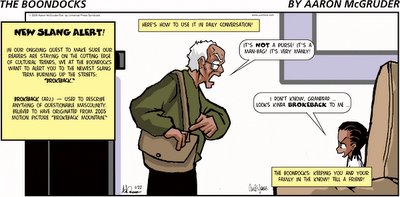
This morning in The Houston Chronicle’s funny papers, though, I read the “Boondocks” cartoon by Aaron McGruder, above. And I thought, “Hoo boy, now it’s gonna get interesting.” McGruder is interesting enough. Enjoy or be enraged by this article about him in The New Yorker. Read his strips to keep your mind aired out.

I’m not carrying his baggage, though. I have enough of my own – usually in my purse.


Cartoon © 2006 Aaron McGruder/Dist. by Universal Press Syndicate. All rights reserved.

Friday, January 20, 2006

Navigator, Sweden

How do you get nominated as Sweden’s best advertising agency? Work real hard. It’s a pleasure to share the news that one of Dialogue International’s long-time affiliates, Navigator Communications KB, has been nominated in the Superettan* class (agency income SEK 10-24 million) of Resumé magazine’s annual “Sweden’s best agency” competition.

Resumé is Sweden’s weekly journal on advertising, PR, marketing and the media. The magazine announced its selections on January 13th.

Navigator’s Managing Partner, Leif Lindau, wrote that almost 1,500 clients throughout Sweden have been asked to answer 21 questions about their agencies, covering above all their knowledge, skills and business value.

The answers have been converted into an index of client satisfaction for each agency, and the nominations are based on these opinions. The agencies have been classified according to income, and the winners in each class are to receive their awards at a big ceremony at Nalen, the historic concert and conference venue in Stockholm.

Filled with wonderful people with wonderful talents, Navigator is unusual since it lives in Malmö, across the Oresund Bridge from Copenhagen, rather than in Stockholm.

I wish I could recapture for you the warmth, the humor, and the excitement of the visits I’ve made there with so many of my colleagues, including (but not limited to) an outstanding Dialogue International Creative Forum on Corporate Citizenship in the Year 2. Navigator has been on the leading edge of marketing through Corporate Social Responsibility (CSR) for many years.

I am waiting for news of the results. Win or lose, though, hats off to Leif Lindau, Jan Berg, and all the other Navigators: friends, colleagues, and genuine professionals.

Wednesday, January 18, 2006

3rd Thursday

In addition to my traditional Martini Night, tomorrow evening is also BrandIt! Marketing’s networking get-together – the latest in a persistent series principal Tad Grow calls “3rd Thursday.”

The city (face it, the nation) is jam-packed with networking events. If you can’t find one out there every night of the week, you aren’t trying. For the socially impaired, there are online options to fit every interest.

That’s the challenge of networking these days: too many choices. Maybe that’s why the quotable Mae West said, “So many men, so little time.”

Man or woman, if you only pick one, Tad’s 3rd Thursday attracts an eclectic bunch of businesspeople orbiting around marketing and advertising. That’s tomorrow, January 19th, at Arturo’s Uptown Italiano in Uptown Park. Hours are from 5:00-7:00 pm. RSVP
Tad@BrandiTMarketing.com. Don’t worry – I’m pretty sure that that’s not Tad in the invitation costume.

Tuesday, January 17, 2006

No "Marketer?"

It’s the 300th birthday of Benjamin Franklin. I’m hard-pressed to write anything really original. Even the recognition that Franklin was America’s first marketing man isn’t new.

(See, for example, here and here. The bemusing article by James H. Morris says, “Ben is rolling over in his Philadelphia grave to see how wasteful and inefficient advertising has become.” I think Morris doesn’t quite credit that America’s population is about to reach 300 million…an utterly different market than Ben Franklin faced.)

When you read Franklin’s most recent biography, by Walter Isaacson, you discover that Franklin developed one early model for an advertising professional to follow, called “doing well by doing good.” Franklin’s publication of Poor Richard’s Almanack, for example, combined the promotion of virtue with the making of money. An old T-shirt of mine proclaimed, “Profit is not a dirty word.” Benjamin Franklin could have said that among the hundreds of other proverbs, sayings and observations.

One more thing he did say speaks directly to people who communicate about features rather than benefits: “If you would persuade, you must appeal to interest rather than intellect.”

So Happy birthday to the Patron Saint of Advertising - even if the Post Office didn't issue a stamp captioned “Benjamin Franklin, Ad Guy.”


New-issue commemorative stamps, USPS.

Monday, January 16, 2006

First Marathon

His knees ache big time. Nevertheless, our son Doug Nytes completed his maiden marathon yesterday. He finished this year’s Chevron Houston Marathon with an official time of 4 hours, 38 minutes. (His unofficial time was 4:34 – it took him and running partner Chris Blume four minutes to reach the starting line from their position back in the pack.)

I almost missed him between Miles 17 and 18 – it’s hard to pick individual runners out of the pack and Doug had gotten a buzz cut just prior to the race. But he heard me cheering on the runners, stopped about five yards past me, turned around and came back for a manly hug.

Post-race, Barbara and I posed with him for this triumphant photo op. We joined the marathoners and their families for seared mammal flesh and margaritas at the Blumes’ home inside the Loop. Chris and Doug said that now they’d run a marathon, they’d never do it again. I bet Chris $10 they’d run next year.

The men’s winner of the 26-mile-385-yard race was an invited runner, David Cheruiyot, in 2:12:02. Only a smidge faster than Doug. But give the lad time to mature and he’ll be a front-runner.

Note the official T-shirt. The finisher’s medal. The big smile. The proud ‘rents. There’re ain’t many things that compare with completing your first marathon (and he's carrying on a family tradition, too).

Congratulations, Doug. You earned it mile after mile!


Photograph by Donna Nytes.

Sunday, January 15, 2006

Moose, Volcanoes

Cyclist, friend and former client Scott McKinley has settled into his new ConocoPhillips assignment in Alaska. Here’s his most recent communiqué to the Lower 48.

Dorothy once said, “Toto, I've a feeling we're not in Kansas anymore.” A quick look around is all it takes to get that Dorothy feeling:
  • Mountains and seawater everywhere you look
  • No traffic jams
  • Moose on the occasional street corner
  • Volcanoes erupting (see Augustine above, 171 miles from Scott’s home).

After all the hubbub of traveling, moving and unpacking, it’s nice to finally settle back into something routine. Routine? Yes, I work Monday-Friday, 8-5. Just about everything else, however, is requiring a fun and challenging learning curve.

  • The New Job…anybody know the best key performance indicator for measuring drilling rig efficiency?
  • The Drive…an 18-minute commute unfortunately limits the opportunities to learn how to best spin the car through icy corners.
  • Wintertime Hobbies…hiking in snow requires certain equipment that you just don’t realize you need until you’re on the trail (like a basket on a hiking pole).
  • House Maintenance…when the neighbor comes by to offer advice on how I might better snow-shovel my driveway.

Back to Dorothy’s comment. Had Dorothy stepped off a plane in Anchorage, picked up a local paper and read the headlines, she may have looked down at Toto saying, “Toto, I KNOW we're not in Kansas anymore.” Here’re a few headlines from December issues of the Anchorage Daily News: helpful indicators this is a unique locale.

“Workers Prepare Ponds for Ice Skating” (12/2/05)…Anchorage’s Park System actually smoothes the frozen surfaces on ponds and lakes for public ice skating.

“Two Men Found Frozen to Death in Valley” (12/1/05)…Getting “fall-down” drunk in Alaska can have fatal effects, as these two blokes never made it inside their home before passing out from alcohol consumption; the cold temperatures did the rest.

“Beached Baby Beluga Whale Dissected in Public School Parking Lot” (12/1/05)…I thought it was cool to be able to dissect a frog during 9th grade biology…but a whale?!?

“High School Skiing Is Off To The Races” (12/4/05)…Spending your afternoons on the slope practicing your skiing under the auspices of a school-sponsored sport. Nice.

“In Juneau, All That Glitters Really Is Gold” (12/7/05)…Construction workers moving earth at a project stumbled on a vein of gold recently, setting off a rash of lunchtime prospecting. Ever think about prospecting over your lunch hour?

“Sunrise – Sunset 10:14 a.m. - 3:41 p.m.” (12/8/05)…The paper publishes this on its front page. The days do become short in the wintertime.

“Volcano Camera Lets Anyone Eye Augustine” (1/11/06)…One of the many ‘local’ volcanoes erupted on Wednesday with an ash plume. See it live
here.

Scott didn’t include it, but I know he’d want you to have your own set of instructions for collecting ash samples from the Augustine Volcano. So when you visit him, you’ll know just how to do it.

Image taken by Game McGimsey, USGS/AVO, January 12, 2006.

Saturday, January 14, 2006

Parker Again

If you have paid any attention at all to the politics of the past few years, you’ve noted that what people have written in the past doesn’t stay in the past. Thanks to the Internet, it’s still floating out there in cyberspace, waiting for someone to make an embarrassment out of it.

I suppose I shouldn’t have been surprised, then, when a friend of a friend (etc.) passed another one of Kathleen Parker’s odd columns, from April 2001. Her piece is about a BBC reconstruction of how Jesus might have looked, as you’ll see on the right.

Who knew the kinds of things that spilled out of Kathleen Parker’s pen? “The willowy, long-haired figure who in picture books attracted children the way Cinderella drew flocks of bluebirds and singing rodents now looks like the kind of guy who wouldn't make it through airport security.”

And “It's hard to suddenly embrace some new dude who looks mostly like my proctologist's great-great-great-great-great-great grandfather after a visit to Carmen's Hair Salon and Spa. Or Charlie Manson's first cousin. Take your pick.”

Two thoughts this morning. First, there’s a wide tonal gulf between the CNN article and Ms. Parker’s. This is the problem with ad hominem rants that you publish: they return like those long-dead, revenge-seeking sailors in “The Fog.”

Second, when you’re too egocentric -
or ethnocentric - life is bound to fool you. It’s a shock to wander through European museums and realize that those larger-than-life knights in shining armor were, mostly, about a foot shorter than we are.

One legacy of Western Civilization: it is difficult for us to reconcile the idea that God made man in his own image with the recognition that humanity comes in so many different sizes, shapes, and colors. Perhaps Ms. Parker has never Googled “Black Jesus?”


Image © BBC. All rights reserved.

Tuesday, January 10, 2006

Turkish Delightful

Unbelievable to find a quiet restaurant in Houston on a Friday night. Yet here we are at Turquoise Grill with Mary Jo and David Martin; owner/chef/host Yilmaz “Jim” Dokoyucu (left) and his father; Barbara and I. Nobody else. It isn't instantaneously noticeable. Although the address is 3701 Kirby, Turquoise is actually just around the corner on Norfolk, east of Kirby – the site’s map is more reliable than Mapquest’s. The simple, attractive place is dominated by Jim’s brick oven – and his gregarious nature.

Houston is filled with Middle Eastern restaurants, many of them very good. This is Turkish, similar in some ways (e.g., hummus), slightly different in others, with some touch-ups added by Jim. The dishes are rich and savory, not especially spicy-hot, with an abundant use of vegetables and everything FRESH.

The bread is fresh-baked. The stuffed grape leaves we had as an appetizer are a familiar menu item, but Jim’s combination of rice, pine nuts, olive oil, and herbs was wrapped in tart, vinegary leaves that were palate-teasing. The fried filo pastry rolls called Sultan’s Cigars, Sigara Böreği, are a specialty of Antalya – Anatolia – on Turkey’s “Turquoise Coast.” They are stuffed with feta cheese and parsley…and melted in the mouth.

It’s true, several of us had shish kabobs. They were nice. But two of us opted for the manly, rugged, lamb version of Jim’s Taurus Mountain Stew, Toros Güveç: fresh tomatoes, chunks of garlic, strips of red and yellow peppers and a homemade sauce baked in small clay pots in that clay oven of his. Made fresh as well (about 20 minutes), they came out temperature-hot but not overtly spicy, and rich-tasting. Minor complaint: the mouths of the pots are a bit too small to dip the fresh bread in the sauce…a minor matter for someone who’s not afraid to look clumsy. And after all, who was there to see me?

Unlike most (but not all) Middle Eastern restaurants here, Turquoise Grill has a modest selection of wines. Many of these are from Turkey's Kavaklidere Winery originally established in 1929 near Ankara, but under “new” management since 1989 and the country's largest winery.

The three we sampled and drank (one white, two reds) are modestly good. But I recommend the Öküzgözü varietal – somewhat similar to a Shiraz – for the heartier stews.

You won’t see many restaurant reviews on Signalwriter, Turquoise Grill is worth a visit before it finds its audience and gets too busy for Jim to explain everything. So? Go.

Thanks to the Atami Hotel for additional grape information.

Monday, January 09, 2006

Brand Stuck

Your company’s clipping right along. You’re pedal-to-the-metal, lights flashing, siren blaring. If you were a K-9 unit, your dog’s head would be out the window, ears flying in the wind.

Suddenly, you’re not moving at all. Morale collapses. Sales stop. What happened? And you think (cupping a hand over your mouth and exhaling), “Could it be…my brand?” Not likely, according to Bob Lamons. He thinks B2B marketers have a hard time with branding, ‘cause a lot of business marketers started on the tech side of their businesses, like engineering or science. In his view, they tend to fixate on “features and benefits.”

I’ll support Bob this much. In the classic Features-Advantages-Benefits (FAB) triad, a large cohort of clients rush to F and A, but forget about the B. Customers do want to hear about the B – what’s in it for them? Lamons does equate brand with emotion: B2B buying decisions are made as much today by gut feel as the result of some detailed evaluation.


Susan Kirkland, veteran ad designer, responded, “Brilliant – what says we can’t manipulate that ‘gut feel’ much the same as we manipulate a hernia? Isn't that what ‘grab 'em by the balls’ means? Pardon my French.”

In a Wall Street Journal piece last month, Leslie Gaines-Ross, chief knowledge and research officer (CKRO – whew!) for Burson-Marsteller reported that in an ongoing survey of 685 global business leaders in 65 countries, 81% reported that there are more “company reputation” threats today than two years ago. She listed seven warning signs of a company reputation in trouble. Of these, Number 6 was the most telling to me: “Employees stop telling positive stories about the company.”

(You may be particularly vulnerable to the brand attack blog. One example: “Verizon Sucks” entered into Yahoo nets 473,000 sites dedicated to exposing brand deficiencies.)

It takes an internal audience to repair this kind of damage. Your stakeholders ought to believe and should have real reasons to do so. Fast damage control: re-energize your internal audiences and unleash the troops.

Quick, Robin, back to the metaphor! You’re hubcap deep or out of gas. You have to get out and push. And if you live in a nice town, you suddenly find that a couple or three or half-a-dozen other people have gotten out of their vehicles and are helping you muscle your car out of the muck.

In B2B buying decisions, the company behind the product or service is a genuinely critical decision factor. Re-build an emotional attachment with customers and prospects, by all means.

But start with your managers, your employees and their families, your retirees, your stockholders. When they believe, when they are missionaries (or in today’s term, “marketing buzz agents”), you not only get help that advertising and PR can’t buy. You re-empower your company with a potentially inexhaustible supply of emotional energy that’s worth millions.


Sunday, January 08, 2006

Spoiled Bloggers

On your left is Kathleen Parker, syndicated pundit. She recently penned a piece titled “Lord of the blogs” that appeared in the Orlando Sentinel. You should read the entire column here.

The Houston Chronicle reprinted it under a different title on January 1. I read it and sent the editor a letter. It appeared this past Friday, January 6, with minor edits. I made several arguments:

In Kathleen Parker's column about blogs, she says we can't silence the ‘Spoiled and undisciplined’ blogs, though we should ignore them not only for the sake of civilization, but for "the integrity of information by which we all live or die."

This is po-faced hooey. Readers of newspapers (her chosen profession) are canceling their subscriptions in significant numbers, not least because many papers have been found guilty of adjusting facts and presenting partisan opinions. Unlike the news/opinions publications of the past 150 years, though, the Internet greatly empowers access to, and creation of, alternative viewpoints – even when sometimes expressed unwisely.

Does her wish to silence the spoiled and undisciplined extend to the celebrity magazines, too? The supermarket tabloids?

As I tried to come to grips with Parker's column, my wife made the most telling point: Unlike the vast majority of bloggers, she gets paid for her opinions. Unlike her ‘new enemies,’ Freedom of the Press appears to apply only to those who earn a salary at it.

I appreciated seeing my letter in print. (PT Barnum said, “I don’t care what they print about me as long as they spell my name correctly.”)

What I genuinely object to, however, is Parker’s apparent presumption that only paid journalists “who suffer near-pathological allegiance to getting it right” are qualified to dispense news and opinions. They can communicate with us – we aren’t qualified to communicate with them.

Yes – this is about communication and (by extension) public relations and advertising. I think the Worldwide Web and the Internet enable more access to information than at any time in human history. Blogs are one new form that lets us communicate more broadly, influence opinions…even promote products and services.

So, does Parker contend that journalism is automatically more worthy? What happens when, say, PR-type communications are used to transmit editorial-style messages? Are the newspaper writers who pick up news releases journalists or flacks? So read her column. Read my letter. Let us both know if I am over-reacting. (E-mail Ms. Parker at kparker@kparker.com.)

Kathleen Parker photograph and column © 2005 Tribune Media Services, Inc.

Saturday, January 07, 2006

Prisoner’s Dilemma

How in the world does the Prisoner’s Dilemma game theory relate to Houston traffic jams? And cooperating with other freelancers or ad agencies on a client project?

Oh-so-familiar scene yesterday: bumper-to-bumper coming back to the office from a meeting. A 24-mile cross-town trip that took an hour and a half in the late afternoon – I made virtually the same trip in 20 minutes at 11PM last evening.

Patience and politeness are the keys to surviving Houston t-jams. Despite the potential for anger and frustration, the drivers around me were courteous (mostly), refrained from blocking intersections (in the main), let other drivers squeeze in front of them when the lanes narrowed (generally).

It wasn’t ‘til this morning that I realized Houston drivers are pretty good at playing the Prisoners’ Dilemma. Click above to read the Wikipedia article about it. Briefly though, two prisoners can gain better jail sentences if they cooperate than if they rat each other out – even though ratting out is the most common and self-interested result, and one prisoner goes free.

By chance, I have read about this zero-sum game in two different novels this week. Bright and early today, I found a fine description of its traffic application in one of them, the 2004 Kim Stanley Robinson book Forty Signs of Rain. One of the main characters is stuck on the Washington, DC, Beltway:

“By and large Beltway drivers were defectors. In general, drivers on the East Coast were less generous than Californians, Frank found. On the West Coast they played tit for tat, or even firm but fair, because in moved things along faster…and so in California cars in two merging lanes would alternate like the two halves of a zipper, at considerable speed, everyone trusting everyone else to know the game and play it right.”

Houstonians, I think, make the same kind of choices in traffic back-ups, generally cooperating out of some instinct that “if we all could just get along,” we’d move faster and generally do despite the horrible traffic. (Except for the bubbas in giant pickups who cut out of the lanes and across the boundary strips to reach a sort of freedom on the access roads.)

Transfer this example to competing ad agencies or freelancers who are teamed on the same client project. If you play the zero-sum game and betray your team-mates, you will do better. You will get more than your share of the work, more of the budget…or even all of it. The other guy (or gal) is the loser, cut out of the opportunity to contribute value and earn a fair share of the money.

At some point, this is going to catch up with you. You will finally run across a client who doesn’t like this kind of behavior and won’t reward it. You will become known as a selfish SOB who doesn’t play well with others. You may make more in the short term but, as Roger Edmonson puts it, “Pigs get fed; hogs get slaughtered.” Eventually.

Oh yes, this is goody-two-shoes stuff. And we all know a lot of practitioners who have retired to their Galveston beach homes or Hill Country hideaways behaving just this way. But if reputation is one of the things you’re selling (as a freelancer), then fairness and amiability will guide your actions. Cui bono? Who benefits? The client does. Maybe you do, too. Happy Saturday.


© Photographer Sparky 2000 Agency Dreamstime.com.

Friday, January 06, 2006

The Angel

This story from Bob Fusillo in Atlanta didn’t arrive in time for the holiday itself. But today is Epiphany, which signals the end of the 12 Days of Christmas. (I have known him for so many years, I’m certain it must be true.)

Santa was in a bad mood. Two reindeer were sick. Several gnomes had hangovers from too much wassail and couldn't help pack presents. Mrs. Claus was on the warpath…something about muddy deer tracks in the kitchen. Santa had heartburn from all those cookies.

Then there was a knock on Santa’s door: An angel appeared. “Here’s a nice Christmas tree for you, Santa. Where should I stick it?”

Which is why you always see an angel on the top of a Christmas tree.

Thursday, January 05, 2006

Hook 'Em!

What a game! Did you watch it? The University of Texas Longhorns edged out University of Southern California 41-38 and clinched the National Collegiate Athletic Association football championship at the Rose Bowl last night. The victory marks UT’s fourth national title and its first since 1970. Texas completed a perfect 13-0 season, the most wins in school history.

I traded text messages with Linda and Greg Krupps, who were at the game in Pasadena. Much tension – much fun. The UT Tower in Austin was lighted utterly orange last evening to celebrate the Horns’ national championship victory at the 92nd Rose Bowl game in Pasadena, Calif. The Tower will be lighted entirely orange with the #1 displayed again today, and it will stay lit through the weekend. I guess most of the UT alums will stay lit, too.

Hook ‘em, ‘Horns!

Tuesday, January 03, 2006

Web Pusher

Everybody wants credit for inventing the Worldwide Web and the Internet – even Al Gore. Despite these claims, the WWW has some genuine fathers. I always felt that a Minneapolis-based science fiction writer, Gordon R. Dickson, pre-visioned it in 1984, when he published a novel about a galaxy-wide confrontation called The Final Encyclopedia. Amazon describes it this way:

“At the center of this galactic conflict is the Final Encyclopedia, a huge space-station in orbit of Earth, that contains all the knowledge of the human race. Whoever controls the Encyclopedia will control the fate of humanity.”

Nobody that I recall imagined the space station-load of all knowledge would include advertising. And you hardly need to be told that the Internet is a major advertising medium. I’m sharing a couple of key points because some industrial firms might not be giving it strong enough consideration in 2006.

There’s a lot of hoopla about “consumer advertising” rather than business-to-business advertising on the Worldwide Web. The financial facts are pretty important. See the latest figures here. National advertisers’ 2005 budgets only grew 3.7% overall in their traditional media (vs 2004), but grew 15% in Internet expenditures. The big guys are spending about $8 billion on Web advertising in one form or another. In 2006, the consumer advertisers are expected to grow that spend another 10%...the highest rate of increase among all advertising media.

Most business-to-business advertisers haven’t come anywhere close to matching that rate of increase – except for the very largest.

I think there’s a good reason for this and you can leave aside the “old guys don’t understand new technology” stuff. It's trite. Author and marketing communications futurist Seth Godin spoke to an interviewer recently who asked two questions:


1. Should every business use the Internet to communicate?
2. What are the basics of an Internet communications strategy?

Godin said, “You should only use the Internet if you want your communications to be FAST and you want to reach LARGE NUMBERS with no intermediaries. If you can't handle that, though, you shouldn't try.”

Sean Finnegan, US director of i-agency Digital/OMD, modifies this in the right direction. The Web is a mass medium, he says – but it’s an excellent way to reach an engaged “consumer” looking for a deeper bond with your brand.

In tightly focused B2B markets such as restaurant management software or drilling muds, for example, companies do use the Internet to communicate, but most often it’s via their Web sites – a pull medium when they can get their specialy focused prospects and customers to view them. They do not make as much use as they could of “push” advertising on the Web...and they could use it if it is strategically and tactically well-executed.

Unlike Dickson’s imagined encyclopedia, there is no “final” in the expanding world of online media. It’s devilishly hard to stay ahead of the curve. For most of us, keeping up is way better than catching up.


Advertising professionals like me want to continue to support clients effectively. This year, I’m going to be an enabler. I want to (first) show clients how to get more out of the digital channels they are already using, to push their prospects and customers into closer, more valuable relationships. And (second) I intend to help them implement these new and continually changing channels. Happy New Year’s resolution.

Book cover © the publisher. All rights reserved.