Friday, March 24, 2006

Javed’s Screed

“First, let’s kill all the logos.” (If you’re going to paraphase somebody, make it a big somebody like William Shakespeare.)

At first glance, that’s what branding expert Naseem Javed seems to be saying in an article here – which you might want to read if you use a logo, want a logo, create logo for other companies or manage the logomarked assets of a business.

He starts his article on this UK business website with the headline, “Is your small business logo that important?” He continues:

Corporations, which have heavily relied on graphic design, logos and too many colorful themes while ignoring the real names, are facing some new challenges. As the logos have lost their power, the companies now have to reinforce their ignored name as a solo warrior. Previously, names were basically seen in print; today they are mainly typed in cyberspace.

Your logo is not that important these days, as most customers have no motivation to remember the subtle intricacies or bizarre approaches to logos that are intended to stimulate demand. They are already flooded with colorful graphic look-alikes and continuously regenerated blasts from every corner.

Javed then goes on for another half dozen paragraphs with his rationale for using (essentially) a simple typeface treatment of your company name instead of attempting to create the next BMW propeller or Nike Swoosh.

According to the article’s tail-end ‘graph, Javeed is the author of several books and “is recognized as a world authority on global name identities and domain issues.” He is also credited with founding ABC Namebank a quarter century ago and conducting executive workshops on image and name identity issues.

I was tipped to this by Susan Kirkland who, as a Master Designer, was upset about Javed’s article: “Some days, I just don't have what it takes to speak eloquently. I don't think he knows much about what bad advice he's giving. I went to his link for his corporate communications website and there's only a home page, nothing else.”

True enough, at the url in Javed’s contact address listed in the article, there’s nobbut a Home Page resembling the “blue screen of death.” Susan warned me to be careful that this isn't an experiment to test word-of-mouth or see just how much publicity he can get for being ridiculous.

Yet he does own ABC NameBank. The company has offices in New York and Toronto.

Criticism’s no new experience for Javed. He’s been nailed a number of times the past few years for silly-seeming pronunciamientos. Wordlab just about lost its mind about something he wrote back in the Year Three (here, about midway down the page). Look for the ‘graphs that starts:

Idiot wind: It's
commentary like this that makes the whole naming and branding profession look bad. No, worse than bad: downright idiotic. This screed by “naming expert” Naseem Javed is appalling in the depth of its wrongness. At first we just threw up our hands (Where to begin?), but now we feel compelled, in the interest of our profession, to debunk this bunk point-by-point.

Which the Wordlab article proceeds to do at great length.

I use the word pronunciamientos advisedly. It’s Spanish for “authoritarian declarations.” Javeed is an authority, even if self-declared. The way he says things apparently raises hackles all over the English-speaking world.

Despite such reactions (The horror! The horror!), the issue he is trying – unsuccessfully – to address is that few companies, especially small businesses, have the marketing dollars to make their logomarks as familiar as Coca-Cola’s and Mercedes Benz’s.

Yet I bet you’ve heard at least one client say, “We want to be the Mercedes of this industry” or something similar. Javed is suggesting – again, unsuccessfully – that businesses should be careful how they spend the dollars they’ve got.

There’s room in the marketing communications industry for a lot of viewpoints – even screeds. I only wish that Javed had made his viewpoint a little more clearly.

Monday, March 20, 2006

Rushing Roulette

Suggestion for certain clients.* Type “instant gratification” into Google. In .31 seconds (that’s three-tenths of a second), an ad will appear on the right-hand margin of the screen: “Instant Gratification…you can get it on eBay.”

Now you know. If your advertising agency, PR firm, design studio or freelancer can’t give you solutions overnight, the next day, this afternoon or by the end of the week for EVERY project, you’ll…you’ll…you’ll just find somebody who can. Perhaps on eBay.

When one of your vendors is away from the computer for a couple of hours, you resort to e-mail: “Why haven’t you answered my request?” “I sent you the copy draft this morning, didn't you get it?” “My boss doesn’t like the direction you showed us this morning! Can I have another idea before the end of the day?”

And the worst threat of all: “I can get someone else to do this if you can’t get me something by Friday.”

Relax – I’m not going to quote John Ruskin about making something a little worse or selling it more cheaply. Leave price out of this – that’s not your issue. I recognize you’re under a lot of pressure yourself: the project that has to launch by a certain date, the supervisor who’s never satisfied, the division VP who can’t tell you what he or she wants but will know it when he or she sees it.

You’re rushing the creative process. One of these days, it’s going to put a hole right in your career.

If you get what you think you need, when you think you need it, time after time, you’ll end up with something merely good enough – instead of the potential breakthrough your project really deserves. You demand instant gratification and you can get it. What’s the cost?

Author Susan Kirkland says, “It’s all about standards.” How long can you survive in your job when you force your vendors to deliver shoddy work? (Or maybe it’s not always shoddy…but you’re driving some of your best resources to madness? That will lead eventually to bad service. Which you don’t want and neither does your vendor.) You may not even care right now, but “a happy creative does excellent work,” according to Kirkland (and me), and you should aspire to it. It’ll make you look better than getting something overnight and then having to get it redone the next night.

Let’s look at it from your side. A consultant and former Director of Marketing for Doskosil, Grant Bergman, wrote:

Years ago I worked with a small design firm that was extremely responsive when needed, and also extremely good about laying out project timelines and estimates so that I could manage budgets.


We had a fantastic relationship and tremendous mutual respect. When I asked for things in a hurry – which often happened because my own management was unmanageable – the first thing I got back was a revised estimate with “rush charges” factored in. Of course, this used to be commonplace in the print industry as other more straightforward “vendor” relationships as well, but I’m not sure how many agencies are doing it.

I try to be a good client and avoid pulling agencies through unnecessary knotholes – especially the small ones with less flexibility – but knowing that rush charges were being incurred was a useful tool for me to manage my own internal management's expectations. Often enough I could say, “That timeline incurs rush charges and the budget is already tight. Do we really need it that fast and, if so, how should I handle the budget implications?”

You say it’s not your job to keep your vendors (even your creative vendors) happy. Or is it? Instead of acting like a client, think of your role in terms of…service.

In 1989, Ron McCann, the President of Service Management Systems, suggested something different: “The way to answer the question ‘Who do I serve?’ is to ask yourself a different one: ‘Who benefits from my work?”

Certainly, your company does directly or indirectly. Your boss does. And so do your vendors. Your designer, your publicist, your copywriter, your printer…all of them benefit from your work. So they’re your customers too. Are you serving them best by jerking them around?

To paraphrase McCann, a manager who serves his vendors is “one who performs the functions of a good coach – he doesn’t play the game for the players, he simply sees that everyone has what they need to play.” (Do you give your creative vendors everything they need to play the game for you? Including enough time?)

I particularly like McCann’s last line in the section – again, paraphrased: “You don’t get paid for what you do, you get paid for what your vendors do.”

Stop playing Rushing Roulette. Give your vendors a chance to make you look good. You could end up looking terrific.

* Thank goodness, not a one of them mine.

Sunday, March 19, 2006

"Accidental Tourist"

One privilege of blogging is taking national columnists to the woodshed (even when you're a small fish). I did that here with Kathleen Parker. One obligation is to offer a compliment when it's due.

Parker's latest column appeared in the Houston Chronicle Saturday. I send her my appreciation for writing it; for being in the wrong place at the right time and making of this accident a story worth reading.

Despite the best attempts of Left and Right, the world is never black and white. Light is composed of all the colors. Parker's column about Paul Wolfowitz sheds light. Thank you.

Saturday, March 18, 2006

Cigarette High

Two voices, one male and one female, overheard on a plane: “I think everyone's asleep, let's go.”

“This one's empty ... no-one’s looking... you go in first.”

“It's a bit cramped - let me sit down.”

“Have you got the condom? Quick - put it on!”

(Sniff, sniff) “Ah, perfume…you think of everything!”

“This is great...” (long sigh)

Static on the loud speaker, then a new voice: “This is the captain speaking, to those two people in the rear toilet. We know what you’re doing and it is expressly forbidden by airline regulations. Now put those cigarettes out and take the condom off the smoke detector!”

Courtesy of NSMA.

Friday, March 17, 2006

Bugler RYO

Circumstantial evidence keeps illustrating the tenacity of brand life. An empty packet of Bugler® roll-your-own cigarette tobacco blew underfoot today during a neighborhood walk. Even after all these years, the three-quarter-ounce blue pouch, with “Ever-Fresh Papers Included,” is still around. You can buy it at most any store.

There is a superb webzine, RYO Magazine, from which some of this information comes.

Compared to machine-made cigarettes (called “tailor-mades”), traditional RYO brands like Bugler, TOP, Bull Durham and Drum have had a very long life. But in the opinion of the magazine’s editor, these brands are far less inviting and romantic in nature (and probably less well thought out) than their packaged counterparts:

TOP does convey quality as an adjective and Durham does place location within tobacco country, but what the hell Bull, Drum or Bugler have to do with anything remains esoteric to most. Now I happen to know some of the history of these names. For instance, Bugler refers to a time during the FIRST World War when our servicemen were introduced to handrolling in Europe and developed a real taste for it.

Yet these brands live on, despite everything that the anti-smokers and their allies have done to kill them dead. Bugler’s still available in the pouch or in the tin, with the familiar blue background and the WWI scene on the front: the lone Army bugler standing before a row of Army pup tents, a small flag flying in the background. If you’ve never noticed it, I bet your fathers have, and your grandfathers.

Anti-smoking, litigation-heavy pressures have taken their toll, though. You won’t find the manufacturer’s name anywhere on the pouch (it’s Brown & Williamson, a division of British-American Tobacco – and you won’t find it on BATUS’s website either). Just the words “Turkish & Blended Cigarette Tobacco” underneath the soldier boy.

An interesting brand hint on the back, though, a line of copy: “A quality smoke since 1932.”

Wall Street crashed in 1929. By 1932, the number of unemployed Americans reached 13 million (10% of the total US population). Wages were 60% less than in ’29. At the end of July ’32, after camping for two months near the US Capitol in Washington, thousands of American military veterans demanding a bonus were attacked by police and US Army units commanded on the spot by General Douglas MacArthur. Two members of this “Bonus Army” were killed.

Times were tough. Men still wanted their smokes. If they couldn’t afford tailor-mades, they’d roll their own, and a tobacco whose name harked back to the glory days of the Doughboys, camp life and “Lafayette, we are here!” was sure to get their attention.

That’s one way brands get born. Who cares if it’s a cheap smoke: this one’s been around for almost 75 years.

PS: Click here to see a superb collection of old cigarette package art. It’s worth the visit.


RYO Magazine™ is a trademark of The Andromedan Design Company, and its contents are protected under all applicable copyright laws. Photo: Roll Your Own Tobacco Store.

Wednesday, March 15, 2006

Square Donuts

Over the pasture and cross the road, there’s an outstanding little example of trade dress in action.


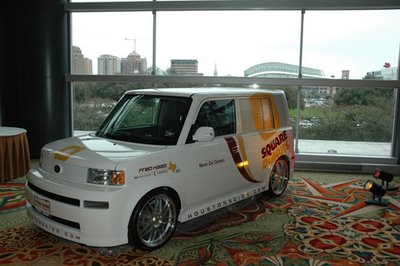
Square Donuts opened a shop on Clay Road, on the corner of Westway Park. The donuts aren’t the only thing that’s square. The CEO, Thai Klam, even extended the corporate graphics to his fleet of delivery vehicles: a half dozen Toyota Scion xBs. These square, boxy shapes are a great extension of the corporate logo. They really caught my eye and underscored the complete design approach.

Large firms are extremely conscious of trade dress, the “distinctive, nonfunctional feature, which distinguishes a merchant's or manufacturer’s goods or services from those of another. The trade dress of a product involves the ‘total image’ and can include the color of the packaging, the configuration of goods, etc. Even the theme of a restaurant may be considered trade dress.” (In the UK, it’s called “livery.”)

What’s remarkable – worthy of notice – is how thoroughly a tyro firm like Square Donuts has carried its trade dress into just about every element of its sales arena.

Thai Klam didn’t invent square donuts. Depending on what you read, that honor probably goes to Richard Comer of Terra Haute, IN, circa 1967. Square donuts have shown up in New Orleans and New York City as well. But Klam has run with the idea. He and his wife, Ann, a graduate of Le Cordon Bleu Culinary Academy, also designed the lunch menu. The restaurant serves nine blends of coffee, produced at a roasting plant in Austin (PRDA).

Klam’s graphic designer is Chan Do. Between them, they have mounted a serious claim to the square company logo concept as a unique trade dress. In a Wolff Companies press release, Klam has said, “Our plan was to create the image – square donuts in a square car with a square driver. We worked with a local Toyota dealer and do a lot of promotions with Scion. We have used our Scion show car for corporate functions and school events. Sometimes, we’ll take a motorcade of Scions to an event as a cross-promotion with Toyota.”

Trade dress is a crucial part of your corporate graphic efforts, especially if it uniquely identifies your business, your product or your service. Since it becomes part of your brand, you ought to nurture it and protect it like crazy. A name like Square Donuts could be what the US Supreme Court calls a “suggestive mark.” But there is no TM or ® on the Square Donuts logo – only a copyright on the design. It may be that the words “square donuts” can’t be trademarked…but the trade dress can definitely be protected.

In addition to creating an individual neighborhood eatery, then, the owners and designer have begun to build something just as distinctive in the Square Donuts trade dress. It’s not only good creative, it’s good thinking.
And the donuts are fine.

Tuesday, March 14, 2006

Court’s Loss

In last Tuesday’s primary race for Harris County Probate Court No 4, Georgia Akers came in second, while the incumbent finished next to last. Well, no matter what gloss I put on it, Georgia didn’t win. Here’s what she wrote to her supporters:

Dear Friends: I did all I could but it was not enough to overcome an entrenched incumbent. Five days prior to the primary, he sent out five mailouts – one a day – one was very uncomplimentary toward me, basically saying I was a “political hack.” There was not time to overcome this. I tried to keep all mailouts positive and focused on me. He did not.

Eventually each of you will get a personal thank you from me but for right now I wanted to reach out to all of you and say thank for your endorsement, your support, your volunteering to help with my campaign in any and every way you did, from lending your name, to sending out emails, to working the polls, to putting up signs.

THANK YOU. I would not have gotten as far as I did if it had not been for you help. I think to get 42% against a 20-year incumbent is not too bad.

The calls and emails and visits I have received this week encouraging me to think four years from now have really helped to sustain me and make the loss not so hard to take.

Thank you again. You all are very special to me. Georgia.

Georgia is a terrific and positive campaigner. In the end, she proved herself a better, nobler human than her opponent, the incumbent judge. Until the end, she empowered dozens (if not hundreds) of supporters to work hard on her behalf. Each one of us felt a special connection with her. Her loss is Probate Court No. 4’s loss, too.


If Georgia runs again, I’ll be out for her. Perhaps you’ll join me.

Sunday, March 12, 2006

Ego Game

A colleague sent me a game called One-Word Play last week. (Played this game before? It already may have appeared on Bzoink. Heck, it may have started in the 19th Century: I’ve found references to it from the 1850s.)

It was tantalizing enough, so I followed her instructions, responding to her with a single word.

Then I sent out my own e-mail: Dear all: you know I do not usually forward this sort of thing. However, this was sent to me by a colleague and I found the idea tantalizing.Please play. I think this will be fun. Describe me in ONE WORD...just one! Send it to me only, then send this message to your friends and see how many strange things people say about you! This could be fun! Just hit reply and send my ONE WORD back to me. Then, forward this message to your friends (including me) and see what they say about you!

I e-mailed the request to half a dozen or eight friends – and to the same number of family members. Two different audiences. Even while I hope my family members are friends too, the groups should approach my one-word description from alternate directions.

I have occasionally used this technique for developing a new identity or market position. It’s part of branding, right? In this case, the method is self-administered, using friends and family to generate key words.

Friend-wise, I have to report that my brand appears to a bit odd. I got back “erudite” and “fanatic.” Another sent back “Masterpiece Theatre,” insisting that as far as I was concerned he considers this one word. I can envision a connection between these three ideas.

But one friend sent back “Huh!” and another sent “( ).” Not helpful – but fun anyway.

Some of the family responded, but not many. I don’t take it personally. I received “bumptious,” “polished” and “big-hearted.” My sister, bless her, also included “handsome.”

Not much to go on. But it’s Sunday. I’m a branding expert. I have therefore carefully evaluated all these words and, by applying arcane methodologies, have come up with a couple of possible answers.

Either I am Louis XIV (Le brand – c’est moi!). Or a circus tent. Happy Sunday.

Friday, March 10, 2006

Red Ryder

It didn’t take a village to remind me that another, classic American “weapon system” is still going – but it did take a cousin, Joel Sabel. He sent the above photo and swears it’s real. (Thanks and a tip of the Hatlo hat but see PS below.)

The Daisy story's got everything: advertising, licensing, adventure and real shooty things. The memories are rosy. My Daisy BB guns were among my most treasured possessions back when.

Maybe yours, too. It was definitely a boy thing in those days. Girls had cooties. You had your Schwinn, you had your Red Ryder and you were set to go. And we did go…all over Atlanta it seemed like, up and down Peachtree Creek, over to Piedmont Park, out to Chastain. There were never enough Yankees, never enough Indians.

Those really were the thrilling days of yesteryear. You could feel it in the ads. Daisy co-opted the Red Ryder cartoon character, a match made in heaven for kids growing up with Johnny Mack Brown, Bob Steele and Lash LaRue. (Can hardly believe I thought the The King of the Bullwhip was so cool.)

I still recall Daisy’s ads: you can see them here. I had that very one, the famous Red Ryder 1000-shot Western-style carbine. I also had the pump-action model that looked about as close to a Model 1897 Winchester shotgun as a BB gun could get – and about as much imagination material as a kid could handle.

The Red Ryder was one of the most successful licensing arrangements ever. According to Daisy, “By 1949 it had become so popular that more than one million units were sold in a single year.”

Daisy Outdoor Products is alive and well and living in Rogers, Arkansas. The company turned 120 this year. Today it’s the world’s oldest and largest manufacturer of airguns, ammo, and accessories. Every year, the company manufactures more than 5 million items. Most of those are airguns, the firm’s specialty.

But don’t read Signalwriter about BB guns. Click right here. Spend a little time with a few old friends…and with some of the advertising that made you absolutely have to have a Daisy BB gun.

If only to hear the words from your own Momma that were on every American mother’s lips: “You watch – he’ll put somebody’s eye out with that thing!”

PS: The billboard is a fake. The photo is from
www.worth1000.com. Its search engine is disabled and I can’t source the board. Please help identify the computer artist.

Wednesday, March 08, 2006

Dueling Keywords

Is it ethical? Is it legal? The president of an interactive marketing firm, Jonathan Trenn, has posted a pretty important question in one of my discussion groups. Since it involves brands and the Internet, I am repeating his post for you:

I’m contemplating spending a significant amount of a media buy on Google AdWord and I’d like some input or your take on something. The client is a mid-sized player in a niche market of a major industry. The product is a mix of a B2B (meaning small business) and B2C.

The client has several competitors, including a Major Player – a company you all have heard of and whose product line is almost synonymous with the product itself. On the keyword buys, we want to develop mini-sites that compare the client vs. competitors, so we’re thinking of purchasing competitor company names as keywords so it will look like:

CLIENT vs. MAJOR PLAYER
CLIENT vs. COMPETITOR

Our client’s product is top-notch in quality but costs less than others. And we figure that a lot for people will be putting in competitor’s names – especially the major players in keyword searches...as opposed to the generic product category.

Yahoo! just banned purchasing copyrighted company names of competitors as keyword. Some think that doing so is “unethical.” I don’t. Especially in a direct comparison type of advertising scenario. I don't really agree with that. Your thoughts?

Keyword searches can yield attention and awareness, valuable leads, good sales. At the same time, using some kinds of keywords to help position a product competitively confronts potential ethical and legal issues. Advertising and marketing people should look at the thread he started here. You’ll get a good opinion sample from a range of industry professionals on brand offense/defense.

I defend the practice of competitive advertising, so I posted my opinions as well. I also recognize how many of my own clients would view this issue: there are situations/market considerations that militate against comparisons in marketing communications. You owe it to your brands to defend them against all comers…which may demand a more competitive stance. Where do you take that stance? In the trade magazines? In the courts?

You can let me know what you think, or plug yourself into Soflow and join the discussion. (Remember to read all the way to the bottom.) It’s good to stretch.

Photograph © Mailis Laos Agency: Dreamstime.com

Monday, March 06, 2006

Ingenious Monkey

A small, neat book on classified advertising, Strange Red Cow is a compendium of “curious classified ads from the past” by Sara Bader. A researcher and producer, Bader adventured among classifieds from the 1700s to the present while working on a documentary about the Declaration of Independence. Since, in her own words, classified advertising is US newspapers was worth $16 billion in 2004, it’s another slice of the ad marketplace that’s worth at least a book – so she wrote one. You should buy a copy for your own library. The title comes from the May 1, 1776 issue of The Pennsylvania Gazette:

Came to my plantation, in Springfield township, Philadelphia county, near Flour-town, the 26th of March 1776, A STRANGE RED COW. The owner may have her again, on proving his property, and paying charges. PHILIP MILLER.

Now you know the cliché: those who don’t study history are condemned to repeat it.

Apparently, even those who do study history are going to suffer repeats. The first compendium (to my knowledge) that covers classified advertising is A History of Advertising from the Earliest Times, published by Chatto and Windus, Piccadilly, London, in 1874. The author was Henry Sampson.

It’s Number 13 on the University of Virginia’s Rare Book School reading list (thank you, Internet). It was reprinted by Gale Research Company in 1974, though it is no longer in its catalogue. Even more amazing, you can get a fresh copy as part of a recently published eight-volume set for just $895. (See the four-color frontispiece from Sampson’s book here – along with publication details.)

I have an original copy, a stunning gift from Mark Self many years back. It’s quite an old-fashioned sort of book and a ponderous read, especially since old Henry felt a bit censorious about our profession: “Advertising has, of course, within the last fifty years, developed entirely new courses…its growth has been attended by an almost entire revulsion of mode…” Gimme some ‘tude there, Hank.

I’ll match Bader’s cow with one of my favorites in Sampson’s book, from the March 1, 1681 issue of an English paper called Heraclitus Ridens:

A MOST ingenious monkey, who can both write, read, and speak as good sense as his master, nursed in the kitchen of the late Commonwealth, and when they broke up housekeeping entertained by Nol Protector, may be seen do all his old tricks over again, for a pence apiece, every Wednesday, at his new master’s, Ben. Harris, In Cornhill.

A Restoration-era classified ad – actually political satire. Do, do write if you’re unclear about Nol.

Book cover © 2005, Clarkson Potter/Publishers.

Friday, March 03, 2006

Rescue Service

What happened was, the cable went down on me yesterday. Or maybe it was my modem or my router. Over an hour’s time, I got a good lesson in service – plus a reminder of why I’m doing what I’m doing now, instead of what I was doing a year and a half ago.

First, here’s the shortest possible way to explain the cable outage and its solution. I got back to the computers in the late afternoon. Discovered that my access to the Internet was out. Called Time Warner technical support and spoke with a very nice young woman (I’ll call her “Zelda.”)


I explained my problem (a recurring one) to Zelda. She took me through the steps. You know: unplug this, replug that, restart your computer. Nothing came up. I was pretty angry because this is a difficulty I’ve had before. But I maintained my politeness and Zelda was constantly helpful. In the end though, we couldn’t get the modem back on line. Zelda scheduled a service call for this coming Monday, four days away. Phone call ended.

I stewed about this for half an hour. There’s a variety of work I have to do Friday, Saturday, and Sunday. Need the Internet access. Gotta have it. So I called Time Warner tech support again and this time got a nice young man: “Arthur.” I explained my frustration (and kept my temper). I asked him if there was anything at all he could suggest that would get me back on line. Patiently, Arthur took me through the same steps. They didn’t work. Then he suggested that I unplug the modem from the router and plug it directly into one of the computer. Then reboot the machine. It’s the older of the two computers; it took several minutes. During this agonizing period (too used to instant gratification…a couple of minutes, right?), Arthur hung in there with me. I plugged the modem back in. And the computer came up.

I was drowning and Arthur got me a lifeline. (I honestly believe Zelda would have done the same thing if I had given her the time to do it.) I was relieved, grateful, and thanked Arthur a lot. I could get on with my connected work life.

I realized then that Arthur did for me what I try to do with clients: maintain a helpful attitude and offer service, service, service. There’s a joy in giving service that is the key to building and maintaining relationships. That’s the rationale for the “customer-centric” philosophy (although it’s honored by most companies mainly in the breach).

This is what I was driving at when I added the word “amiability” to my blog and my web site. I feel better when I am offering service – and as Ron McCann says in The Joy of Service, there’s genuine pleasure in offering service. It’s what I wasn’t able to deliver the past few years in the agency business. It’s what I aim for now and always try to deliver. You may not always be up to your neck in the water, but I feel great about standing by with the life preserver.

That’s my little morality tale. Have a great weekend.

Karsten image provided by Dreamstime.com.

Thursday, March 02, 2006

Freiburg Fresh

This just in from Philippe Holtzweiler, Managing Director of HOPE International Communications in Freiburg, Germany, and occasional champagne-bearing guest with us in Houston. So I pass it along because it’s got some European and Dialogue news (and a compliment or two about me).

Hello, Richard, I read about your new venture into podcasts – there has started to be some talk about them here. But again, you are impressively cutting-edge.

We finished our fiscal year 2005 with a heavy workload (i.e. a nice amount of billable hours), but with neither the opportunity to revel in ‘La trève des confiseurs*’ nor to send out any seasons greetings: I'm afraid that the ho, ho, ho tune will have to uttered by the ‘Osterhase.’ Our 2005 net profit rose tremendously. (You probably know the joke about Skoda back in Communist time: Skoda has achieved a 300% increase in production – instead of producing 10 cars a month, they are up to 40). Yet the shadow of two fairly disastrous years (2003 and 2004) still loom in the background.

We have won an interesting new account, in Paris of all places (for the national French association of heating systems professional). In parallel, we are developing our internet expertise, going increasingly from concept and screen design all the way to programming. These days maximizing the added value is the name of the game – at least in Germany or France where morale and poultry sales are low and falling further (with swans dropping dead by the dozen as well as erratic ducks and a whole turkey farm in France proving to having been infected by the H1N5 virus in the last days.

More awful yet: a cat died of the bird flue according to today’s broadcasts. With the number of cats statistically dying on any given day, I just wonder how they singled out this one, but that’s another story).

By the end of March, we will have the next Dialogue meeting in Gdansk. I just hope more ideas will surface than was the case in Budapest. Wining and dining is nice (especially when part of it is deductible from German taxes), seeing old friends too (but I think that Timo Kivi and I are the sole survivors of times gone), and going to nice places is indeed pleasurable.

With the price wars raging between low cost airlines, it has got easy to go anywhere in Europe for around US$100 return – and cheap enough to go there on one’s own. I had my last pack of beef jerky yesterday, reason enough to go to the US to replenish the stock. But it’s not yet the time. All the best to Barbara, hoping she (and you) are fine. Viele Grüße aus dem kalten und verschneiten Freiburg…Champagne Phil.

*Something to do with candy-makers – which I think means whoop-it-up-time. I have got to get better at my European languages. Meantime, Philippe, congratulations on the new business, and have a great time in Gdansk. RLB.

Wednesday, March 01, 2006

Afghani Chestnut

Barbara Walters of 20/20 did a story on gender roles in Kabul, several years before the Afghan conflict. She noted that the women customarily walked five paces behind their husbands.

She recently returned to Kabul and observed that women still walk behind their husbands. From Ms. Walters’s vantage point, despite the overthrow of the oppressive Taliban regime, the women now seem to walk even further back behind their husbands and are happy to maintain the old custom.

Ms. Walters approached one of the Afghani women and asked “Why do you now seem happy with the old custom that you once tried so desperately to change?”

The women looked Ms. Walters straight in the eye and without hesitation said, “Land mines.”

Moral of the story: Behind every man is a smart woman.

Thanks and a tip of the Hatlo hat to Roberta Lewis.

Monday, February 27, 2006

Defense, Defense!

What makes a niche market? Unless you’re in one, you’d hardly believe the amount of advertising done in specialized markets, or the amount of marcom money spent in them. Today’s example: the defense business.

You won’t run across weapons systems ads in People, American Girl, or Bon Appétit. You won’t find “Defense Industry” if you go to the
1997 NAICS and 1987 SIC Correspondence Tables, the newer North American Industry Classification System (NAICS) that superseded the old SIC codes. Search for “Military Contractors” or “Weapons Systems.” No NAICS class for any of them.

I bring it up because Charles de la Rochefoucauld kindly sent along some ads for one of his clients, MBDA, that I concepted a while back. They were based on the new corporate logo with its red point that Charles’s team created.

Creating the brand, working with the client, producing the ads, buying the media…all done by La Rochefoucauld, part of Publicis in Paris. (Charles now heads up another Publicis operating unit, Corporate Factory.)

The ad on the right is for weapons systems – missiles, to be precise. It’s dramatically simple and builds a “pointed” impression for the brand, even in magazines filled with war-fighting materiel. The client chose the series represented by this ad to start their post-merger campaign. Today, MBDA is the only company in its sector able to design and produce missile systems for land-based, naval, and airborne missions.

The MBDA ads are the latest examples of work I’ve done for the defense industry over the past few decades: for RPVs (think “Predator” drones, the current equivalent), ballistic fire control computers for the M1 Abrams, electronic warfare systems, air traffic control systems – you name it. Serious toys for big boys…and a significant contributor to ad agencies’ bottom lines for decades.

Bill Mitchell was working for the Wyatt & Williams agency in Dallas when I was with Kerker & Associates in Minneapolis. He worked on the Bell Helicopter account; I was working on ads for Sperry’s Defense Systems unit. I found out recently that he donated a collection of his materials to the Texas/Dallas History & Archives of the Dallas Public Library.

It’s called (naturally) the Mitchell Defense Industry Advertisement Collection: approximately fifty advertisements pertaining to Dallas-based companies involved in the defense industry. The collection’s ads are from as early as 1953, when Mitchell worked for Tracy-Locke Advertising, and as current as the early 1990s, when he moved from Dallas.

Someday, maybe I’ll pull on my defense-industry ad materials together and donate them to some deserving library. Meanwhile, I’ll keep working on new defense ads – way too much fun.

Saturday, February 25, 2006

More Alaska

Ready for the further adventures of “Scott of the Arctic?” Scott McKinley of ConocoPhillips continues his adventures in Alaska with this long letter. He sent his own photos – I couldn’t convert them to the appropriate files. Use your imagination or go here.

The North Slope (the northern coast of Alaska) contains huge reserves of oil and gas in a Tennessee-size area. Thousands of employees, contractors, and caribou travel to and from the slope to harvest its natural resources. Living and working on the Slope is an experience unlike any other.

Dave E. is one of those North Slope employees. He’s a drilling engineer at the Kuparuk oil field. Dave works twelve-hour shifts for two weeks straight, in some of the world’s harshest weather conditions, and then has two weeks off. Since Dave grew up and lives in Butte, Montana, he knows about harsh winters. But now he works ten miles from the Beaufort Sea, and “harsh winters” has a whole new meaning. The wind-chill the day I met Dave was -49ºF with a 20mph wind. Cold? Yes, but it doesn’t stop the experienced hands. Work continues unabated by the cold until ambient temperatures reach -35ºF, when company policy requires all outside work to cease. That’s why most everything on the North Slope is covered. Wellheads, process equipment, and drilling rigs are all encased for protection against the bitter temperatures far inside the Artic Circle.

To support oil-finding and producing activities on the North Slope, BP and ConocoPhillips jointly own two 727 jetliners to shuttle employees and contractors between Anchorage and the Slope. These planes are becoming the last of a rare breed….they are equipped to land on gravel runways. The pilots are also a rare breed…landing a fully-loaded jet in subzero temperatures on a single ice-covered gravel runway is not in most pilots' job description. As we landed, I didn’t look at the other passengers. But I was holding my breath as the pilot heavily applied the wheel brakes, tilting my torso forward, thinking we were about to skid off into the frozen tundra.

While at Kuparuk (America's 2nd-largest oil field) up to 1,200 company and contractor staffs are housed within the Operation Center’s three-story dormitories. Each room has a bed, a sink and a desk; sharing the bathroom with the bedroom next door. The room measures 8 feet x 15 feet, obviously not designed for employees’ leisure time. The facilities are relatively nice for being in the middle of an arctic desert: reading rooms, 24-hour café, exercise rooms, gymnasium, satellite TV, racquetball court, archery range, and a full-service cafeteria are a few of the amenities. Employees definitely don’t go for want of food here; it’s all you can eat 24 hours a day. Their real challenge is preventing extra layers of “insulation” forming.

Dave E. doesn’t sleep or eat at Kuparuk’s Op Center (KOC), even though his drilling rig is only four miles south. Drillers stay with the rig 24/7 until the hole is completed, so the drilling crew has its own small cafeteria and sleeping quarters. His bed is 35 feet from the door, in case the drill encounters unforeseen difficulty during his few sleeping hours.

After arriving at the KOC, I received my room assignment, dropped my travel bag, and headed out to talk with the operators at Central Processing Facility #3. Dressed up in my arctic gear, we checked out a vehicle from Dispatch (engines are kept running 24/7 to keep the vehicle viable for transportation) and drove the gravel road north. Reflector posts are spaced fifty feet apart on the roads, which comes in handy when everything is white; really handy when everything is blowing white. When conditions enter “Phase 2” (visibility of 50 feet) you have to drive in a convoy of two or more vehicles. When conditions enter “Phase 3,” all transportation is prohibited.

After completing our visit to CPF3, we drove three miles north to the Seawater Treatment Plant, on the Beaufort Sea.

I’d like to say I saw the rolling waves of the Beaufort Sea, but all there was to see was a continuation of white. White and blowing white. White plains. White rises. White drifts. White snow. White ice. And, while the white polar bears were miles further out to sea hunting seals or denning (we did a polar bear check before exiting the vehicle), I was fortunate see a small herd of caribou and a white artic fox that looked like a yip-yap dog on hair steroids.

If you’re getting a mental picture of a monochromatic, desolate place, devoid of conveniences and the lifestyle you’re accustomed to, then you’re getting an accurate picture. Thus so, why do people agree to work here? Some do it for the money. Some for the advancement opportunity it can yield. And some, like Dave E., do it because they’ve dreamed of it their whole life.

As Dave drove us around his drill site, he pointed to an idle rig in the corner of the pad. “See that rig over there?” Dave said as his active-motion hands paused in the direction of an idled steel structure encased in ice and snow. “I saw a picture of that rig when I was a sophomore in college. It represented the latest technology then, and I sooo wanted to drill with that rig someday. Now, I get to see that rig every day as I walk over to drill with its technologically superior successor. We’re drilling wells so complex, so cutting-edge, that suppliers are still trying to develop downhole tools to support them.” Dave E. is living his dream on the North Slope of Alaska.


So, I think, is Scott McKinley.

Photo of CPF3 © Deb’s Web.

Friday, February 24, 2006

Early Georgia

Vote. Vote. Vote. You know I believe in the American political process. The primary is slated for March 7. Early voting has already begun throughout Harris County. (Click here for early voting locations.)

Georgia Akers, my candidate for Probate Court No. 4 judge, is at the end of the ballot. What happens when you get down there? You don’t know anybody.

You already know about Georgia. (I first posted about her candidacy last month: go to the Archives, right, and look at Monday, January 23.) She is running against the incumbent, William McCulloch. I think she’ll make a far better Probate Court judge. So when you get down among the judges, I urge you to click on Georgia’s name.

Several of you asked if she’d blog about the process. Next best thing: her latest e-mail, below.

Dear Friends: I just wanted to report in on my race for Probate Court No. 4. It continues to go very well and gain momentum. I have had some very gracious and wonderful good Republicans take an interest in this race and contribute to my campaign. This has allowed me to purchase radio time, so listen to 950 AM for my ads.

If you go to my web site,
www.georgiaakers.com, you can see some wonderful endorsements from individuals and organizations. The latest: The Houston Realty Breakfast Club, the Republican National Hispanic Assembly of Texas and P.O.L.I.C.E. Inc. (Peace Officers Looking Into Courtroom Excellence).

I have so many good volunteers that are helping me. The response has been overwhelming and I feel blessed. This is truly a grass roots effort. Thank you.

We are now down to the final stretch. I met with my political consultant last Friday. Up until now he has always commented, “Now Georgia, this is an uphill battle.” Last week he said, “Georgia, your race is so close no one can call it.”

What that means is whoever gets the voters out will win. There is no Democrat in the general election, so the race is over on March 7.

PLEASE e-mail, phone, send letters to everyone you can to vote in the Republican primary. If you need push cards, please email me. If you can work a polling place on March 7, please e-mail me and let me know which one.

If you can work early voting, let me know. Anytime, any place, would be fine. We have workers this weekend at Ponderosa, Barbara Bush, Tracey Gee, Bayland, Bear Creek, West Gray and Pech.
(I’ll will be at this one.)

I know if you can come for a little while it would be great. Anything you can do would be very much appreciated. We are so close to victory – I just need a little more help.

The one government branch that voters come into contact with are the courts: sometimes as a juror, sometimes as a victim/witness and sometimes in probate court due to death or incapacity. It is so important to have a person that is knowledgeable of the law and truly cares about the people appearing in probate court. It is a difficult time for families. I am that person.

I promise I will not let you down as your judge. Thank all of you and God Bless. Georgia.

That's today's refrain: Vote. Vote. Vote. (And if you please, vote for Georgia Akers.) See you at the polls.

Thursday, February 23, 2006

Payne Shot

In a post back at the end of the Year 5, I showed you a new ad created for Deepwater Specialists, Inc. I forgot to mention the photographer that created the watch that’s featured in the new DSI ad. (Losing…mind…must eat…more fish.)

Tom Payne took that photo. From his point of view, “There is no big story here. Finding the right watch was the most difficult part. Then it was mostly tedious Photoshop work.” Easy for him to say. Much harder to accomplish…even taking a picture of a watch. It’s the photo that makes the ad…makes it stand out from the wallpaper. What is seemingly simple is what makes the concept work: quality of image.

I suggest again (see Sunday, 5 February, below) that there’s a big difference between a sales guy with a digital camera and a professional photographer. Tom is one. He’s been shooting for years and most of you have seen his work for a wide variety of clients, especially in this area. Some of his oilpatch images are iconic.

More of his photographs are here. You can also see how easy it is to get in touch with him. Join my modest campaign to return to a higher standard of industry photography by looking at his work.


Photo © Tom Payne. Client: Nobel Drilling/Savage Design

Wednesday, February 22, 2006

KRES Birthday

Bulgaria has been populated for more than 2,000 years. It became a “nation” in 1878, and Sofia became the capital in 1879. A mere 113 years later, Krassimir Guergov (left) founded Advertising Agency KRES. It is with some pleasure, then, that I received the following e-mail from long-time Dialogue colleague Kalina Ivanova.

Dear Friends! On February 20th our agency celebrates a Birthday for the 14th time. To be born is an act, but to live is a continuous voyage with you - our clients and partners. Thank you so much for being with us, our wish is to guide you with confidence along the signs that lead to success! Krassi Guergov and your KRES Team.

KRES became a member of the Association of Advertising Agencies-Bulgaria in 1996, and joined Dialogue International in the millennium year: a welcome addition to our European-based network and a regular participant in our Dialogue Managers Meetings and Forums.

In Eastern Europe, KRES has worked on the Levis account, Daimler Chrysler, Guinness, and a potload of public campaigns, like the media campaign aimed at promoting the EU among the Bulgarian public. E-mail
krassimir@kres.com and k.ivanova@kres.com if you want to join your congratulations to mine.

Now: a particular shout-out to Kalina and Stanislava Ivkova – and Happy Birthday to everyone at KRES in Sofia. Enjoy your teenage years!

Friday, February 17, 2006

Lawyer Limits?

I am not certain who originated this. I got it straight from an Austin colleague who’s not known for his Republican sympathies. He got it from his lawyer: blame it on him.

Impatient with efforts to close the courts to litigants, the Administration literally fired the first shot in its groundbreaking “No Lawyer Left Standing” initiative. Vice-President Dick Cheney, hunting on a private lawyer ranch near Kingsville, Texas, bagged an impressive buck (Harry Whittington, UT Law ‘50).

Under the new program, hunters may take one white shoe in-house lawyer or three outside lawyers daily. The limit has been suspended for trial lawyers. “We've just got to thin the herd,” said the Vice-President. “We've tried tort reform and caps on damages, but people are still suing.” Cheney added, “It’s easy and fun. In Texas, you can shoot in almost any direction and hit a lawyer.”

In fairness, the Texas Parks and Wildlife Department has not yet revised its Upland Game rules to include attorneys – it is not clear if lawyers fall under the “Depredating Feral Hogs” exception. Game wardens have received no new instructions.


However, it is rumored that TPWD will either issue a RFP for designing a new Texas Lawyers Hunting Stamp or conduct a design contest for a 2007 stamp similar to that conducted by the Federal Duck Stamp Program. Watch this space for further developments.

Thanks and a tip of the Hatlo hat to Roger Edmondson.

Thursday, February 16, 2006

Valentine Prizes

For Valentine’s Day, Prism Design is a multiple winner. Principal Susan Reeves set an internal challenge, asking her “Prismatics” to create a package reflecting the Valentine’s theme, “Do You Have Heart?”

The contestants were asked to create a package design using a blank container and heart provided. No other rules. The contestants’ entries were to be submitted one week later for judging. Six Prismatics accepted the challenge. (Not all were designers.)

The competitors included: Terry Teutsch, Rhonda Stegent, Stacy Allen, Miss Anne Stovall, Susan Reeves and Paul Leigh. Celebrity judge Becky Chaffin of Olmsted-Kirk Paper Company awarded the win to Miss Anne’s entry (above). Congratulations!

Then all the decorated boxes were filled with chockies and shared with a group of Prism’s clients on Valentine’s Day. E-mail susan@prismdesigninc.com to get a look at all the entries.

Win #2: Mary Teutsch, Terry’s wife, gave birth to a beautiful girl – on Valentine’s Day. So the Prismatics not only gave, they received. Double congratulations to Mary and Terry. Photos to follow.

Tuesday, February 14, 2006

My Valentine

We are at a wedding in Lake City, Minnesota. St. Mary’s Church this past October. Rachel took the photo on the fly. I am sure I made some sort of joke – and cracked myself up. Barbara liked it, too. After almost 29 years, she is remarkably forbearing. All my love…Richard.

Photo © 2005, Rachel Baron. All rights reserved.

Monday, February 13, 2006

Snowpologies, Paul

The creator of Mister William, Paul Leigh, telephoned me Saturday morning, just before he got on a plane to go to New York City to attend Toy Fair. He was looking forward to the trip, but a trifle worried about the possibility of snow in the city.

While we talked, I pulled up the Weather Channel and looked at the forecast. I noted that a modest snowfall was predicted: four to six inches on Saturday night and on Sunday. I said, “Bundle up warmly.”

I said, “New York City is used to these snow amounts. You won’t have any problem getting around.”

He was concerned about cabs. I said, “No worries, mate. Cabbies know how to get around in this kind of snow. You won’t have any difficulties.”

Man proposes – God disposes. I woke up this morning to see the Houston Chronicle’s sidebar story head: STORM BURIES EAST COAST. Besides which, the snowfall in NYC has broken a record, with 26.9 inches being recorded in Central Park. You can see photos of the City in the storm here. Whooaa! Looks pretty rugged.

Paul: I apologize.

Friday, February 10, 2006

Shoelace Relief

This is about money. Yesterday’s post told you about the hapless Nick Flynn, who tripped over his shoelace at the Fitzwilliam Museum in Cambridge, UK. Fell down a flight of stair or two. Landed on some rather valuable ancient Chinese vases – and busted them all to hell. Hey, it could happen to anyone.

Today, I received another note from Robert Ware: “I heard a spot on the famous (even infamous) Today programme on BBC Radio Four this morning and, would you believe it, the Fitzwilliam actually reckons it will be able to rebuild the three vases piece by piece. As the Official Conservator of the museum said ‘This will be a great project for someone.’ Rather them than me.”

Who is going to put these vases back together? More important, how is the Fitzwilliam going to pay for this? I therefore ask you all to join me in contributing to the NICK FLYNN SHOELACE RELIEF FUND – which I have just invented.

What I propose is fairly simple. Send a pound or two to:
“NICK FLYNN SHOELACE RELIEF FUND”
c/o Duncan Robinson, Director
The Fitzwilliam Museum

Trumpington Street
Cambridge CB2 1RB
United Kingdom.

If you are in the US, you apparently cannot do this with a US International Money Order – according to USPS, Great Britain is not on its list of accepting countries. I would use Western Union, here. I have had success with them, and locations are everywhere. Outside the US, I bet you have more effective methods of getting a couple of pounds to Cambridge. You Brits, just paste a couple of pound coins on a stiff cardboard, slip it into a padded mailer, and ship it off to the address above.

It’s possible you may need the Museum’s telephone number: 01223 332900. I also suspect that you’ll want to e-mail the Western Union tracking number to someone on the Museum’s staff. I nominate Lesley Nolan, the Director's Assistant, at lan22@cam.ac.uk. (She doesn’t know about this yet, but I’ll pass the word to her. I’m sure she won’t mind.)

Look now, some kid in the UK raised beaucoup bucks for himself just by asking for it. Certainly we can send a couple of dollars (pounds, euros, what-have-you) to the Fitzwilliam. It could buy a few tubes of glue.

It’s not the thought that counts. It’s the money! And I bet global support of the NICK FLYNN SHOELACE RELIEF FUND would make everyone in Cambridge feel quite a bit better.

Feel free to send along a comment if I’ve gotten any of this wrong. Me? I’m heading to the Western Union kiosk up at the corner.


Thursday, February 09, 2006

Smashing Vases

It isn’t very often that a news item from Cambridge, UK makes it to the Houston Chronicle, but today's "Newsmakers" item about Nick Flynn tripping over his shoelace at the Fitzwilliam Museum raised a smile. A more complete story is here.

Mr. Flynn retold the incident graphically: “I snagged my shoelace, missed the step and ‘crash bang wallop,’ there was a million pieces of high quality Qing ceramics lying around beneath me.”

While visiting my Dialogue colleagues at WAR in Cambridge, I have strolled through the Fitzwilliam several times: a sedate and enjoyable institution just a bit down the street from the University’s buildings. Eminently suited for a seat of ancient learning. Fitzwilliam has barred Mr. Flynn, a regular visitor, from returning.

The museum’s loss of three Qing dynasty vases is to be regretted. They’re worth US$175,000 and likely irreplaceable. But if the Fitzwilliam is thinking of a whip-round to buy Mr. Flynn a pair of loafers (or would the British call them “slip-ons,” which doesn’t necessarily sound much better, Qing vase-wise, does it?), I'll be glad to contribute a couple of pounds.

Former WAR Managing Director Robert Ware has written, “I have to say that I too was rather amused (or should I say horrified) by the story of the Fitzwilliam’s disaster. The spokesman quoted is actually a friend of mine, Duncan Robinson, who is both the Director of the Museum and also the Master of Magdalen College (obviously pronounced maudlin). A lovely man and actually married to an American artist from Vermont. But only a British museum could leave some of its exhibits to be shattered in such a way (actually, that's not true, the Italians are simply leaving Pompeii to the ravages of the weather)!”

If you’re visiting Cambridge and would like to tour the Fitzwilliam (without Qing vases and Mr. Flynn), Opening Hours are:
  • Tuesday - Saturday: 10:00 - 17:00
  • Sunday: 12:00 - 17:00
  • Closed Mondays (except Bank Holidays, when open 12:00-17:00)
  • Closed Good Friday, 14 April 2006

Please note: photography is not permitted in the Museum. Nor is tripping over your shoelaces. And smashing priceless relics to bits - that’s right out.

Wednesday, February 08, 2006

Joke. Stop.


Even the Drudge Report noted that, after 145 years, Western Union will no longer send telegrams. Click on “Telegrams” in the left-side navigation bar on the Western Union site. This simple message ends a technological triumph with a whimper: “Effective January 27, 2006, Western Union will discontinue all Telegram and Commercial Messaging services. We regret any inconvenience this may cause you, and we thank you for your loyal patronage. If you have any questions or concerns, please contact a customer service representative.” I wonder how many ordinary Americans noticed.

With the passing of the Western Union telegram, a great joke passes too. With all the fondness I can muster, here is that joke:

A Western Union delivery man rings the door bell to deliver his next telegram. An elderly woman in a worn housedress answers the door, and the delivery man says, “Telegram for you, ma’am.”

The old woman exclaims, “Oh, how lovely! Is it a singing telegram? I've always wanted to get one of these.” The delivery man replies, “I’m sorry, ma’am, but this isn’t a singing telegram. It’s just a regular telegram.” The woman is visibly disappointed.

She sighs and – with tears in her eyes – says, “Couldn't you sing it to me anyway? I’m 91 years old and this may be my last chance to get a singing telegram!”

The Western Union courier is now obviously uncomfortable and says, “No ma’am, really, it’s not the kind of telegram you sing, and I don't sing very well anyway.”

The woman pleads and pleads with him: “I’m an old woman - please, please sing me the telegram…”

The delivery man finally gives in. Throwing back his head and holding the telegram in front of him with a flourish, he sings, “Da-da-de-dum-dum-DUM, Your sister Rose is dead...”
Stanley Ireland’s telegram to his wife, dated April 16, 1945, is from the South Dakota Photo Archive, with thanks.

Tuesday, February 07, 2006

Hasty Podding

New information about the RADIOLOUNGE podcasts featuring moi.

Bruce Abbott sent me the following note: Someone visiting the blog link I gave you technically can download and listen to the audio, but it is not set up truly as a podcast. (i.e. being able to “subscribe” in such software as iTunes, iPodder, etc., to pull the latest audio automatically into one’s iPod).

“I’m finding out there is a big difference between RSS feeds with blogs (i.e. text readers) and RSS feeds with audio (i.e. iTunes, etc.) I did not realize this. We are working right now to make sure that everything works the way it is supposed to. I have adjusted the RSS code and so far tested with iTunes and it works.”

Well, it’s fixed. Now you can subscribe to the RADIOLOUNGE RSS feed to download podcasts and hear great interviews with some of the advertising industry’s brightest minds (like, again, moi); Wacky World of Marketing; and creative radio commercials. Visit any RSS reader/player such as
iTunes, iPodder or Bloglines. When asked to subscribe to a feed, paste this code:

http://www.radioloungeusa.com/podcasts/radiolounge_rss_feed.xml

Then enjoy!

Monday, February 06, 2006

Humanizing Web

In these past few warm, Southern winter days, I have had several conversations about the effects of the Internet on human beings. Not just about marketing and advertising, mind you, but about the world which is opened up to us by the Worldwide Web.

Then author Susan Kirkland sent me a link to a provocative blog by Virginia Postrel, which in turn led me to a remarkable essay by Jaron Lanier on the Cato Unbound Web site.

His long article is not an easy read, even though cleanly written. Anyone who thinks they “understand” the Internet may not have the developed view that Lanier takes of it. But his words are real fuel for a conservative humanist. I simply offer you three statements from Lanier’s essay.

1. The most technically realistic appraisal of the Internet is also the most humanistic one. The Web is neither an emergent intelligence that transcends humanity, as some (like George Dyson) have claimed, nor a lifeless industrial machine. It is a conduit of expression between people.

2. This perception seems to me not only beautiful, but necessary. Any idea of the human future based only on amplifying some parameter or other of human capability inevitably leads to disaster or, at best, disappointment.

3. It’s often forgotten that the Web grew suddenly big in the year before it was discovered by business. There were no charismatic figures, no religious or political ideologies, no advertising, no profit motive; nothing but the notion that voluntary, high quality connection between people on a massive scale was a good idea. This was real news, a new chapter in the unveiling of human potential.

Jaron’s concept is, in one sense, utterly removed from the commercial way we normally view the Internet these days (although there is a great deal more to his essay than this). If, on the other hand, you believe that blogging is about community-building, then Jaron is spot on. Come on, folks: there are people thinking out there. Let's join ’em.

Sunday, February 05, 2006

Media Spinners

Between “Bladerunner” and “Minority Report,” the total immersion of the human race in advertising messages has been foretold and retold. But just when someone says there’s nothing new under the sun, along comes hubcap advertising.

Hubcap ads may have started in Singapore. They may have started in the UK. But they’re definitely in the US now and they’re supposed to be the next out-of-home sensation. In a copyrighted article in The Houston Chronicle, reporter David Kaplan covered it neatly…hardly any reason to expand upon his words.

Bumper stickers are so last century. Spinner hubs are flashy, but I hear they’re already out of fashion. Be the first in your neighborhood to try these hubcap messages for your junior soccer team.

There is another lesson being taught today. The first photo is from HubAds in the UK. Look at the other photos on its Web site. Look at the photos on its North American counterpart's site. Now compare those with the picture immediately above, a much more compelling photo taken by a professional news photographer, the Chronicle’s Nick de la Torre. It appears with Kaplan’s article.

It is composed with greater drama in mind - one that shows the "product" clearly, but with far better design. It’s the difference between giving some sales manager a digital camera and telling him to go shoot some pix of the product, and using a talented professional photographer to help you tell your story. A picture's worth a thousand words, right? But some photographs are worth a lot more. What value do you set on your product?


Upper photograph: HubAds Limited. Lower photograph: Houston Chronicle. All rights reserved.

Friday, February 03, 2006

Blogging Cure

The Martini was precisely right: crisp, cold gin, no olive. I almost spilled the damn thing when I heard an attorney say, “Did you know Lord Palmerston spoke against the practice of blogging?”

Henry John Temple, Viscount Palmerston, was a famous British Liberal politician, vigorous anti-slavery advocate, and well-known ladies’ man. He died in 1865 at the age of 81. I was pretty sure he wouldn’t have had much to say, pro or con, about blogging.

So when attorney David Stevens made his statement while we were chatting at a fund-raiser on Wednesday, I said (mark this clever response), “Huh? Blogging?” No, no, replied Dave: “Flogging. I’ve got a Parliament speech of Palmerston’s where he defends the military’s practice of flogging.” I asked him to send it to me and he did.

The speechifying is more fun when you substitute “blogging” for “flogging.” Here, from the House of Commons debate as reported in The Times, June 22, 1815, are some modified excerpts.

Mr. BENNETT rose, in pursuance of his notice, for leave to bring in a bill for the purpose of limiting the infliction of corporal punishments in the army…From a document which he then held in his hand, it appeared, that in the 10th regiment of hussars, between the 4th of January, 1813, and the 4th of January, 1814, no fewer than 62 persons had been blogged, and they had received no less than 14,100 lashes. Six months afterwards 35 were blogged…He called on every military man to say, whether he had ever known a regiment or a man reformed by such severe inflictions? On the contrary, he was perfectly convinced, that every evil propensity was increased, since the miserable victim found himself degraded in his own eyes.

Mr. W. SMITH said that it appeared to him, the present system exposed men to degree of degradation which would shame boys…Was it possible to suppose there could be no cure for drunkenness but blogging?

A member spoke briefly against the cruelty of blogging.

Sir FRANCIS BURDETT: It was impossible for him to agree that such a punishment as blogging ought at all to exist…He could call the punishment by no other name than blogging: corporal punishment did not convey the idea; mere imprisonment was corporal punishment. What, then, was the nature of this blogging? As a mere question of bodily pain, it was too intense to be exceeded.

Lord PALMERSTON said the abolition was not resisted from any predilection for some corporal punishments… but severe punishments were necessary for great offences. If that were admitted, then this mode of punishment seemed as little liable to objection as any that was likely to be substituted for it.

If blogging is indeed a severe punishment (or even a cure for drunkenness), then you who read this should understand: I don’t do it from “any predilection” for punishment. It’s for your own good.


Thanks and a tip of the Hatlo hat to David and his sons, who turned up this arcane reference. Photo from The Victorian Web, with appreciation.

Thursday, February 02, 2006

Pod People


Today, you get a choice, [a] or [b]. It’s about podcasting. If you haven't heard about podcasting yet, you may be in the more…mature…segment of the population. (Remember the bumper sticker? “If my music is too loud, you’re too old.”)

Podcasting is significant because [a] it represents a leading-edge medium you can use to connect with (and gingerly market to) your target audiences; and [b] I am about to become a podcasting star.

Okay! You picked [b].

Good choice (‘cause if you picked [a], I’d send you to Wikipedia to get you started; it’s a long article but you should be keeping up, so read).

Ray Schilens (top) and Bruce Abbott (bottom) run RADIOLOUNGE. Smart, clever guys. They help agencies, direct advertisers, and broadcasters create memorable messages so that clients can stand out in the crowd. Although the name includes the word “radio,” Ray and Bruce are media-neutral: they create radio commercials, audio for television and video, podcast production, creative marketing on hold and more. They work from the RADIOLOUNGE Advanced Audio Technology Centre high atop a single-story office building in Sugar Land, TX.

But their podcasts are downloaded all over the world, from the RADIOLOUNGE podcast site where you’ll find “Advertising's brightest hangin' out.” (You can also use the link in the column on your right.) Ray and Bruce are putting together three podcasts in which they interview me on different marketing-related subjects. It started thusly:

“Richard, would you be a guest on our podcasting program?” Ray asked.

“No, Ray – I’d be embarrassed.”

“Come on, Richard, it’ll be fun,” Bruce pitched in.

“Really, guys – my voice is squeaky, and who wants to hear my opinions anyway?”

“Our podcasts reach thousands of people worldwide, Richard.”

“I’m in.”

As of yesterday, I participated in three separate interviews and did have a lot of fun. Ray and Bruce interviewed me about advertising for Enron's Jeff Skilling, about Oprah Winfrey’s brand, and about selling creativity to clients. You’ll be able to download the podcasts over the next couple of weeks – and I hope you will – because they’re podcasts.

Which returns us to podcasting itself. Blogging is the second fastest-growing new medium in the world. Guess what’s Number 1? It used to be that you needed to be 18 years old and have an iPod, so you could listen to “your music.” Now, podcasts are a far-reaching communications medium – and that’s part of my charge with clients: offer new ways to get their messages out to audiences externally and internally.

Listen, how many of your companies gave you a Blackberry, so you could stay in touch with work? I think an iPod-like device is next. I’ll be talking further about this medium with you. (And maybe get some extra help from Ray and Bruce at RADIOLOUNGE.)

PS: Is my voice squeaky? Come on, you can tell me the truth.